
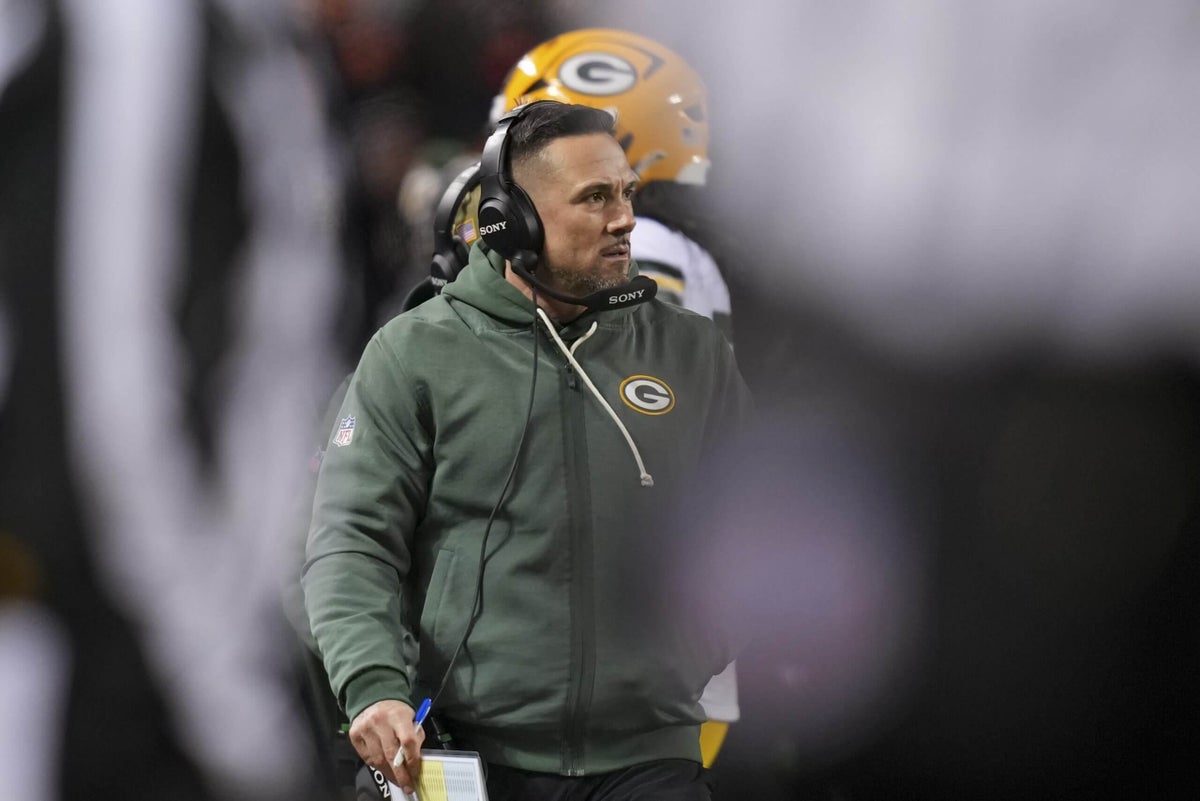
Matt LaFleur ranks 11th in winning percentage (.654) among 113 NFL coaches with at least 100 regular-season games. That’s better than the win rates for 20 Hall of Fame coaches on that list. It’s better than the rate for one notable Canton-bound contemporary, Bill Belichick.
Not that fans of LaFleur’s Green Bay Packers are interested in any of that after their team — their coach, to hear some of the criticism — surrendered a 15-point fourth-quarter lead at Soldier Field, falling 31-27 to the Chicago Bears in the wild-card round.
To the critics, LaFleur is 2-3 in the playoffs as a betting favorite, tied for the worst win rate among 19 coaches with at least five such games this century.
The Pick Six column wades into the Packers’ fourth-quarter collapse to assess LaFleur’s culpability, while all wait to hear whether the organization extends the coach’s contract or considers moving in another direction. The full menu:
• Matt LaFleur’s culpability
• Is John Harbaugh’s success exportable?
• Seven Tier 3 QBs made playoffs
• Seattle’s secret weapon awaits
• Defense tells Bills’ playoff tale
• 2-minute drill: NFC West keeps winning
1. The Packers led the Bears by 15 points through three quarters and lost. How bad was LaFleur’s game management, anyway?
One had to look closely for evidence that LaFleur was running a four-minute offense to eat up the game clock after the Packers took possession with 4:12 remaining and led the Bears by three. Chicago had all three timeouts, so Green Bay could not get overly conservative. But there is ample space between curling into the fetal position and firing away as if this were the second quarter of a Week 4 game against the Chargers.
“The smugness of playing your regular offense, with huge air-yard plays, in a four-minute situation,” a coach from another team said. “Of course you are not going to have (the clock moving). They are trying to score an explosive touchdown. Who does that?”
If this sounds familiar, it should.
“When we played them, I was like, ‘Man, this ball is going downfield — he don’t give a s—,’” an opposing coach said of the Packers before the season, when commenting about Jordan Love for 2025 Quarterback Tiers. “You don’t see a lot of quarterbacks play like that these days. It’s almost like they build it into their offense and see the benefits of making you defend the whole field and hitting a couple in exchange for a pick or two.”
Against the Bears, Green Bay threw a receiver screen behind the line of scrimmage on the critical drive’s first play. The Packers took the play clock down to one second with a moving game clock on the next play. That was four-minute behavior, and wholly appropriate.
But from that point forward on the drive, the Packers attempted three passes traveling at least 20 yards past the line of scrimmage. They ran perimeter and outbreaking routes, which risked players stepping out of bounds, when there was space in the middle of the field, especially against an all-out blitz on a second-and-10 deep shot to Luke Musgrave.
“Where is ball control, short passing game?” the coach asked. “Where are the angle routes?”
LaFleur, hired for his offensive acumen, would not be the first offensive play-calling head coach to lose sight of the big picture while chasing big plays. But it was hard to say anything else happened during what turned out to be a fateful drive, capped by a delay-of-game penalty coming out of a timeout. That miscue turned a potential 39-yard field goal into a 44-yarder, which kicker Brandon McManus missed in the stadium that is toughest on opposing kickers.
Since 2016, kickers visiting Soldier Field have made only 54 percent (13 of 24) from 40-45 yards in the regular season and playoffs, by far the lowest rate for visitors to any of the 36 stadiums where kickers have tried even three attempts, per TruMedia. The average is 81 percent for visiting kickers from that distance overall.
That makes it tougher to shove all the blame onto McManus (though he also missed two other kicks — a 55-yarder to end the first half and an extra point in the fourth quarter).
If it’s any consolation for Green Bay fans, and it might not be, the Packers were not alone. Their defeat was the fourth in the NFL this season by a team that led by exactly 15 points entering the fourth quarter, per TruMedia. Teams leading by 15 through three quarters went only 4-6 in those games this season. They were 102-2 in them from 2000 to 2024.
Not that we’re giving Green Bay a pass (sorry, wrong analogy).
The Packers were the 48th team this century to take possession inside their 40-yard line with between four and five minutes left in regulation, leading by three and with their opponent holding all three timeouts, per TruMedia.
Twenty-one of those teams mounted drives spanning at least six plays.
The Packers were one of them.
So far, so good, but …
Of those 21 teams, the Packers used the least amount of clock (1:27). They passed on early downs at the second-highest rate (four times in six chances, or 67 percent, with some of those on run-pass options). They stopped the clock through their own actions at the highest rate (four times in seven plays, twice by going out of bounds, twice by throwing incomplete). In fact, the clock stopped after six consecutive plays to end the drive, including twice when the Bears called timeout.
“Every time you go out of bounds, it is like sending a ball boy around the field to hand a card to Ben Johnson reading, ‘You are hereby gifted a timeout — Happy New Year,'” the coach said.
The counterargument is the Packers’ aggressive passing is what got them into field goal range in the first place. Critics very well might be ripping LaFleur for being too conservative if he had forced handoffs to Josh Jacobs on the drive. Jacobs gained no yards on two first-down runs during the possession (both were RPOs from shotgun formations, which limit options in the run game but can lighten the box to enable better rushing).
“You have to know how to play with the lead,” another coach said. “You have Jacobs fully healthy — so healthy, they put him on kickoff return. There is nothing wrong with running the ball with him.”
Yes, but the Packers were playing with backups at right guard and right tackle (rookie right guard Anthony Belton missed his block on the Bears’ Grady Jarrett during Jacobs’ second failed first-down run; backup center Sean Rhyan was later injured on the game’s final drive).
Should we have expected this team, with this offensive line, to execute a four-minute running game efficiently enough to close out the Bears? Entering the drive, Green Bay had five carries for 6 yards in the second half, all by Jacobs.
Then again, Love was not exactly looking like vintage Bart Starr/Brett Favre/Aaron Rodgers (or even Lynn Dickey) to that point of the half (7-of-15 passing for 87 yards).
A case can be made that LaFleur, his options already limited since losing elite tight end Tucker Kraft months ago, called successful plays that ended with suboptimal results because Romeo Doubs (age 25) slid out of bounds untouched after falling on a 34-yard gain and Matthew Golden (age 22) went out after a 12-yard gain.
The second gain was made on an outbreaking route that, by design, took the receiver out of bounds. On Doubs’ big catch, Love threw wide enough to lead Doubs out of bounds, although it was close.
“He is throwing the ball like it’s two-minute,” the second coach said. “In a four-minute offense, (LaFleur) takes an offensive timeout to think about it and takes a delay of game to make it third-and-15.”
No matter how much LaFleur was at fault on a play level, he bears responsibility for the offense struggling so much in the second half after building a 21-3 halftime lead.
This game will add to the evidence against LaFleur as the Packers consider a potential contract extension for him entering the final year of his deal. They somehow went 1-2 against the Bears this season while holding a 106-0 advantage in offensive snaps with a lead. Beyond that, every other coach in the NFC North has won the division since Green Bay last won it in 2021, when Aaron Rodgers was behind center for LaFleur and the Packers.
There are extenuating circumstances.
The Packers shook the NFL when they traded two first-round picks to Dallas for pass rusher Micah Parsons before the season. The move looked like it could put Green Bay over the top this season, until Parsons suffered a torn ACL against Denver in Week 15. The Packers were leading 23-21 when Parsons was hurt late in the third quarter. They lost that game and their remaining three to finish the regular season, then went one-and-done in the playoffs.
Injuries happen to every team, but Parsons and Kraft were their two most dynamic players — strong game-plan considerations for every opponent.
That is why Packers CEO and president Ed Policy said more than a week ago that he was proud of the current team for weathering key injuries and adversity. The picture could look different after the Packers blew that 15-point lead to the rival Bears, and as more qualified candidates enter the field. That list includes John Harbaugh, whose Baltimore Ravens tenure ended last week.
2. John Harbaugh looks like the hottest candidate in the 2025 coaching cycle. Should he be?
When the Ravens fired Harbaugh after 18 seasons, 12 playoff appearances and one championship, the 63-year-old coach instantly became the most qualified candidate in the market.
His resume speaks for itself, but how much of Harbaugh’s success with the Ravens is exportable?
“Harbaugh gives you a system and a leader,” an exec from another team said. “If you are an organization that is rudderless, he gives you that direction. He automatically establishes a standard and a belief. But you could say that about Pete Carroll as well, and that has not changed with him, but organizational dysfunction is dysfunction.”
Harbaugh, whose background is on special teams, does not call plays or design schemes on either side of the ball. He does not coach quarterbacks. Unless he lands in Green Bay, there’s almost zero chance Harbaugh will have anything close to the personnel support Baltimore provided him and his predecessor, Brian Billick, over the past quarter century.
The difference between Carroll in Seattle and Carroll in Las Vegas comes to mind. Harbaugh’s ability at this stage of his career to put together a vibrant staff to carry out his vision is one big difference. Carroll took the Raiders’ job on their terms, as a coach desperate to get back into the league. Harbaugh would have more leverage to operate on his terms.
“There are hurdles to overcome,” a coach from another team said, “but Harbaugh is still better than the rest even without that.”
What gives Harbaugh an edge? He’s known as an excellent coach of fundamentals and someone capable of putting together a strong staff. His brother, Jim, is strong in those areas as well, and he’s won everywhere he has coached, but as a former quarterback, Jim adds another dimension. Perhaps no one is better at instilling confidence in players of all experience levels at that position.
“The Giants or Tennessee would probably be the best spots for John,” another exec said. “If I’m the Giants, I need somebody to be an adult. Even if a younger coach is the right guy, I don’t know if they can afford it right now. They need a steady-the-ship guy, someone who can say, ‘I don’t give a s— what has happened in the last 20 years. This is what we are about.’ Tom Coughlin was that.”
There is no precedent for head coaches succeeding or failing after leaving the Ravens because Harbaugh’s only predecessors, Billick (1999-2007) and Ted Marchibroda (1996-98), never coached again.
Billick, hired after leading Minnesota’s record-setting offense in the late 1990s, had an 80-64 (.556) record and won a Super Bowl in his second season with Baltimore, despite having an offense that ranked 29th in EPA per play over his final eight seasons (EPA for Billick’s first season, 1999, is not available).
Harbaugh was 180-113 (.614) and won a Super Bowl in his fifth season.
Both coaches won championships without top-tier quarterbacks (Joe Flacco produced like one for the 2012 Ravens when they went 4-0 in the playoffs, but Baltimore ranked 17th in offensive EPA per play that season, and 24th when Billick won it all after the 2000 season).
Though Billick and Harbaugh deserve credit for leading Super Bowl winners, neither assembled or coached Baltimore defenses that ranked No. 1 in EPA per play across both their coaching tenures (the Ravens ranked sixth in points allowed in 1999, before EPA was available). This would suggest the Ravens have a better shot at winning in the future than any coach leaving their organization for another opportunity.
“What does not come with Harbaugh to another team is the scouting department and ownership, two big components of success,” the coach from another team added. “Then you have to find a quarterback who is worthy, or else you are Bill Belichick, who could not win without Tom Brady.”
No head coach has ever won a Super Bowl with two different teams, although seven have won conference championship games with multiple teams.
3. Seven Tier 3 quarterbacks reached the playoffs, most on record. Here’s who benefits.
The Jaguars won the AFC South, which was great until the team had to face Josh Allen in the wild-card round.
“If I am (Jaguars coach) Liam Coen, I am thinking, ‘Wait, my reward for winning the division is to play the most dangerous quarterback in the entire playoff field in Round 1? Really?’” an exec said in the Pick Six column last week. “Houston must be thinking, ‘Sweet, we get 42-year-old Aaron Rodgers instead of prime Josh Allen.’ I’d take that every day.”
The quote was spot-on after Allen led a late touchdown drive to knock out the Jaguars, 27-24. Now, facing Allen will also be the Denver Broncos’ reward for getting the AFC’s top seed, instead of drawing Houston or Pittsburgh. Both Jacksonville and Denver opened as home underdogs.
Allen and the Los Angeles Rams’ Matthew Stafford were the only Tier 1 quarterbacks in the playoffs this season, based on 2025 QB Tiers results from before the season.
That wasn’t so unusual of late. There were two last season (Allen and Patrick Mahomes, when 50 coaches and executives voted only three QBs into Tier 1, with Stafford in Tier 2) and two the year before (Allen, Mahomes).
The 2025 playoffs stand out for having seven Tier 3 QBs — defined as a solid starter who requires significant help from his defenses and ground games to win. That was up from two in each of the past two seasons. It was three more than in any postseason since QB Tiers debuted in 2014.
The table below shows how many quarterbacks from each tier have reached the playoffs every season since then.
Though both Tier 1 QBs survived the wild-card round, three of the five quarterbacks in Tier 2 have already lost (Jordan Love, Justin Herbert and Jalen Hurts). That leaves only Brock Purdy and C.J. Stroud, who faces Pittsburgh on Monday night, from that group.
Two of the seven Tier 3 QBs lost in the wild-card round (Carolina’s Bryce Young and Jacksonville’s Trevor Lawrence). Also from that group, Chicago’s Caleb Williams advanced against the Packers, while New England’s Drake Maye, who will skyrocket in the 2026 Tiers, beat the Chargers. Rodgers, who slipped into Tier 3 entering his first season with Pittsburgh, faces Stroud’s Texans on Monday night. Denver’s Bo Nix and Seattle’s Sam Darnold enjoyed first-round byes.
The Rams, winners over Carolina on Saturday, could make it to the Super Bowl as a wild-card team without facing a quarterback in the top two tiers if they beat Chicago and then get past Seattle. That’s an ideal path for a team with a top-tier quarterback (the 2021 Rams had to beat Tom Brady on their way to facing Joe Burrow in the Super Bowl). The same could be true for the team with a Tier 1 QB on the AFC side, but the Bills could face Maye, who has played like a Tier 1 QB (although not Sunday).
Seattle stands to benefit as a No. 1 seed with an elite defense (No. 1 in EPA per play this season) and a lesser offense (No. 18). That’s because it’s more realistic for a team reliant on a dominant defense — but less sure what it will get from its offense — to shut down one or two elite quarterbacks than a series of them.
The 2014 Seahawks lived this. They had the No. 3 defense and got past a red-hot Carolina offense (fourth in EPA per play over its final four games, with quarterback Cam Newton on his way to MVP honors the next season) before outlasting Green Bay’s top-ranked offense featuring Rodgers in the NFC Championship Game. Seattle then lost to Brady’s Patriots (No. 6 offense) in the Super Bowl, when in-game injuries hurt Seattle’s defense and, as some might recall, the offense faltered late.
The current Seahawks could still face Stafford and/or Allen, the only Tier 1 QBs in the field, but the odds of facing established top quarterbacks were higher in 2014 when Rodgers, Brady, Andrew Luck and Peyton Manning were in the field.
The table above shows the seven teams since divisional realignment in 2002 to reach the Super Bowl with offenses ranked in the NFL’s bottom half by EPA per play. The ones with No. 1 defenses (2002 Bucs, 2015 Broncos) won it all, with Denver taking down three of the top-five offenses in the playoffs (Pittsburgh, New England and Carolina). One of the two with No. 2-ranked defenses also won it all.
That’s the profile Seattle fits. The Seahawks will draw the 49ers, who they held to three points in Week 18, and would face Stafford or Williams in the championship round if they advance.
4. Meet the Seahawks weapon who covers Christian McCaffrey, Justin Jefferson, George Kittle and Nico Collins
Beginning in Week 6, when Seahawks rookie Nick Emmanwori resumed a full workload coming off an ankle injury, Seattle has played nickel or dime defense 83 percent of the time against base offenses (two or fewer wide receivers). Baltimore is second at 72 percent. The average for the other 30 NFL teams is 29 percent.
Emmanwori and his multifaceted Ravens contemporary, Kyle Hamilton, are keys to letting their defenses keep pass-oriented personnel on the field against heavier offensive personnel, a luxury few teams can afford. They were the only players from Week 11-18 to play 150 snaps at inside linebacker, 150 snaps at slot corner and 75 snaps as a pass rusher, per TruMedia. Emmanwori has also played outside corner and traditional safety, but only sparingly.
What separates the 6-foot-3, 220-pound Emmanwori from others is his ability to cover any of the five eligible receivers on any play, while also setting the edge against tight ends in the run game and knifing into the backfield to take down runners. It’s not that the Seahawks use Emmanwori in man coverage all the time or even frequently. It’s that when they do, they trust him with the most difficult matchups. His coverage snaps tend to be high leverage more than high volume, including against:
• Collins, Houston’s 6-foot-4, 222-pound receiver, on a stutter-and-go in Week 7
• Jefferson, Minnesota’s record-setting receiver, on a route Emmanwori covered so closely, he had time to get his head around before the ball arrived, resulting in a breakup
• Kittle, the 49ers’ Pro Bowl tight end, whom Emmanwori ran with so easily that he kept one hand on Kittle’s shoulder pad during the route
• McCaffrey, the 49ers’ do-everything running back, who got little action in the passing game with Emmanwori on him
It was clear upon visiting Seahawks camp in August that the team had big plans for the 2025 second-round pick.
Whenever Emmanwori was not participating in a play or drill, he could be found standing next to position coach Jeff Howard, who previously coached Harrison Smith in Minnesota and Derwin James in Los Angeles. The Seahawks’ defensive designer and play caller, head coach Mike Macdonald, coached Hamilton, Baltimore’s do-it-all star on defense, when Macdonald was the Ravens’ coordinator.
But when Emmanwori suffered an ankle injury in Week 1, Macdonald’s plan was put on hold for a month. Now, as the Seahawks take the NFL’s top defense by points allowed and EPA per play into the playoffs, Emmanwori is a potential breakout player to watch.
5. Sean McDermott wanted to play defense and did, successfully
Jaguars kicker Cam Little recently set an NFL record for the longest outdoor kick, 68 yards.
Little connected from 70 yards during the preseason.
So, when the Jaguars took over at their own 23 with 0:59 on the fourth-quarter game clock Sunday, needing a field goal to tie Buffalo, they were only 25 or so yards away from having a decent shot at the tying kick.
But when Bills cornerback Tre’Davious White tipped Trevor Lawrence’s first-down pass and safety Cole Bishop intercepted it, the Bills had put away the game on defense, something they’ve struggled to do in their worst playoff games.
They closed out this 27-24 victory that way partly by choice.
Trailing 24-20 and facing first-and-goal from the 1 with 1:05 remaining in regulation, the Bills could have told quarterback Josh Allen to inch the ball forward, short of the goal line, allowing Buffalo to run more time off the clock before scoring the high-odds touchdown.
Buffalo had all three timeouts remaining. Jacksonville had none.
This would have been a risky decision by coach Sean McDermott, who has worked to put distance between himself and memorable game-management issues from past playoff games. If he’d gotten cute in that situation and failed to score a touchdown, that might have defined his Bills legacy. But there was also real risk in returning the ball to the Jaguars with so much time. On the ensuing kickoff, Buffalo saved 12 yards and killed five seconds by forcing a return, something McDermott’s team did not do in the infamous final 13 seconds of regulation loss at Kansas City four years ago.
The correlation between the Bills’ defensive performance in the playoffs and game outcomes becomes obvious when we stack Buffalo’s last 13 playoff games from best to worst defensive EPA per play. The team is 8-0 in its eight best games on defense and 0-5 in the five worst. The game Sunday was solidly in that 8-0 block.
There is no such correlation when stacking the games by offensive EPA per play, affirming that only a baseline level of defense is required to win with a quarterback of Allen’s caliber.
Buffalo met that baseline Sunday and reached the divisional round as a result.
Allen delivered as expected, throwing for one touchdown and rushing for two more, including the game-winner. He did not commit a turnover.
That is the Allen we’ve come to expect since his ascension into Tier 1 before the 2022 season.
6. Two-minute drill: The 49ers, Rams and Seahawks are all in the divisional round, so how good is the NFC West?
With 3/4 of the NFC West reaching the divisional round, it’s a good time to put into perspective the division’s dominance.
Led by the Seahawks, Rams and 49ers, the NFC West finished the regular season with a +6.7-point margin per game in non-division matchups. That ranks fifth among 192 division seasons since realignment in 2002, behind only the 2013 NFC West (+9.0), the 2024 NFC North (8.7), the 2007 AFC South (+7.4) and the 2004 AFC East (+7.0).
Not that the way the Rams beat an 8-9 Carolina team (34-31) or the 49ers outlasted the Eagles (23-19) signaled dominance. The Rams trailed in the final minute against the Panthers. San Francisco’s victory was impressive more for the state of the 49ers’ roster, which suffered another devastating loss when Kittle suffered a torn Achilles tendon, than for anything else. Coach Kyle Shanahan’s call for a trick-play pass from receiver Jauan Jennings to McCaffrey for a 29-yard touchdown to take the lead in the fourth quarter reflected this team’s incredible resourcefulness during a season marked by attrition.
“Philly looked horrible to me,” an exec from another team said. “They could not move the ball. The offense looked sluggish. They were getting into it on the sideline. Just not good. San Francisco could not run the ball at all. They hit a few passes, but that was really it.”
The NFC West is not exactly storming into the next round, in other words. But only the Bears stand between this division and the Super Bowl at this point.
• Familiar ground for Pats: This Patriots season was all about Drake Maye’s emergence as an upper-tier quarterback in his second year. The historical echoes were real. Twenty-five years ago, the 2001 team broke out with a second-year QB (Brady). Twenty-five years before that, the 1976 team emerged from a losing season to finish 11-3 with another second-year QB (Steve Grogan). The team did not exist in 1951, or else surely another second-year QB would have led a New England revival.
But that was not the historical echo reverberating the loudest during the Patriots’ 16-3 victory over the Chargers. As Maye properly pointed out after the game, this victory was all about the Patriots’ defense. Sound familiar?
For as great as Brady was, the Patriots’ defense carried New England in the playoffs during his formative seasons. No opponent exceeded 17 points in any of Brady’s first five postseason starts.
• Lots on line for Chargers: Jim Harbaugh has succeeded over the years in part because he has put together strong coaching staffs. He needs to figure out this offseason how much the team’s problems along the offensive line reflect injuries, and how much reflect areas the coaching staff can control. The inability to pick up stunts by opposing defensive lines was a big problem.
“I watch what they do, and they don’t know who to block,” a former Super Bowl-winning head coach said. “They set deep. That poor quarterback is getting killed. They just do not look like they know what the hell is going on.”
This coach then asked rhetorically why the Patriots won at such a high level during Brady’s years with the team. Yes, Brady was incredible. Yes, the defense and special teams were strong.
Acclaimed line coach Dante Scarnecchia was also part of the equation.
“That is the one thing that keeps Philadelphia viable,” the coach said, pointing to the Eagles’ line and their line coach, Jeff Stoutland. “Why do you think the Patriots won all those championships? Dante was the reason why. The quarterback stood back there for three seconds and patted the ball and threw it down the field.”
Let’s just say this game did nothing to reframe narratives about Justin Herbert in the postseason. His struggles against the Patriots contributed to the Chargers finishing this game with -0.25 EPA per play, by far the worst for any offense in the wild-card round.
Bad as it was, the 2024 Chargers own the worst wild-card figure for offensive EPA per play (-0.49) among 214 teams since realignment in 2002. The performance against New England was “only” 21st-worst on that list.
• Duuuval goes full circle: Liam Coen has long since overcome that awkward opening attempt at “Duuuval” at his introductory news conference. Winning 13 games in his first season made sure of that. Perhaps it was destined that his final postgame news conference of the season would feature another awkward “Duuuval” shoutout, albeit through no fault of his own.
A reporter in Jacksonville gave Jags coach Liam Coen encouragement after their playoff loss:
“You just hold your head up, OK?”
— Front Office Sports (@FOS) January 11, 2026
Instead of asking Coen a pointed question about abandoning the run game or whatever else typically arises in these settings, Lynn Jones of the Jacksonville Free Press sounded like a kindly neighbor offering encouragement to a 10-year-old who had fallen off his bike.
“I just want to tell you, congratulations on your success, young man,” Jones said. “You hold your head up, all right? You guys have had a most magnificent season. You did a great job out there today. So you just hold your head up, OK? And, ladies and gentlemen, Duval, you the one. All right? You keep it going. We got another season, OK? Take care and much continued success to you and the entire team.”
The unusual attaboys for Coen sparked debate over what is appropriate behavior for a journalist in a professional setting. That conversation is particularly relevant if Jones is covering the team regularly. In my experience, sports teams capture the hearts of fans in their communities. Some of those fans cover local news, not sports, and things can get awkward when they suddenly show up once the local team reaches the playoffs.
Still, I can’t recall anything quite like this one in Jacksonville.
That’s it for the Pick Six column this week.
Take care, and much continued success.