
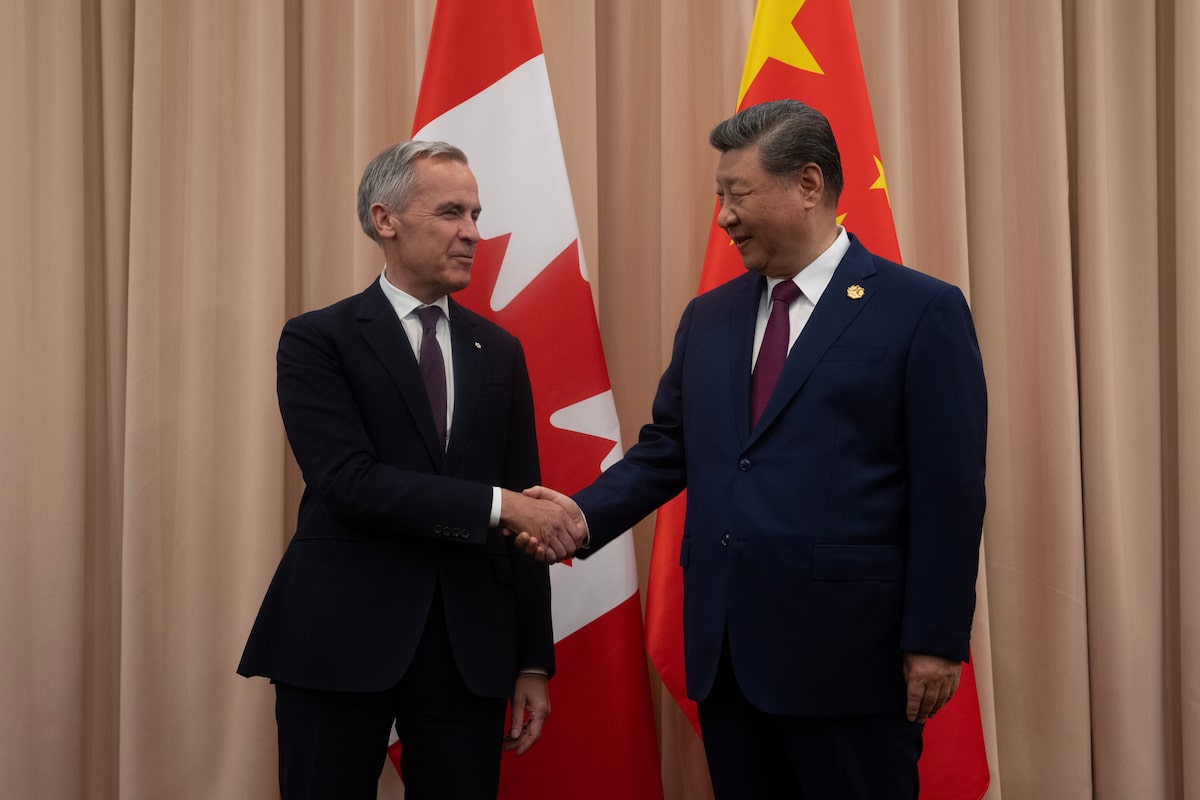
Prime Minister Mark Carney, left, shakes hands with Chinese President Xi Jinping in Gyeongju, Korea, in October, 2025.Adrian Wyld/The Canadian Press
Let’s see – in the past week or so, the United States has raided another country, arrested its president and commandeered its oil. President Donald Trump issued an executive order targeting defence contractors, seeking to impose new restrictions on share buybacks and executive pay. He also announced plans to ban institutional investors from buying single-family homes, and directed Fannie Mae and Freddie Mac to buy US$20-billion worth of mortgage bonds. You can call Mr. Trump a lot of things, but lazy isn’t one of them.
Here are five things to know:
Window or aisle? Prime Minister Mark Carney will be visiting China this week, in the first trip there by a Canadian prime minister since 2017. While meaningful announcements are unlikely, it is an important trip that could thaw relations. It comes at a time when Canada is looking for a new dancing partner given the situation with our neighbours to the south. Of course, it won’t be easy, given years of tensions between Canada and China. This is also the first visit by a Canadian PM since China detained the two Michaels for almost three years. Ottawa has imposed significant levies against Chinese electric vehicles, and Beijing has retaliated with tariffs on Canadian agricultural products. Officially, Mr. Carney said this would be a trip to discuss trade, energy, agriculture and international security.
We’ll do it live: Whatever remarks Jamie Dimon may have prepared ahead of quarterly results, he has likely ripped them up and is starting from scratch after the events of last week. America’s sweetheart CEO will speak as JPMorgan Chase and Co. JPM-N is set to kick off earnings season Tuesday morning. In addition to Mr. Dimon’s views on policy changes in Washington, his thoughts on the economy could be particularly insightful given the diametrically opposed economic data. On one hand, U.S. GDP is expanding 5.1 per cent, according to the Atlanta Fed’s GDPNow calculations. On the other hand, U.S. job growth is anemic with the three-month average showing 22,000 jobs lost per month. Fun fact: Canada has added more jobs than the U.S. from September to December. As for JPMorgan’s stock itself, it is sitting near a record. “Issue remains valuation at 3x (tangible book value) reflecting best-in-class performance, but we see better value elsewhere,” Citi analyst Keith Horowitz wrote in a note to clients. He rates JPMorgan a hold and only has a buy on Bank of America out of the big U.S. banks.
Bankers box: After JPMorgan, Bank of America BAC-N, Wells Fargo WFC-N and Citi C-N will report on Wednesday, followed by Goldman Sachs GS-N and Morgan Stanley MS-N on Thursday. For the money centre banks, investors will be watching for their outlooks on loan growth and credit quality, RBC Capital Markets managing director Gerard Cassidy wrote. “We do believe … the commentary on loan growth for 2026 will be more positive than earlier in 2025,” Mr. Cassidy said, noting that this year doesn’t feature the looming threat of tariffs. Over all, Mr. Cassidy believes this is a sector investors should continue to own. A combination of lower interest rates, deregulation, greater share buybacks, robust U.S. GDP and potentially more bank M&A activity in 2026 are all supportive of the sector, he argues.
Buckle up: Delta Air Lines Inc. DAL-N will give us the first glimpse into how bad the U.S. government shutdown was for domestic air travel and what the recovery for 2026 will look like. Delta has already warned that the shutdown has caused a US$200-million hit to its bottom line. Its outlook will also be closely watched when it announces earnings on Tuesday. One of the most important drivers for Delta is business travel. Citi notes its barometer of business travel has “bottomed out” and, if it rebounds, it could be an “asymmetric coiled spring to look out for in 2026.” Business travel is also important for Air Canada, and any positive indications it is rebounding could breathe life into the stock, which has flatlined in the past six months.
Data dump: U.S. inflation for December will be released Tuesday morning and is expected to show signs of softness. The data are messy because they weren’t collected for October, which makes month-over-month comparisons trickier. Nevertheless, energy prices fell and that is expected to keep overall price growth in check. This should give cover for further rate cuts in the U.S. at some point this year.
In the Money with Amber Kanwar is Canada’s top investing podcast. New episodes out Tuesday and Thursday. Subscribe now at www.inthemoneypod.com