
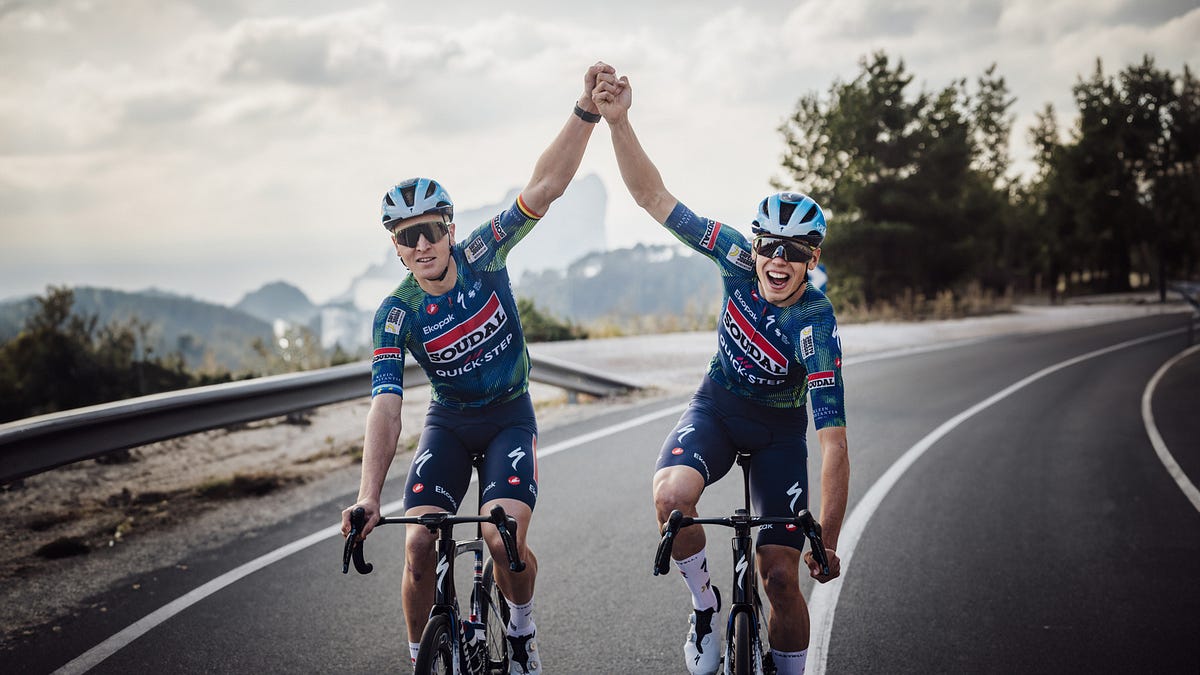
 Soudal Quick-Step rider recruitment under the microscope. Tim and Paul are thrilled. ©Wout Beel
Hi Subscribers,
For a limited time only, annual subscriptions have ⭐ dropped 20% to just £52 for a year.⭐
The annual subscription will give you complete access to every story I write in 2026, all my breaking news and transfer analysis, as well as the full archive of content I’ve written since our launch (756 stories and counting).
You’ll receive year-round coverage and be taken behind the scenes daily with insight you won’t find anywhere else.
Follow me on: Twitter 🟢 — Instagram 🔴 — Bluesky 🔵
Click the link to receive a 20% discount on an annual Substack subscription. The offer ends soon!
Daniel 🫶
Training camps are one of my favourite parts of the season. Not only do you get to travel without having to lug your suitcase around every single day, but you also have the chance to sit down with riders and staff and really talk to them.
In-race interviews are great, but they’re often limited to a few minutes here and there; at camps, you can ask follow-up questions and come away with so much more.
At the end of the Soudal Quick-Step media day in Calpe, Spain, I had the opportunity to interview team boss Jurgen Foré. My aims were twofold: to have an in-depth interview into how he identifies talent and recruits riders, and to go 30 minutes without peppering him with questions about Remco Evenepoel. I think that topic has been covered.
We discussed a range of subjects, from compiling databases and negotiating contract extensions to using AI, and having Jasper Stuyven over to his house for three hours during the Spring Classics. There’s a lot.
This might become a mini-series, as I had a similar conversation with Fabian Cancellara from Tudor Pro Cycling Team a couple of days earlier, and that story will be published later this month.
Daniel Benson: Can you give me an overview of how WorldTour rider recruitment works at Soudal Quick-Step?
Jurgen Foré: You start with the return that you want to give to your sponsors, and based on that, you define the sporting strategy. With all our sponsors, including Soudal, they’re focused on international exposure and winning across the world, so we need a team that’s capable of performing in 285 race days. Based on that, we always discuss with the sporting staff which athletes would be of interest. Then we create a long list of riders available in the market who might be a good match for the team. Then I usually start by speaking with those riders and giving a digital presentation on the team and what we do.
That’s usually the first exchange. It lasts about 90 minutes and covers who we are and how we work, giving us a chance to get to know the rider and what’s important to them. I might do 50 to 70 of those calls throughout the year for all our teams. On a couple of those occasions, a member of the performance team is also present. If that’s interesting and it stays in the rider’s head and with us, we do two things: we analyse their training data to see how much they train, how they train, and where their values are. We have a historical data house, so we can see and compare with riders we have in the team, and that allows us to analyse the profile of the rider in a deeper way and where they excel and where we can add things. Based on that, we’ll have a second conversation, and we do that face-to-face because it’s always better to speak in person.
So with Jasper Stuyven, we spoke the morning after Gent-Wevelgem. He came to my house, and we spent three hours together discussing his goals. With that type of rider, it’s also important to consider, because after those second meetings, I always ask myself, ‘Will this person be happy in our team?’ Because if they feel good, they’re happy and have a free mind to perform and contribute… With a rider like Jasper, he can be there in Classics, he has the ambition to win a stage in the Tour, he can pass on his experience, and he can also be in a leadout. If we were still going to the Tour de France for Remco Evenepoel, I would still put Dylan van Baarle and Jasper Stuyven in the team because they’re so professional and a rider like Laurenz Rex, he’s good in the Classics, and he’s still young, so he can still improve. For me, he’s a potential sprinter, a potential one-day winner, but he can also do a great lead-out for Paul Magnier.
Daniel Benson: That’s a great overview, but let’s dive into the scouting. How does that process play out?