
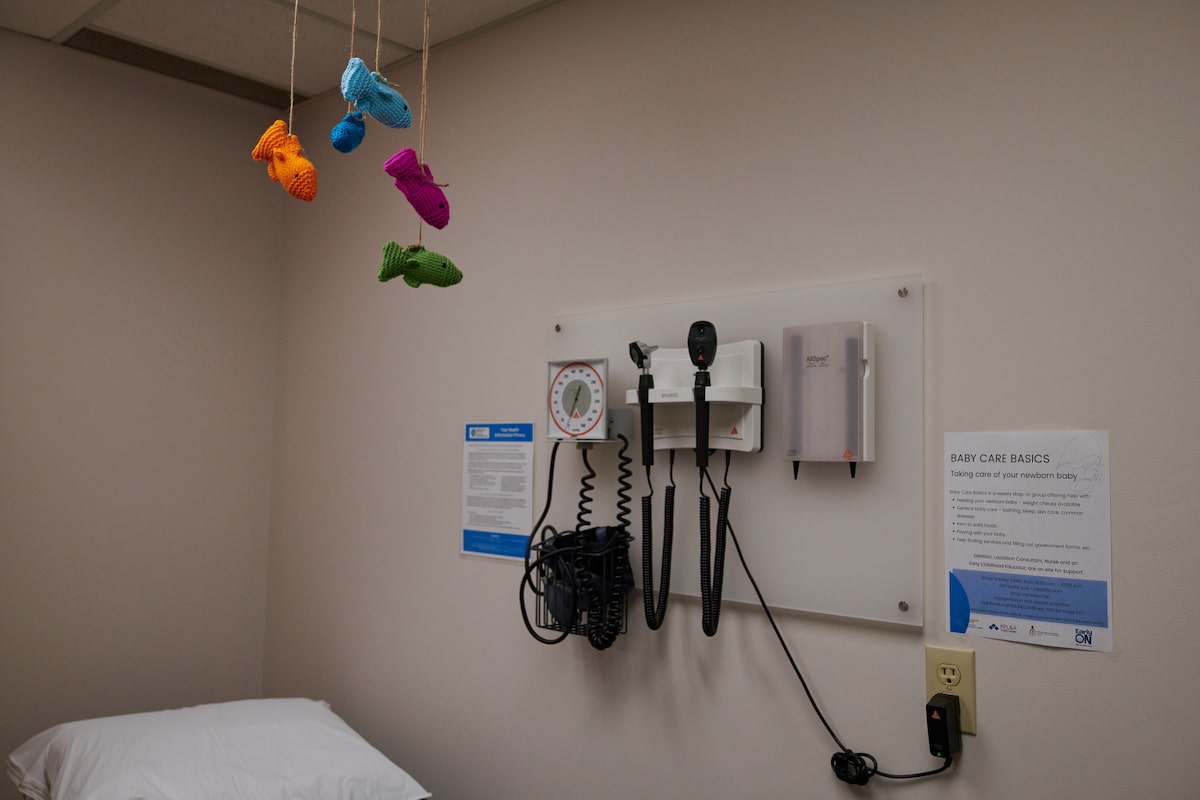
More than 275,000 Ontarians were newly enrolled with a family doctor or nurse practitioner in the first nine months of last year, according to the province, but the government still has a long way to go to reach its goal of ensuring every resident has a primary-care provider by 2029.
The Ontario government announced Monday that the number of Ontarians without a regular health care provider has dipped to 1.98 million, down from the last widely shared estimate of 2.5 million as of 2023.
However, some of that reduction came from the Ontario Ministry of Health and the academic network that produces the estimates agreeing to align and refine the way they count people who are “unattached” – the health policy term for patients who don’t have a family doctor or nurse practitioner.
The province shared the new data to mark the one-year anniversary of the creation of the Primary Care Action Team, led by Jane Philpott, a former Liberal federal health minister.
PCAT’s focus has been on expanding the number and size of interdisciplinary primary-care clinics in Ontario, with an eye to enrolling patients without a doctor who live nearby. The province is spending $235-million in 2025-26 to beef up or open 130 of these clinics, which feature doctors working alongside other health professionals such as nurses, social workers, dietitians and pharmacists.
“These teams are already making a difference,” Dr. Philpott said Monday at a news conference with Ontario Health Minister Sylvia Jones. “They are attaching tens of thousands of patients in the areas of highest need across the province.”
Dr. Philpott started as chair of PCAT on Dec. 1, 2024. Last January, on the eve of an election the Progressive Conservatives would go on to win, the party responded to widespread public discontent about health care by promising a primary-care provider for every resident. The government has committed $2.1-billion to the effort over four years.
On Monday, the province revealed detailed patient attachment statistics for the first time since Dr. Philpott’s appointment. It reported 93,277 net new attachments in the first quarter of last year, 76,371 in the second and 105,904 in the third. Those figures account for people who have lost their doctor to retirements or moves. Fourth-quarter figures were not yet available.
The province also announced a significant reduction in the wait-list for Health Care Connect, the service that is supposed to connect patients in need with family doctors and nurse practitioners, since the start of last year.
There were 234,503 people in the queue as of Jan. 1, 2025. Of those, 177,108, or just over 75 per cent, were off the list as of early this year, most because they were newly enrolled with a primary-care provider, although some had moved away or died. However, since Jan. 1, 2025, another 91,000 patients have joined the Health Care Connect wait-list.
The province’s Auditor-General, in her annual report released last month, criticized Health Care Connect as an out-of-date service that left patients languishing too long in a queue, but Dr. Philpott said that many of its shortcomings had been reversed in the past year.
Ontario isn’t auditing doctors for excessive claims, Auditor-General finds
Zainab Abdurrahman, president of the Ontario Medical Association, said she was buoyed to hear that many Ontarians got a family doctor last year, but she worries the government still isn’t moving fast enough to keep pace with demand.
“Connecting nearly 300,000 patients in a year, or less than a year, is indeed significant,” Dr. Abdurrahman said. “But we have to keep in mind that Ontario’s population grows roughly by 200,000 to 300,000 people per year. So this, at best, keeps the system from failing further, rather than making real gains.”
The province has set more ambitious targets for the years to come, vowing to attach 500,000 patients in the next fiscal year, and 600,000 in each of the two years after that.
Adil Shamji, health critic for the Ontario Liberals and an emergency physician, cast doubt on whether the government is making as much progress on primary care as it claims.
“The on-the-ground feeling is that people are still struggling to find a family doctor,” he told reporters. “I think that’s reinforced by the fact that the only thing that they are able to point to is movement on the Health Care Connect list, a list that is barely used by Ontarians.”