
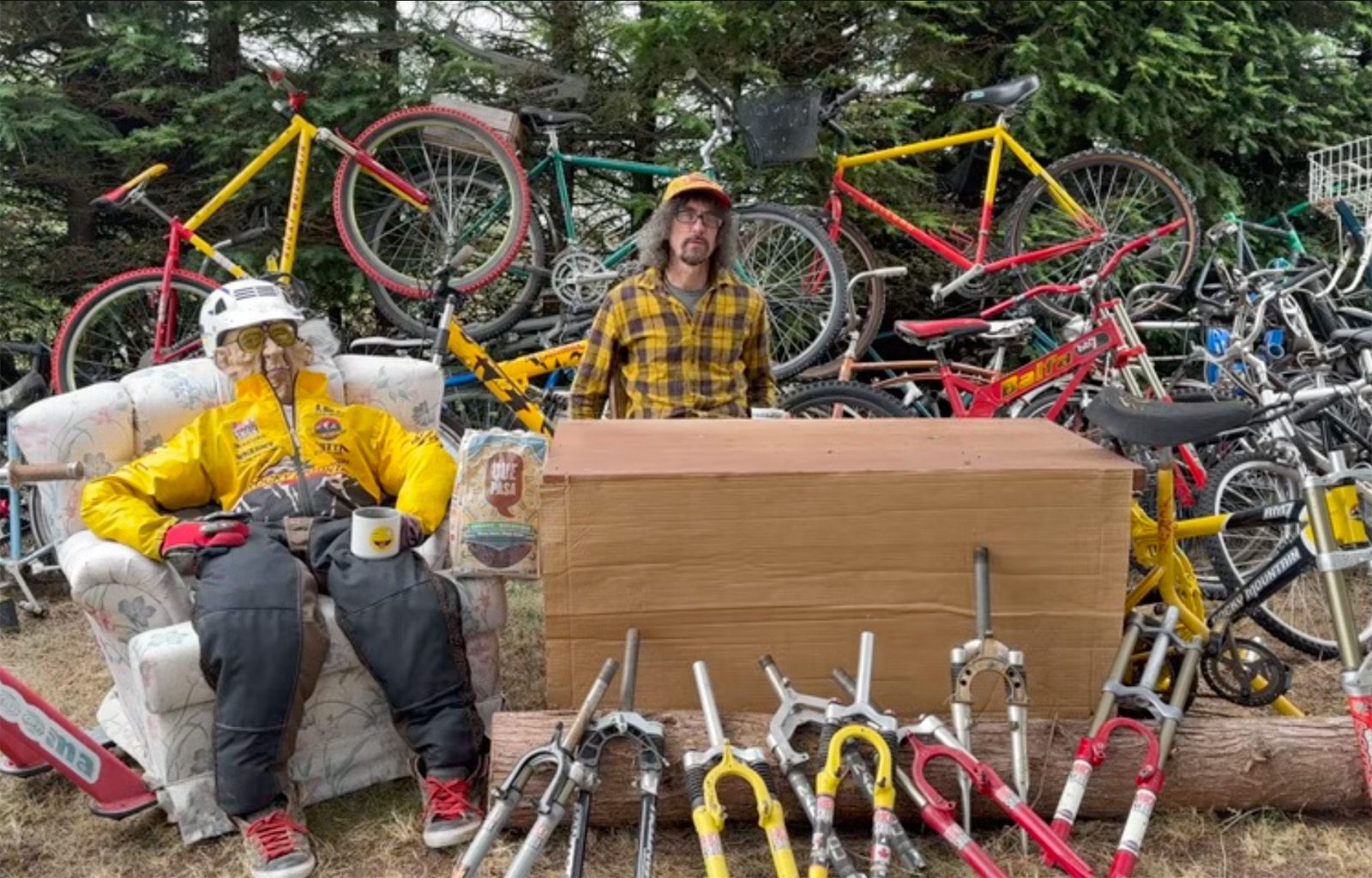
Dylan Tremblay did not come roaring back to mountain biking. He pedalled. Slowly. Carefully. With his seat high, tire pressure low and expectations even lower.
“I was away from riding for ten years. It’s just a slow kinda battle to get back on the bike,” Tremblay said.
Now 45 and living in a small town on Vancouver Island, Tremblay is riding again, filming again and finding an audience again. This time on his own terms. His YouTube channel blends vintage mountain bikes, modern trail rides, mental health honesty and a lifetime of stories from Canadian freeride’s early days.
It is funny, reflective and sometimes raw. And it is resonating.
Life after Drop In
For many riders, Tremblay is linked to Drop In, the early-2000s mountain bike TV series that defined freeride culture. He appeared across five seasons, beginning in his early 20s, living out of the bus and riding with cameras rolling.
“That was a really good time,” he said. “We were all pretty young, there was a lot of partying.”
But the lifestyle came with a cost.
“The hardest part was because it was so long, it was just hard to stay healthy and stay on your game,” Tremblay said. “Riding kind of became secondary.”
The show paid expenses but not salaries. When seasons ended, riders were often left scrambling.
“The season would end and basically they just kind of drop you off on the corner with all your stuff and it’d be like, now what do I do? My body is broken. I got no job. I got no money,” he said.
Eventually, Drop In faded. Tremblay’s life shifted toward family, home renovations and staying close to bikes without riding much at all.
A collector in the shadows
While riding faded into the background, collecting did not.
Tremblay began quietly building what has become one of Canada’s most extensive vintage mountain bike collections. More than 100 complete bikes, dozens of frames, hundreds of wheels and forks.
It started with nostalgia.
“The bike I had when I was 15 years old back in ’96,” he said. “It was a 1996 Rocky Mountain Blizzard.”
He found one on Craigslist for $100, sold the bike stand it came with and ended up with the bike for almost nothing.
“And that’s what started it,” he said.
Unlike collectors with deep pockets, Tremblay hunted patiently.
“I never had a lot of money to spend on bikes like some collectors, so for me it was just a lot of digging and being really patient,” he said. “Lots of searching.”
His focus became 1990s mountain bikes, especially Rocky Mountain dual-suspension models and rare frames that tell a story.
“For me I love the patina,” Tremblay said. “Some guys like to strip the paint and repaint it but for me it’s all about it having the bike be original.”
Pain, health and starting over
The reason Tremblay stopped riding was not a lack of love. It was his body.
“Chronic back and hip pain, a lot of problems with my body,” he said. “In my 30s I really started struggling.”
Attempts to jump back in the way he rode in his 20s ended badly.
“I’d ride with my buddies and then my back would be screwed for weeks,” he said.
The breakthrough came when he accepted that the only way forward was slower than he wanted.
“The only way I can get back on my bike is the slow route,” Tremblay said. “Very slow progression, not jumping back into it like I was 20.”
A used 2016 Giant Reign, purchased unexpectedly by his boss, helped restart the process. Later, a switch to a 2016 Rocky Mountain Altitude made riding playful again.
“That really changed my riding,” he said. “Then I really started getting back into some manual stuff and jumping and whatnot.”
YouTube as therapy and focus
The YouTube channel began quietly. Filming alone.
“It’s hard to put yourself out there,” Tremblay said. “But now it’s definitely a lot easier.”
What surprised him was how grounding the process became.
“Doing the YouTube stuff, it’s just a really great way to focus that energy,” he said. “Having something to really put it all into.”
The channel is not about chasing Drop In nostalgia.
“From the get go, I didn’t want it to be about Drop In,” Tremblay said. “I want it to be about what I’m doing now.”
That includes riding alone in the woods, restoring old bikes and rediscovering forgotten dirt jumps near his home.
“I think just with the bikes alone, I’ve got years of interesting content to show off,” he said.
Building without a safety net
Financially, the channel is far from lucrative. Tremblay is candid about that too.
“You get 10,000 views on a video,” he said. “You’d be making less than 100 bucks through YouTube.”
Copyright disputes, music issues and monetization headaches add friction. Occasional viewer donations help but they are not a solution.
Still, the response keeps him going.
“I read all my comments. I respond to all my comments,” Tremblay said. “Whenever I get a coffee bought for me, that’s amazing.”
Being temporarily on EI has given him time to create and reflect but also raises bigger questions.
“What am I gonna do with my life now?” he asked.
A different kind of comeback
This is not a redemption arc of contest podiums and sponsorships. It is quieter and more relatable.
“I just want to inspire people to ride and get some laughs,” Tremblay said.
He is realistic about aging, technology and the modern bike industry, skeptical of electronic shifting and happy on a 10-year-old trail bike. What matters more is feeling connected again: to riding, to creativity and to a community that has grown alongside him.
“It’s so nice to not be spinning my wheels,” he said.
After years away, Dylan Tremblay is finally moving forward again; one pedal stroke, one old bike and one honest video at a time.