
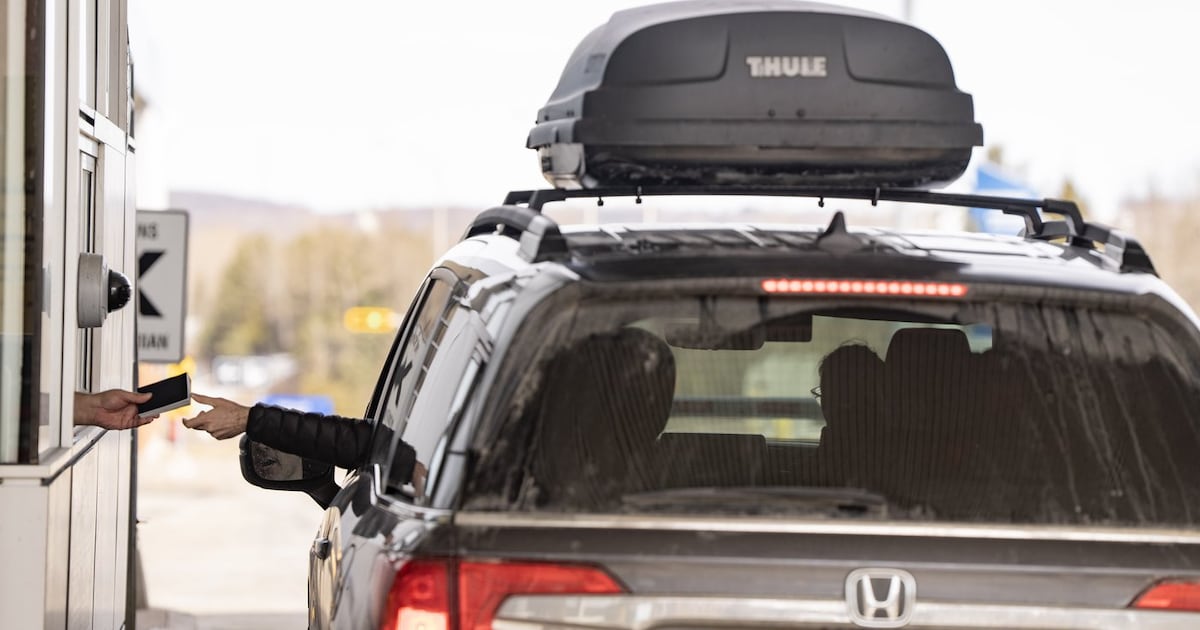
Amid ongoing tensions between the U.S. and its historic allies, some Canadian snowbirds are reevaluating their winter roosts, while others are looking forward to another migration next year.
“Snowbird” refers to Canadians who spend their winters in sunny climates, which include Florida, Arizona, Texas, as well as other sunny U.S. locales. CTVNews.ca interviewed a flock of snowbirds and received scores of emails from those sharing their experiences with their U.S. properties in the last few years.
 A Canada Border Services officer hands passports back to visitors entering Canada from Vermont at the Highway 55 Port of Entry in Stanstead, Que., Thursday, March 13, 2025. THE CANADIAN PRESS/Christinne Muschi A Canada Border Services officer hands passports back to visitors entering Canada from Vermont at the Highway 55 Port of Entry in Stanstead, Que., Thursday, March 13, 2025. THE CANADIAN PRESS/Christinne Muschi (Christinne Muschi) ‘Hard no’
Sharel and Dan Wallis told CTVNews.ca on Friday that they started snowbirding in 2018, but have now sworn off the United States completely.
Dan said that he and his wife had always enjoyed their drive down, “taking their time to travel.“
“We found some really hidden gems, nice places to explore.” But now they’re staying in Mexico over the winter, as they no longer felt welcome in the U.S., with both giving a “hard no” to returning for a future vacation.
Now they winter in Baja California, Mexico. Sharel said she misses her American friends, “It’s hard to see those people in a country that’s doing what it’s doing. These are kind, giving, generous people. They have a government that has no rules.”
“How did these people get to that place to have leadership like that?”
Nick and Pamela Nikolais from Edmonton emailed CTVNews.ca to share “in the fall of 2024 we flew to our home of 20 years in Apache Junction,” located in Arizona.
“We had talked about selling but when we arrived and sat on our deck watching the sunset, we said we just couldn’t sell,” they wrote.
“Then came the (U.S.) election.”
 Donald Trump is sworn in as the 47th president of the United States by Chief Justice John Roberts as Melania Trump holds the Bible during the 60th Presidential Inauguration in the Rotunda of the U.S. Capitol in Washington, Monday, Jan. 20, 2025. (AP … Donald Trump is sworn in as the 47th president of the United States by Chief Justice John Roberts as Melania Trump holds the Bible during the 60th Presidential Inauguration in the Rotunda of the U.S. Capitol in Washington, Monday, Jan. 20, 2025. (AP Photo/Julia Demaree Nikhinson, Pool)
After Donald Trump was elected as U.S. president and began talk of turning Canada into the 51st state, Nick and Pamela said they listed their property, adding that it was difficult to sell as “thousands” of Canadians with property near theirs began selling theirs, too.
While they miss their friends, neighbours and the Arizona lifestyle, “it was the right decision for us.”
Rosie Muzechka told CTVNews.ca on Friday in an interview that she’d been going down to Florida for 15 years to escape the true north’s winters, but snowbirding was becoming less attractive, partially due to American attitudes, but also because of the Canadian-U.S. dollar conversion rate.
She said that in one of the neighbourhoods where she vacationed, Americans who moved into the neighbourhood “didn’t like us Canadians very much.”
Soon after Trump was elected, Muzechka said she sold her vacation home.
‘If you wanna dance, gotta pay the band’
Some Canadians were happy to stay at their vacation homes, no matter which U.S. administration was in charge, and one was considering buying more property. A recurring theme in the responses CTV News received was the value of the Canadian dollar compared to the American, with US$1 equating to between C$1.35 and $1.45 in the last few years.
Trevor Marsh, a financial advisor from Niagara region, told CTVNews.ca on Tuesday that he’s been visiting the U.S. “since he was old enough to drive.” Along with being a frequent visitor, Marsh said he has three long-term rentals and a vacation property, which he bought in the wake of the 2008 financial crisis.
“Typically, I’ll go down there with my wife (and) her family three to four times a year. Last year, I traveled to the States about eight times, in total,” Marsh said. He added that his client base is now slightly more American than Canadian visitors; previously, he said it was split more evenly.
“I sense that’s a little bit to do with the U.S.-Canadian exchange, although I have some friends and colleagues that refuse to travel to the States for their own personal reasons,” he said. “You got to respect that. But for the most part, our place is still rented out.”
Marsh also said he would consider buying more properties in the U.S.
Steve McCall from Omemee, Ont., told CTVNews.ca in an interview Monday that he enjoys staying in Florida at his vacation home, and feels welcomed by the community. A former trucker for a U.S.-based company, McCall said he was “very familiar” with the U.S. border and American citizens.
“We’ve seen two other Ontario cars when we’re here,” McCall said. “It’s not near as busy as it usually is when we’re down here, definitely not as many (visitors).”
McCall says that he’s a grateful guest and that his biggest concern is the exchange rate, but “if you wanna dance, gotta pay the band.” He says that he was able to buy the house in 2011 while the U.S. real estate market was still recovering from the 2008 crash and “the dollar was almost at par.”
“We got a really nice house for not a lot of money … (one) that we could never get at home,” he told CTVNews.ca. “We just always loved coming to Florida to vacation and it was our chance to be part of it,” adding that he didn’t have any plans to sell his property.
Splitting his time between Hollywood, Fla., and Toronto, Barry Nathanson told CTVNews.ca on Tuesday that “without exception whatsoever in those 15 years (of snowbirding), through various political climates, our experience with Americans has been uniformly favourable.”
He said that the “devaluation” of the Canadian dollar has had a “huge impact” on him and his wife.
“It’s a far cry from where we were 15 years ago,” Nathanson said, adding “that’s one part that (Canadians in Florida) all share, that it’s a financially unfavourable environment to be in.”
He went on to suggest that the decline in U.S. tourism was due to financial issues as well as political, calling it a “very mixed bag.”
Nathanson said he had no plans to sell.
“We’re here 15 years, we have a community of friends, American friends here that we have lovely relationships with,” he said. “We’re very, very comfortable here and that’s what we value. We don’t consider ourselves tourists here.”