
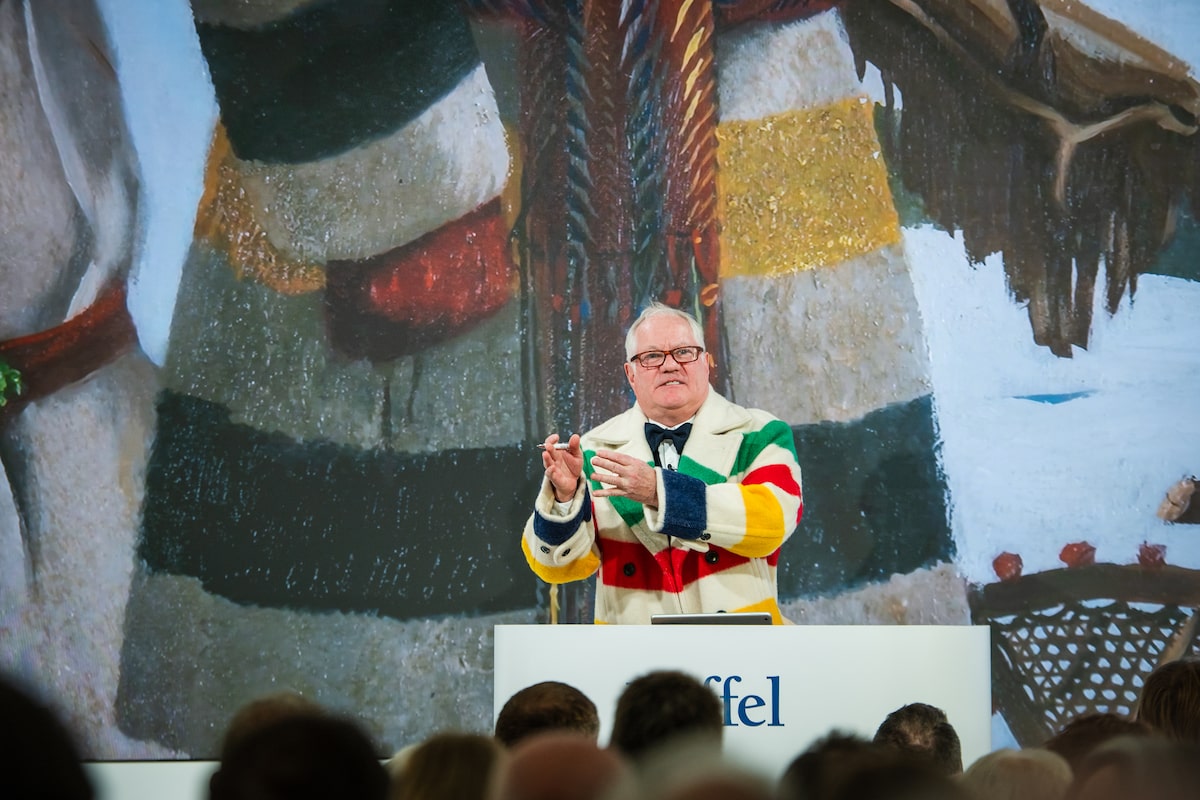
David Heffel wears a Hudson’s Bay coat as he auctions off items which belonged to the Hudson Bay Company’s collection, in Toronto, in November, 2025.Laura Proctor/The Canadian Press
Gold coins, a commemorative sword, a 1990s Barbie and a replica of a cheque printed on a beaver pelt are some of the items up for sale in the latest round of online auctions for the art and artifacts of failed retailer Hudson’s Bay.
Toronto-based Heffel Fine Art Auction House launched seven online sales on Tuesday, which include a coin collection; company memorabilia; Inuit art prints and sculptures; antiques and ephemera; and the Bay’s well-known woollen point blankets – some of them nearly a century old. The bidding for this round will close on Jan. 27.
The auction is part of the dissolution of Canada’s oldest retailer, which was granted court protection from its creditors last March as it faltered under the weight of more than $1.1-billion in debt. After the Bay failed to secure a plan to refinance the business, it was forced to close all of its stores across the country.
Former Hudson’s Bay employees seek class action to claim pension plan surplus
Since then, in a bid to repay some of what it owes to its senior lenders, Hudson’s Bay has sold off a number of its assets – including transferring store leases to new tenants, and selling its intellectual property to Canadian Tire in a $30-million deal. (The name of the company was included in that deal, meaning that the entity that is still under creditor protection and winding down the business, is no longer officially known as Hudson’s Bay.)
Still continuing is the long process of auctioning off the company’s collection of more than 1,700 pieces of art and more than 2,700 artifacts – which Heffel is handling, and which is expected to take months. The first auction, held in person in November, attracted enthusiastic bidders who paid far over the estimated price for a number of pieces of art in the collection. (Auction houses’ estimates can be conservative, since they act as a minimum price designed to attract buyers’ interest.)
The sales that launched on Tuesday include a hodgepodge of company memorabilia. Some of the items include a hockey sweater from 1950 with an “H.B.C.” badge featuring a beaver; a silver pocket watch; a 1931 set of porcelain dishes; model ships; a 1973 sword commemorating the 100th anniversary of the Royal Mounted Canadian Police; a 1940s cash register; a collector Barbie; and a poster advertising the 1940 movie Hudson’s Bay, a fictionalized account of the adventures of French explorers Pierre Esprit Radisson and Médard Chouart des Groseilliers.
An Arcadian Court Barbie sold by Hudson’s Bay.HO/The Canadian Press
Another collection of antiques and ephemera includes vintage suitcases, a horse yoke and stirrups, and HBC-branded canoe paddles.
The coin collection includes a $10 Canadian gold coin from 1912, among the first gold coins produced by the Ottawa branch of Britain’s Royal Mint, which opened in 1908. There are also American gold coins from the late 19th and early 20th century, and assorted commemorative and British coins.
The collection of Hudson’s Bay point blankets includes various designs and vintages. (The blankets, a popular and nostalgic item sold for decades at the retail stores, hark back to the origins of Hudson’s Bay as a fur-trading monopoly. The blankets were traded during that time, and the “points” were lines sewn into the fabric, indicating their value.)
The oldest item in that auction is a rose-coloured blanket dated circa 1930. In addition to such solid-colour wool blankets, there are also a number of items in the recognizable multistripe design, including one dated circa 1955 to 1973, and several more recently produced blankets in both wool and fleece.
A model of the Hudson’s Bay ship, the Nonsuch.HO/The Canadian Press
The company is also selling a number of Inuit soapstone sculptures. For a number of years, Hudson’s Bay sold Inuit carvings in its department stores, and also collected pieces for display in its executive offices. The sculptures with the highest expected value in that auction include Lucassie Ikkidluak’s Inuk with Pack, Kiawak Ashoona’s Man Eating, and Pudlalik Shaa’s Animals and Hunter. The latter, made with stone, bone, sinew and ivory, cannot be exported, according to the Heffel site, because its organic material is governed by the Convention on International Trade in Endangered Species of Wild Fauna and Flora. Each of those three items carries an auction estimate of $3,000 to $5,000.
The three items with the highest expected value in the auction of Inuit art prints are by prolific artist Kenojuak Ashevak, whose red-and-black image The Enchanted Owl is instantly recognizable to many Canadians. Ms. Ashevak’s A Vision of Animals, a stonecut print from 1961, is listed with an estimate of $10,000 to $15,000. Other artists in the auction include Pudlo Pudlat, Josephie Pootoogook and Tudlik.
A separate listing of fine art includes a 1979 print called Cat and Artist by Alexander Colville, estimated at $6,000 to $9,000, and other works by Canadian artists such as David Lloyd Blackwood, Walter Joseph Phillips and Douglas Forsythe.