
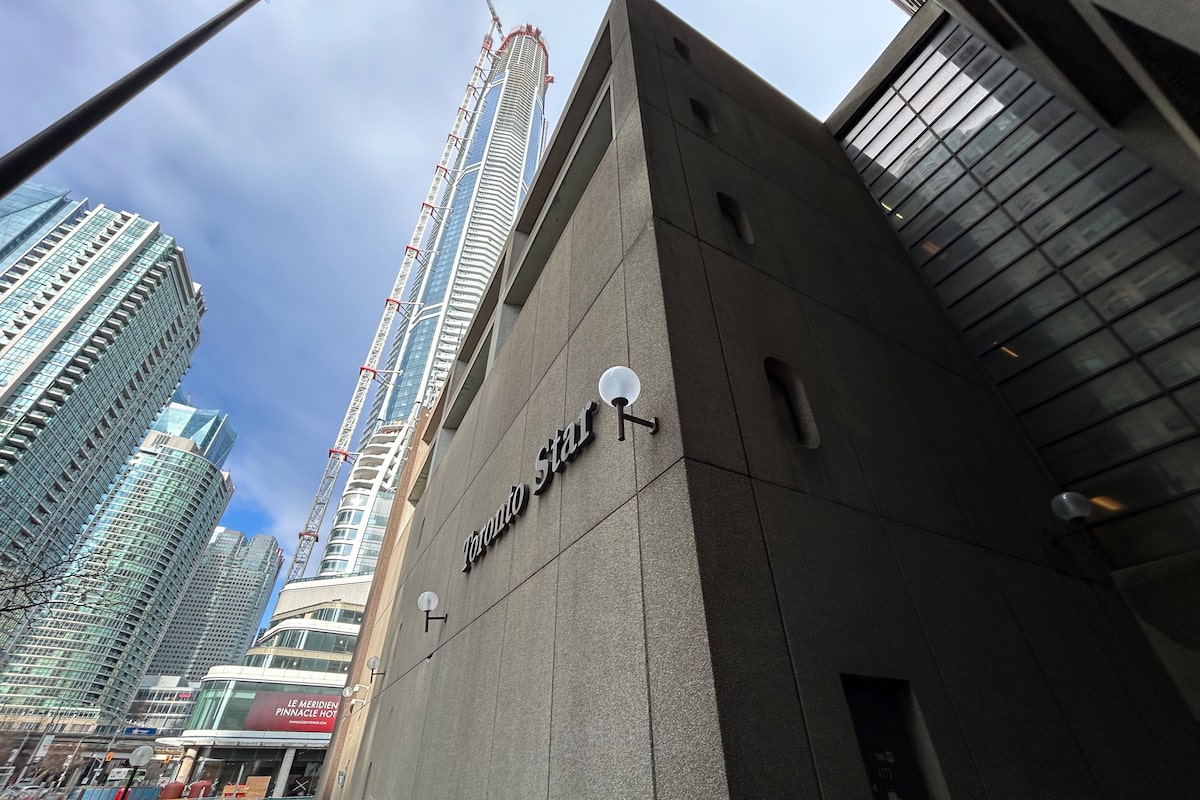
The Toronto Star vacated the storied building at 1 Yonge St. in 2022.Dave LeBlanc/The Globe and Mail
Splashed across the front page of the June 17, 1969, edition of the Toronto Star was an enormous rendering of a new 25-storey building to be located at the very bottom of the city: 1 Yonge St. Calling it the “first major step in a development of residential and commercial buildings” that would “eventually” grace the harbour, the paper began making plans to vacate their old Art Deco building at 80 King St. W. (Chapman & Oxley, 1929, and the one cartoonist Joe Shuster first drew as Clark Kent’s workplace) for that sleek, Brutalist tower by Webb Zerafa Menkes when ground broke later that year.
In June, 1971, Mayor William Dennison unveiled the building’s cornerstone as Toronto Star field sales manager Eric Whitfield watched. Mr. Whitfield was one of the more than 100 employees and guests attending that day, and he was quoted as saying he’d also been at the opening of the King Street building in 1929. “The paper is really taking a long view with this building – it’s planning for the future,” he said.
A pedestrian walks past a newspaper box in front of the then-Toronto Star building in January, 2008.MARK BLINCH/Reuters
In late 2022, when the Star moved to The Well at Front Street West and Spadina Avenue – surprisingly, the former location of its rival The Globe and Mail – that future was over.
So, what to do with an office tower and printing plant full of Toronto memories? Owner Pinnacle International, the development firm that bought the site in 2012, had very big (and tall) plans. Those have now resulted in Canada’s tallest building, Sky Tower, at 106 storeys. At first, the plan was to include the newspaper building in SkyTower, with a new, taller tower grafted onto its north side. Then, in late 2024, Pinnacle announced that the building would be demolished.
However, as Pinnacle vice-president of sales and marketing Anson Kwok and I walk to the old newspaper headquarters, I learn that the building will indeed enjoy a long second life … as a 468-room hotel. While Le Meridien Toronto will occupy the first 12 storeys of the Hariri Pontarini-designed Sky Tower, the entire Star building will be handed to a different hotel operator.
“That’s one of the reasons why we’re pursuing a [separate] hotel,” says Mr. Kwok. “We’ve had a lot of positive feedback [about Le Meridien], and we have hotels in Vancouver. So it’s not really an uncommon use for us.” He adds, too, that Toronto is becoming known as a “waterfront city” and, currently, there is a dearth of hotel rooms with water views.
Dave LeBlanc/The Globe and Mail
The lobby of the former Toronto Star building, which houses an old printing press.Dave LeBlanc/The Globe and Mail
Walking into the 1 Yonge lobby, I’m immediately struck by the two-storey windows, the pebble-finish panels (which match the exterior cladding), the mezzanine, and the rhythmic, square ceiling fixtures, which could easily be fitted with new, energy-efficient guts. In my mind’s eye, I’m sipping the fictional Don Draper’s favourite cocktail (an old fashioned) on that mezzanine as I watch new guests stream into “Hotel Star”; I’m surrounded by 1950s to 1970s Modernist furniture (when the Star moved in, the very progressive design firm J&J Brook did the interiors) and the walls of the bar are covered with award-winning photographs by Star photojournalists.
“When we first bought it, some of the floors, they were exactly like Mad Men,” says Mr. Kwok.
A view of a park from the Toronto Star building.Dave LeBlanc/The Globe and Mail
Fourteen years later, I can still find traces: sturdy, chocolate-brown terrazzo flooring; an elevator corridor covered in groovy wood panelling; a curved drop-ceiling with pot lights; and a rolling library shelf system that could contain a bunch of design books celebrating mid-century modernism or Brutalism for hotel guests to read.
And why not? Some of the best vacations I’ve ever taken were spent in “retro” hotels such as the Hotel Valley Ho in Scottsdale, Ariz., the countless converted motels of Palm Springs, Calif., and Universal Studios’ Cabana Bay Beach Resort (I still haven’t been to the TWA Hotel at JFK Airport). At such places, the sightseeing begins as soon as you open your eyes in the morning.
Pinnacle is also considering dedicating portions of the hotel to longer stays: “I think there’s a market for that,” says Mr. Kwok. “If we get away from the Airbnb world, and we get people that come to the city to stay for one to six months, we don’t really have that.”
And unlike its new 351-metre-tall neighbour (which I also visited) the views from the Star building, even from the 25th floor, are more intimate. If one can pry their eyes from the sparkling waters of Lake Ontario, Queens Quay East now presents itself like the grand boulevard that 1969 story anticipated: the glassy Pier 27 condos sparkle as well; next is the humming, hivelike Redpath Sugar complex; and then, stretching all the way to the Victory Soya Mills silos are new, low-rise condo buildings, the best of which is 3XN Architect’s Aqualuna.
The view to the east from 1 Yonge St.Dave LeBlanc/The Globe and Mail
Whether the 25th floor contains a restaurant or long-stay suites, it will not only be a lovely place to be, it will build community says Mr. Kwok: “We want the tenants to be successful, we need everyone to be successful,” he says as he points to the new park that Pinnacle and Menkes Developments have built. “You cannot expect the same person to be the person that drinks all the coffee or does all the dry cleaning – it takes a village.”
That means the new waterfront’s energy needs to be powerful enough to pull Torontonians from as far away as Scarborough or Etobicoke to dine, play, enjoy a TSA boat tour, or rent a kayak, and I’m confident that it will. As for me, if my fantasy comes true I’ll be enjoying an old fashioned on the mezzanine.