
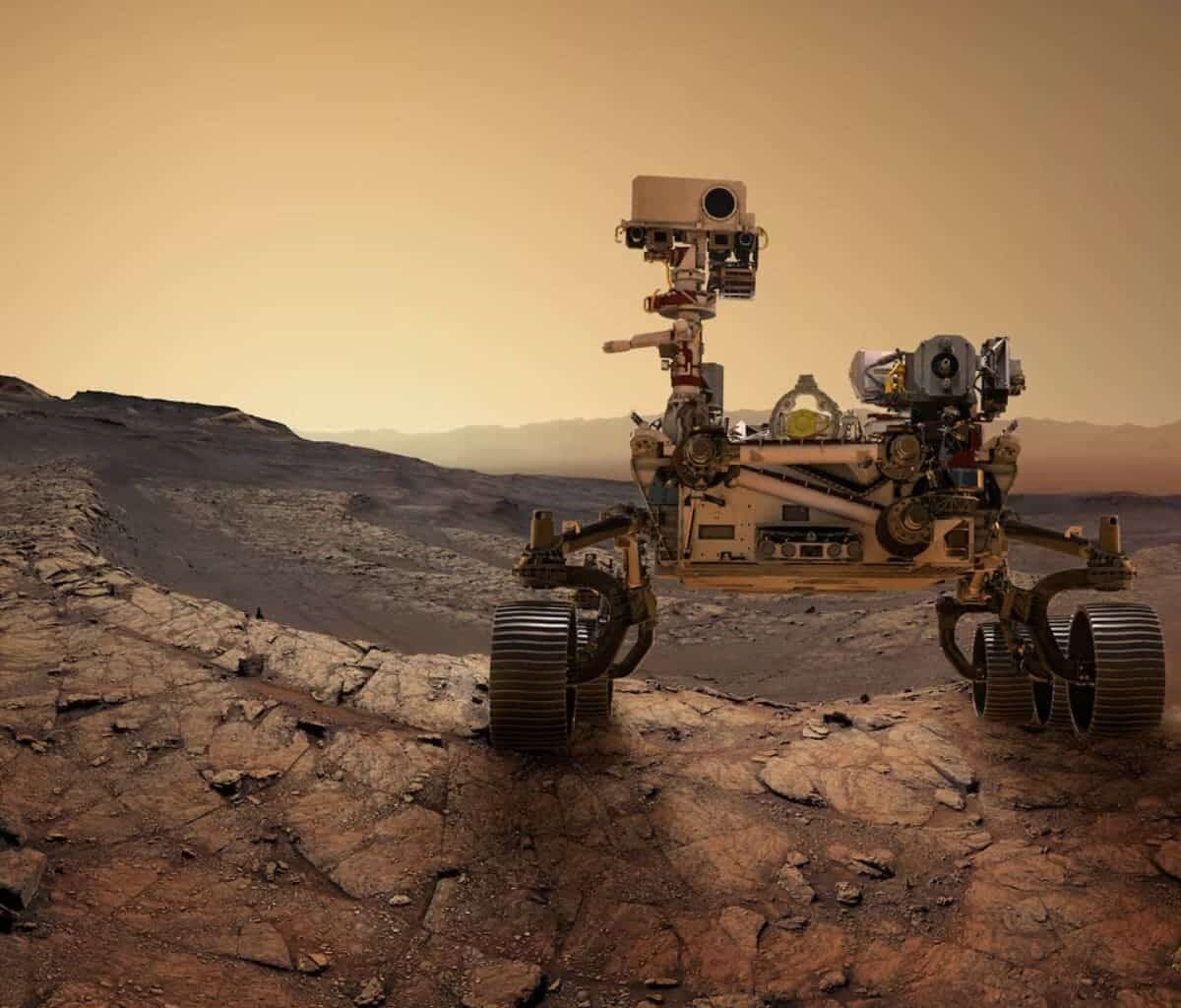
After logging 40 kilometers on its wheels and spending five years navigating some of the roughest terrain imaginable, Perseverance shows no sign of slowing down. To the delight of scientists and space enthusiasts alike, NASA now believes the rover could travel as much as 60 kilometers more across the Martian surface.
Nearly five years have passed since Perseverance first touched down on Mars. Since then, the NASA rover—about the size of a small car—has been anything but idle, even if its progress is necessarily slow. Frequent stops for scientific measurements, sampling, and analysis have punctuated its journey, yet Perseverance has already covered an impressive 40 kilometers. Its route first took it across the floor of Jezero Crater before leading it up the crater’s rim. Today, the rover has moved beyond the crater and is making its way toward extremely ancient landscapes in an area known as the Charmes Lake region.
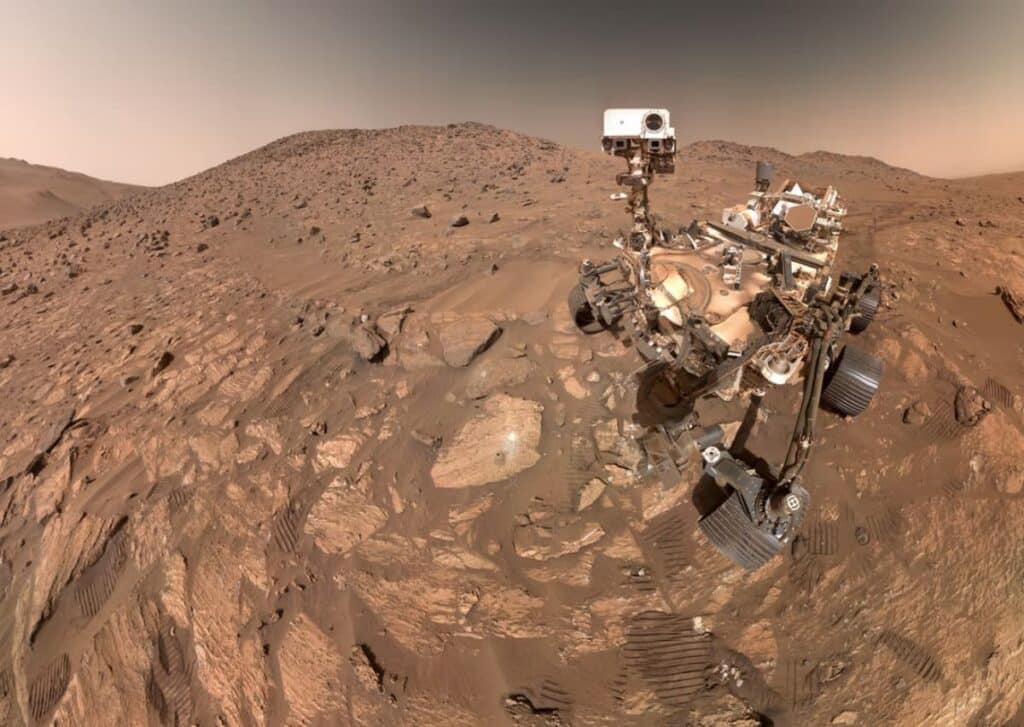
Perseverance took a selfie in July 2024 after drilling into the rock at Cheyava Falls. © NASA
Autonomous driving under extreme conditions
This trek has been far from smooth. Mars is covered with rocks, some of them sharp, scattered boulders, patches of loose sand, ravines, and uneven ground. All of these hazards pose constant challenges for the rover. So far, Perseverance has managed to avoid most of them thanks to its advanced autonomous navigation system. “More than 90% of Perseverance’s journey so far has relied on autonomous driving, which has allowed it to collect a large number of samples efficiently,” explains Hiro Ono, a researcher at NASA’s Jet Propulsion Laboratory.
A mission still unfolding, with more discoveries ahead
The question, then, is how long the rover can continue operating under such demanding conditions. Perseverance, like its predecessor Curiosity, was engineered to survive the harsh Martian environment over the long term. Still, its originally guaranteed mission duration was just two Earth years. Even though the rover currently appears to be in excellent condition, engineers felt it was important to carry out a thorough check of its components, especially the wheel axles, to ensure they could continue to endure the strain. To that end, tests were conducted on Earth last summer.
The verdict is encouraging. Researchers now believe Perseverance should have no trouble pressing on with its mission—and may even be capable of traveling an additional 60 kilometers. If so, Mars could continue to surprise us for many years to come.

Morgane Gillard
Journalist
As a child, I dreamed of being a paleontologist, an astronaut, or a writer… and ultimately, my heart led me to geology. After years of studying to gain deep knowledge, I now share it with you, the readers of Futura!
Looking back, I realize that my passion for Earth and science in general started very early! My first spelunking expedition was at the age of 4, my first scuba dive at 7, fossil hunting all across France, nighttime outings to watch the stars… With a father who was a chemistry teacher and an avid cave diver, and a mother who was the first female commercial diver in France, my childhood was filled with adventure and discovery! One memory in particular stands out: observing the Hale-Bopp comet in 1997, in the middle of the night, standing in a field while my parents whispered the countdowns for the exposure times to photograph that strange celestial object lighting up the sky. That image is forever etched in my memory, a moment filled with a certain magic—and even today, I still get chills when I gaze up at the stars. Head in the stars, feet on the ground. It was probably during our travels in an old Volkswagen van, between Andalusia and the barren lands of the North Cape, that I discovered the incredible beauty of nature and the stunning diversity of landscapes our planet has to offer.
Discovering Earth and Its Inner Workings
After high school, pursuing scientific studies felt like a natural choice, so it came as no surprise when I enrolled at university for a full degree in Earth Sciences. But I struggled to stick to just one field. During my studies, I explored all areas of geoscience: from geodesy to electromagnetism, from mineralogy to field geology… I loved learning about Earth and its complexity, its beauty, its strength, and its fragility. So when I was offered the chance to start a PhD in geodynamics in 2011—studying the development of the Australian and Antarctic margins—I didn’t hesitate. More things to learn and discover!
One of the most fascinating aspects of geosciences is how you juggle both vast timescales and spatial scales. You never stay still—you’re constantly zooming in and out. In a single day, you might shift from looking at the oceanic crust to analyzing a tiny mineral. You might be discussing tectonic plate movements and then chemical interactions between minerals. What could be more exciting?
From Continent to Ocean: The Incredible Journey of a PhD
Over those three years, I gradually specialized in seismic interpretation. Like a detective, I learned to read those striped black-and-white images and reconstruct a story—the story of plate tectonics and the opening of an ocean. Specifically, I worked on the development of detachment faults in the continent-ocean transition zone and the sedimentary record they produce. I had the opportunity to present my work at many international conferences and built a strong scientific identity. Three years of hard work, amazing discoveries, and incredible encounters shaped me into who I am today. After defending my thesis in 2014, I completed several years of postdoctoral research with CNRS and in collaboration with oil companies interested in these increasingly strategic zones for petroleum exploration.
Science, Always and Forever
But… academia is demanding, requiring full-time commitment—something not always compatible with starting a family. So I made the tough decision to shift career paths and turned to scientific writing. It turned out to be a great choice, as it allows me to keep talking about science, especially geology. Working with Futura is a real opportunity because it lets me share the world of Earth Sciences—an often-overlooked field—with a broad audience. After all, what could be more important than understanding the planet we live on?