
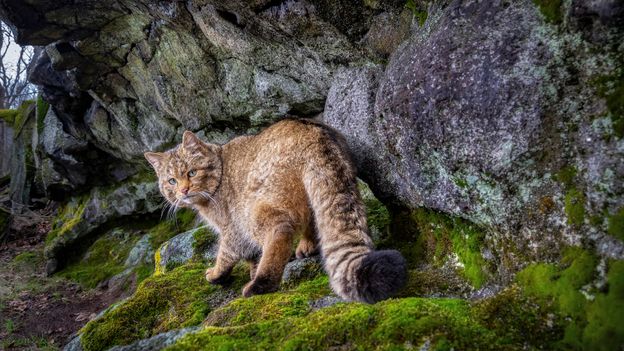
Sforzi, who identified the animal in De Giovanni’s footage as a wildcat based on its appearance, says that for a full identification, a genetic analysis would be needed, based on hair samples – which again, are tricky to obtain from the elusive wildcat, even with lure sticks.
“Not all wildcats are attracted by the sticks, and of those attracted, not all rub against it,” Sforzi says. “Of those who rub against it, not all leave hairs – and if they leave hairs, not all of the hairs have a hair bulb, which is where the DNA is.”
When he received De Giovanni’s video, it was one of very few images of wildcats in that area. “It was interesting because it was one of the first from that area, and it was a good image and clear enough to see the visual characteristics,” Sforzi says.
More like this:
• The polar bears living on a Russian ‘ghost island’
• The maritime lions hunting seals on the beach
• Seven quiet wins for climate and nature in 2025
The wildcat has a distinctive striped pattern, Sforzi explains, similar to domestic tabby cat but with crucial differences. For example, the wildcat has a stripe along its spine. While a tabby cat has black or brown stripes all over, the wildcat has black stripes on its back and tail, and more faded, lighter ones on its side and legs. Interbreeding between wildcats and domestic cats is one of the threats to the wildcats, firstly because it results in hybrids, and secondly, because domestic cats can pass on diseases that are dangerous for wildcats, says Sforzi.