
The wild-card round delivered the goods, bringing us four one-score games, all of which were won in the final three minutes. The resulting divisional round matchups are split into two groups: Evenly-matched teams pitting strengths against strengths, and underdog stories featuring teams largely subsisting on magic. The spreads are narrowed, the stakes are raised and the expectations for entertainment are sky-high.
Let’s dive into the matchups with staff picks below.
📺 What To Watch 📺San Francisco at Seattle
This has to end at some point. The 49ers’ roster is so depleted it’s a shock they haven’t had to play guys both ways. If they make the Super Bowl, Brock Purdy and Kyle Shanahan will be all that’s left; staggering into Levi’s Stadium in each other’s arms before collapsing at midfield in a cloud of dust and dried athletic tape.
George Kittle tore his Achilles, Fred Warner will likely not be cleared for the game, Ricky Pearsall remains questionable and the second level of the defense is staffed by a temp agency. San Francisco was manhandled by the Seahawks in Week 18, averaging -.49 EPA per play on offense while their defense allowed 180 rushing yards and six runs of 10 yards or more.
In the two games these teams have played, Seattle pressured Purdy on 48.5 percent of his dropbacks. In Week 18, he didn’t attempt a single deep pass, and 75 percent of his throws traveled less than 10 air yards.
Shanahan’s hat is deep and full of magic, but even he runs out of tricks when the offense can’t run the ball and the quarterback has no time to read the play. He’s done an inspiring job keeping the engine running, but there’s a reason cars don’t roll off the assembly line with chewing gum and paperclips under the hood.
San Francisco’s best chance, perhaps its only chance, is to disrupt Sam Darnold enough that he gives them extra possessions. Despite their offensive woes in Week 18, the Niners still had a chance to tie late thanks to the Seahawks’ inability to move the ball through the air most of the game.
Darnold didn’t throw any picks, but managed only 198 yards on 20 completions. More importantly, the 49ers pressured him on 36.7 percent of his dropbacks and sacked him twice, which is something they rarely manage to do. San Francisco had just 20 sacks in the regular season, making them the only team with so few sacks to win a playoff game in the Super Bowl era. If they can muster similar production, Darnold’s propensity to go kablooey could be the equalizer. On 152 dropbacks under pressure this season, he had the highest turnover rate in the NFL.
But San Francisco’s problem is with the run and is twofold. They are unable to dictate terms on either side of the ball, and allowed a rushing success rate of 40 percent or better in 14 of their 17 games. Even when holding Seattle to 38.5 percent in their last matchup, they allowed 180 yards and the game’s only touchdown.
Ugly or not, if your opponent can run and you can’t, creativity can’t carry the day. That’s the reason for the 7.5-point spread, and why it finally feels like the Niners are all out of moves.
Los Angeles at Chicago
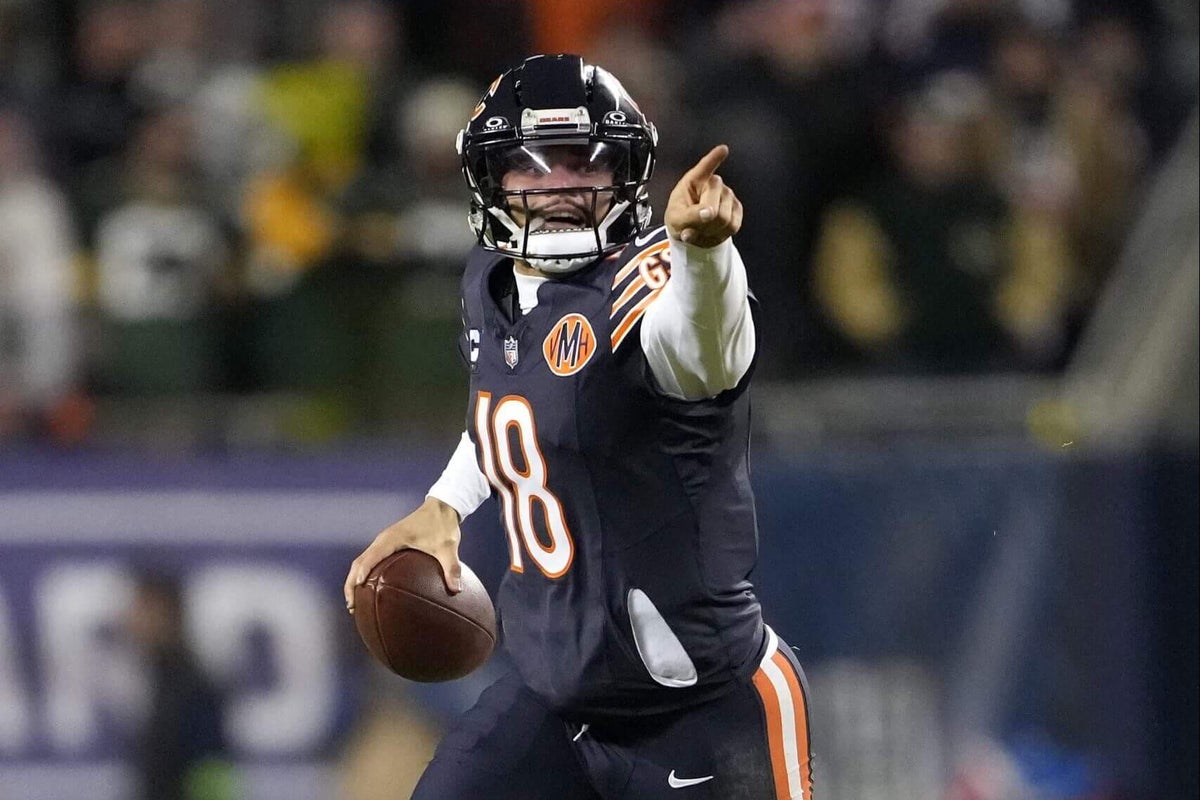
We know that isn’t how it works for Ben Johnson and the Bears. We know that. This is the NFL, and Chicago obviously has a game plan coming into every contest. But knowing and feeling are two different things, and boy, it feels like the Bears are performing free jazz up until the fourth quarter. With their impossible comeback win over Green Bay, Chicago has now won seven games in which they were trailing in the final two minutes, two more than any team has pulled off in a single season (playoffs included) in the Super Bowl era.
But the Packers, while talented, are not the Rams. Los Angeles is a far more efficient offensive machine and isn’t dealing with the gut punch of losing their core defensive player. It’s tempting to point to the wild-card game against Carolina as proof of L.A.’s fallibility, but consider this: Abraham Nunez batted .242 for his career, but hit .429 off Greg Maddux the 30 times he faced him. Weird stuff happens, and sometimes mediocre talent finds the magic against a particular opponent.
The Bears are at home, and their two losses at Soldier Field were by three points, so in that sense, the Rams being favored by 3.5 points has a certain logic to it. But in every other sense, this spread seems awfully conservative. A quick rundown of the Rams’ advantages:
The deep ball
The Bears allowed the second-most touchdowns and second-most yards per game on deep passes (20-plus air yards) this season, and only the Cowboys gave up more touchdowns on passes that went 10 or more yards in the air.
Matt Stafford completed more deep passes than any quarterback in the league, throwing an NFL-best 10 touchdowns and one interception. On passes over 10 yards, he had the most touchdowns (19), most yards (2,568) and threw just three picks. His EPA on throws over 10 yards is an astounding (and league-leading) +138.6.
Play action
Chicago has allowed more touchdowns off play action than anyone but the Jets, and surrendered the fifth-most yards per game to it this year.
Play action is the lifeblood of the Rams’ offense, and they are devastatingly good at it. L.A. runs play action more than any other team, averaging more than 100 yards and a touchdown per game. No one comes close to Stafford, who has thrown 20 touchdowns and one pick, six more scores than the next-closest quarterback.
The ground game
There’s no doubt the Bears can run the ball, but the problem for them is the Rams can, too. The bigger problem is that Chicago’s defense is worse at stopping the run than L.A.’s is. The biggest problem is that the Bears are really bad at stopping the types of runs the Rams are great at. Los Angeles is seventh in EPA per rush outside the tackles; Chicago’s defense is 29th. The Rams’ Blake Corum and Kyren Williams are first and third in rushing success rate on runs from under center; the Bears are 24th against under-center runs. It’s not that Chicago can’t run on the Rams; it’s that the Rams can run right back.
Fourth-quarter magic
The Bears have been heroic in the last 15 minutes of games. Through last week, they have 20 fourth-quarter touchdowns (second), average +.11 EPA per play (second) and are first in yards per play (5.9). Impossibly, the Rams have the exact same numbers. The two teams are tied in each one of those fourth-quarter stats.
Defensively, the Rams outshine Chicago considerably in the final frame. L.A. has the most fourth-quarter QB pressures, the third-most sacks, and allows the seventh-stingiest EPA per play.
Caleb Williams and his pixie dust represent Chicago’s only true edge in the game, as the Rams are bad against quarterback scrambles and among the worst at surrendering passing yards when they blitz. The second-year QB is tremendous at both of those things, and his ability to execute near-impossible throws can make up a lot of lost ground in a hurry. Still, there’s only so much you can do in 120 seconds, and the first 58 minutes against the Rams could make the final two irrelevant.
Buffalo at Denver
Josh Allen sacrificed his entire body for his first road playoff win, and his reward is a trip to Denver and a date with an even more physical defense.
The Broncos had 68 sacks in the regular season, 11 more than the next closest team, and the most in a season since the 1989 Vikings. This defense doesn’t smother so much as it intrudes, making it their business to be uncomfortably close at all times. They allow receivers the least amount of separation, pressure quarterbacks on 40 percent of their dropbacks and give runners less than a yard before contact. You could bring a backpack full of bacon to a dog park and be given more personal space.
The Broncos are one of two teams that allow less than 5.5 yards per pass in both zone and man coverage, but those sorts of things are less impactful for Allen than most other quarterbacks. He simply creates. Well-timed scrambles, howitzer throws into tight windows and battering-ram short yardage gains are effectively scheme-proof, so long as he can remain on the field.
Allen is averaging more than 350 yards of total offense himself in playoff road games, and his fourth-quarter heroics are so absurd this season they’ll seem apocryphal when we recount them in 10 years. But he has to make it there to pull them off.
The Bills need James Cook more than ever, not only to soften Denver’s middle and bring more men into the box, but to absorb some of the blows. When Cook is tilling the earth, everything gets easier for Buffalo. The Bills’ offense seeks to exploit those diversions, using pre-snap motion more than any other team to find fissures and blind spots and get to the red zone, where they dominate. Those opportunities manifest much more often if the under-center run game works.
Defensively, the plan is the same as always against Denver: Pressure Bo Nix. The guy just does not like it. Nix has thrown six picks under pressure and four touchdowns, compared to 21 touchdowns and five picks when kept clean.
If he’s crowded, he averages less than four air yards per completion and sports a passer rating of 54.5. If you spike the ball every play, your passer rating is 39.6, so what he’s done is only slightly better than doing nothing at all. Buffalo is 12th in pressure rate but 29th in time to pressure, and the 2.86 seconds they average is more than enough time for Nix’s legs to carry him to safety (and positive yardage). Their pass defense is excellent against short and intermediate throws, but bad against the deep ball, which matches up well against the shortest thrower in the league.
Whichever team makes the opposing quarterback the most uncomfortable wins.
Houston at New England
Drake Maye brought a playoff win to New England for the first time since 2018, and he’s made his reputation as a steely downfield passer who’s cool under fire. But, as we said last week, the Houston pass rush is a different animal. Ask Aaron Rodgers, who had the lowest pressure rate in the NFL by a mile this season (21.5 percent) but faced it on 17 of his 37 dropbacks against the Texans (46 percent).
Houston’s Danielle Hunter and Will Anderson were responsible for 15 of the 17 pressures, and have combined for 28.5 sacks and 168 pressures so far this season. The duo harassed quarterbacks into nine turnovers, by far the most by any tandem.
Worse for Maye, that pass rush is backed by the league’s stingiest secondary at the moment, allowing -.28 EPA per throw and less than 180 yards per game. But they’re vulnerable deep, and no one is worse against a quarterback scramble, so Maye will get his chances so long as he stays composed.
Helpfully, the Texans are particularly generous on runs outside the tackles, so TreVeyon Henderson can help ease the burden. The rookie ran for five yards per carry and scored six touchdowns on outside runs, tied with Bijan Robinson and Jahmyr Gibbs.
The Patriots are at a disadvantage defensively insofar as Houston’s erratic offensive improvement makes them difficult to game-plan for. For example, rookie Woody Marks had the league’s lowest rushing success rate in Weeks 1-9 (25 percent), but raised it to 40.3 percent over the final nine weeks and rushed for a career-high 112 yards last game.
C.J. Stroud has targeted receivers deeper than he did before his concussion, raising his average depth of a target by a full yard since Week 13. The Texans allowed a pressure rate of less than 20 percent six times this season, but the Steelers pressured Stroud on half of his dropbacks and sacked him thrice.
They go in fits and starts, but still have playoff success on their resume and the talent to score on anyone. So long as the offense coalesces from the jump, Houston should give the Pats all they can handle, and is the safest bet for a straight upset this weekend.
Divisional round staff picks