
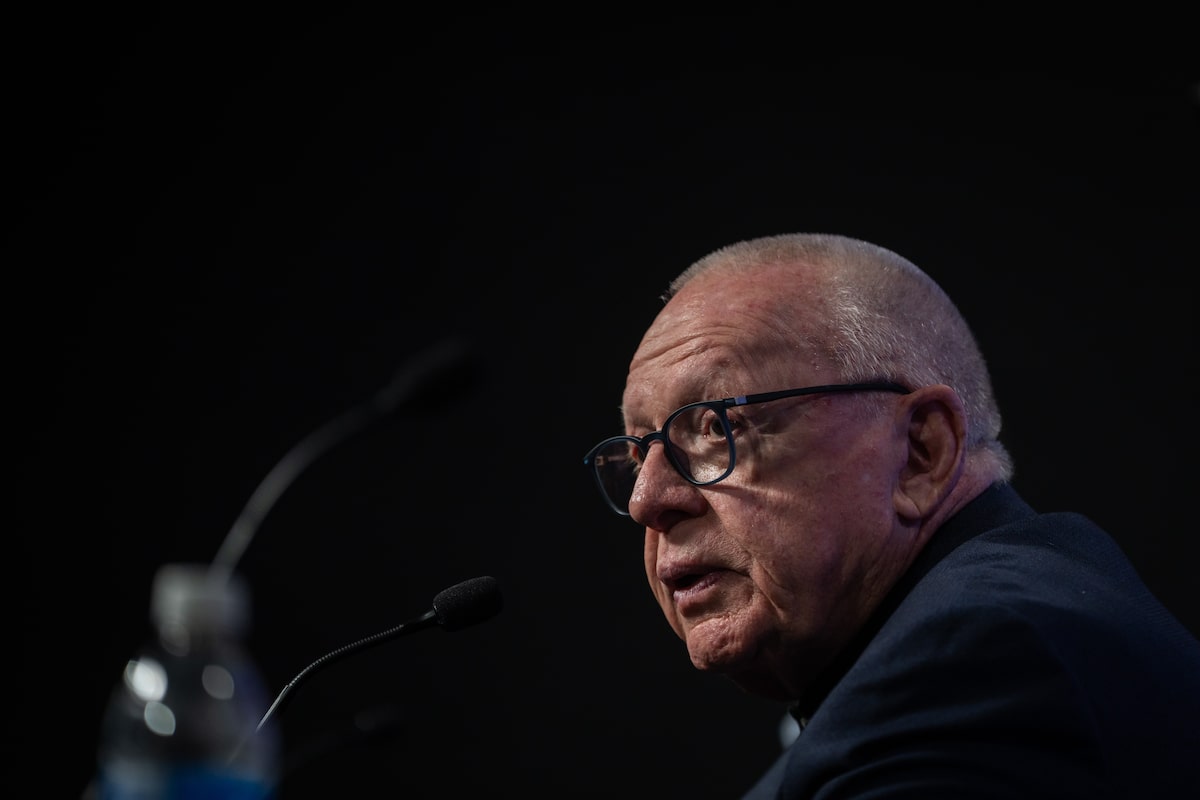
Vancouver Canucks president of hockey operations Jim Rutherford, seen here at the start of the 2025-26 season, said Quinn Hughes’s desire to play with his brothers forced the team to shift into a rebuild, with Quinn dealt to Minnesota in December.ETHAN CAIRNS/The Canadian Press
It’s fair to say that when Jim Rutherford agreed to become the new president of hockey operations of the Vancouver Canucks five years ago he thought he was taking over a team with excellent potential.
It had two top centres in J.T. Miller and Elias Pettersson and a burgeoning superstar defenceman in Quinn Hughes. His optimism was warranted when, three years later, the Canucks won the Pacific division with one of the best records in the NHL. Vancouver took the Edmonton Oilers to Game 7 of the second round of that season’s playoffs.
Rutherford couldn’t have imagined that would be as good as it got.
Today, both Miller and Hughes are gone, the team has the worst record in the league and is now in full rebuild mode.
The Miller-Pettersson feud – the details of which still remain murky but involved an intense dislike between the pair – was affecting the entire dressing room. Rutherford views that feud as an inflection point from which a line can be drawn to where the team stands today.
Gary Mason: Rebuilding Canucks had to trade Quinn Huges, but fans are entitled to feel angry
“Everything went sideways once we got into the Miller-Pettersson thing and we had to move J.T.,” Rutherford told me in an interview this week. “And within a year of that we were dealing with Quinn’s situation as to whether he was going to stay in Vancouver or not.
“Basically, within a year, we moved out the two driving forces of what could have made the Canucks successful going forward. There wasn’t going to be a rebuild as long as we had players like that.”
Rutherford doesn’t think losing Miller had anything to do with Hughes’ desire to leave. In fact, Rutherford told me, he thought ending the turmoil in the dressing room by removing one of the principal actors involved in it, would make Hughes happy. As captain, Hughes never liked dealing with the questions about the entire affair and he knew the toll it was taking on his teammates.
In the end, it was a desire to play with his brothers, or at least play somewhere in the east, that became the biggest factor in Hughes’ decision to leave, Rutherford said. He wouldn’t get as far east as he may have hoped because Minnesota made an offer that the Canucks couldn’t refuse.
Quinn Hughes, right, seen here in his new uniform with the Minnesota Wild, has a desire to play alongside his brothers, Canucks’ president of hockey operations Jim Rutherford said.Bailey Hillesheim/The Associated Press
Without Hughes and Miller, and the short-term future bleak, Rutherford made the decision to pivot to a full rebuild. Something, he told me, that was completely supported by team owner Francesco Aquilini.
“He’s fine with it,” Rutherford told me. “For all the people who want to take shots at him and what not, he always wants to do what’s best for the Canucks and their fan base. He’s like anybody. When you have a meeting, he wants to ask questions about why? Why will we do this? Why are we doing that? Which is exactly what he should do.”
Rutherford said a rebuild involves growing young players and he thinks the Canucks have an excellent developmental system, one he thinks the team may expand as it moves forward and drafts even more young players. He said that the team already has some top young players it is in the process of building into solid NHLers.
“And so, if you want to start the clock [in terms of the rebuild], do you start it when Quinn was traded and say the Canucks started the rebuild then?
“To me, the clock actually started two or three years ago because we have very good young goalies in the system and now we have very good young defencemen. These are two positions that are hard to build and we’re already ahead of the rebuild before the clock started, including the [Hughes] trade.”
Canucks trade captain Quinn Hughes to the Wild
He went on: “We need to strengthen our centre ice [position]. We need to build that and once you get centre ice, defence and goaltending your rebuild can move along much quicker.”
Rutherford pointed to teams such as Toronto and Detroit, which both took years to rebuild – somewhere between six and 10 years. He thinks the Canucks can do better than that despite their recent spate of poor play.
Soon, they should start getting some key injured players back at both the centre position and defence.
“So it’s not like it has to be as ugly as it’s been over the last few weeks but as far as getting to be a contender, I believe it’s going to be two to three years. In the meantime, I don’t mind it being ugly this year, because getting that high [draft] pick is important.”
Rutherford understands the impact a shift from a team recently viewed as one of the top in the NHL – see the 2023-24 season – to one in full rebuild mode can have on the psyche of veteran players who thought they were part of something special.
Winger Brock Boeser would fall into the category of someone whose play has tailed off dramatically this season. I asked Rutherford if he thought the Hughes trade has something to do with that.
“I’m sure it has,” Rutherford said. “Yeah, they were very, very good friends and I’m sure that was part of that. You know he’s [Brock] just a terrific person and he can be sensitive sometimes to situations like this. So, I’m sure it has. Yeah, no doubt.”
Canuck Brock Boeser has had a down season in the wake of the Hughes trade. Rutherford said Boeser is likely impacted by the move and the void that Quinn’s departure creates.Derik Hamilton/The Associated Press
Boeser, who is 28, is one of seven or eight Canucks players who do not fit the demographic profile of a team in the midst of a rebuild. Filip Hronek, Jake DeBrusk, Conor Garland, the aforementioned Pettersson, would be included in that group as well. Kiefer Sherwood, 30, who is an unrestricted free agent after this season, is sure to be moved before the trade deadline. But Rutherford does not view those other players as assets depreciating in value with each passing year and so should consequently be traded for draft picks or young prospects.
“You can’t just have young guys on your team or you’re going to set them up to fail,” Rutherford said. “You have to have good players to mentor them.”
That said, Rutherford also agreed no player is off limits to being traded either (except those with no trade clauses) given the right offer. “We’re open for business,” the president said.
Opinion: With the Canucks’ season slipping away, a Quinn Hughes trade feels inevitable
Asked whether he thought rookie head coach Adam Foote was doing a good job behind the bench, Rutherford gave him a vote of confidence. Given the injuries the team has incurred, Foote is doing about as good a job as you can under the circumstances, he said.
Rutherford turns 77 next month – not usually the optimal age of a president of hockey operations overseeing a total rebuild of his team. It’s certainly not what he signed up for when he took the job.
“Eventually I will have to do what’s best for my family but also what’s best for the Canucks,” Rutherford told me. “I’m committed to this rebuild. I’m committed to this job today and as long as I’m here.”
But he conceded he does not know how long that is. Asked if he’s committed to next season, he said, “As we speak, yes I am.” But beyond that, he said he didn’t know.
I think he honestly doesn’t know what the future holds for him, even beyond this season. If I’m betting, he’s not going to be holding his current job in three years’ time. That would be asking a lot. But then, you never know. Lou Lamoriello was president and general manager of the New York Islanders until he was fired at the end of last season at 82.
Rutherford will have a much better idea of how his rebuild is going after this year’s draft, and the team evaluates its haul from the players it’s traded – and are still to be traded. He truly believes the Canucks are on the right track. Only time will tell if he’s right.