
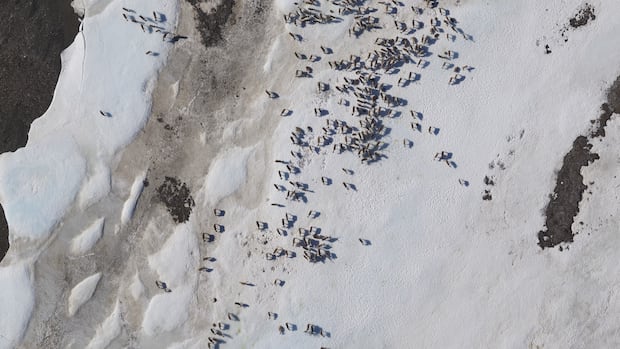
One of North America’s largest caribou herds — known for its over 2,400-kilometre migration across Arctic tundra, snow-covered mountains and roaring rivers to its calving grounds on Alaska’s coastal plain — is declining.
The Porcupine Caribou Management Board released its latest population estimate for the barren ground caribou herd last week. It says the herd’s population is estimated to be 143,000, down from 218,000 in 2017, when biologists last conducted surveys.
Despite the decline, chair of the Porcupine Caribou Management Board, Joe Tetlichi says the decline was expected and the board doesn’t have to “put up the red flags yet.”
“The population goes up and down and we know that through Indigenous knowledge and scientific knowledge,” Tetlichi said. “And we’ve had that same scenario back in 1989 to 2001 when we had an population estimate of 187,000. And then in 2001 we finally got a count and it was 123,000. So we know that it [goes] up and down.”
Biologist Mark Nelson with the Alaska Department of Fish and Game says nutrition could be playing a role in the current decline.
“We compare the older animals, the younger animals and when there’s a lot of nutrition on the landscape and everybody’s fat and happy, the younger animals are giving birth at a rate very similar to the older animals.”
Nelson says in the last six to eight years the herd’s younger females have been giving birth less often, signalling that nutrition could be an issue. And if birth rates remain low for several years, the herd is unlikely to grow.
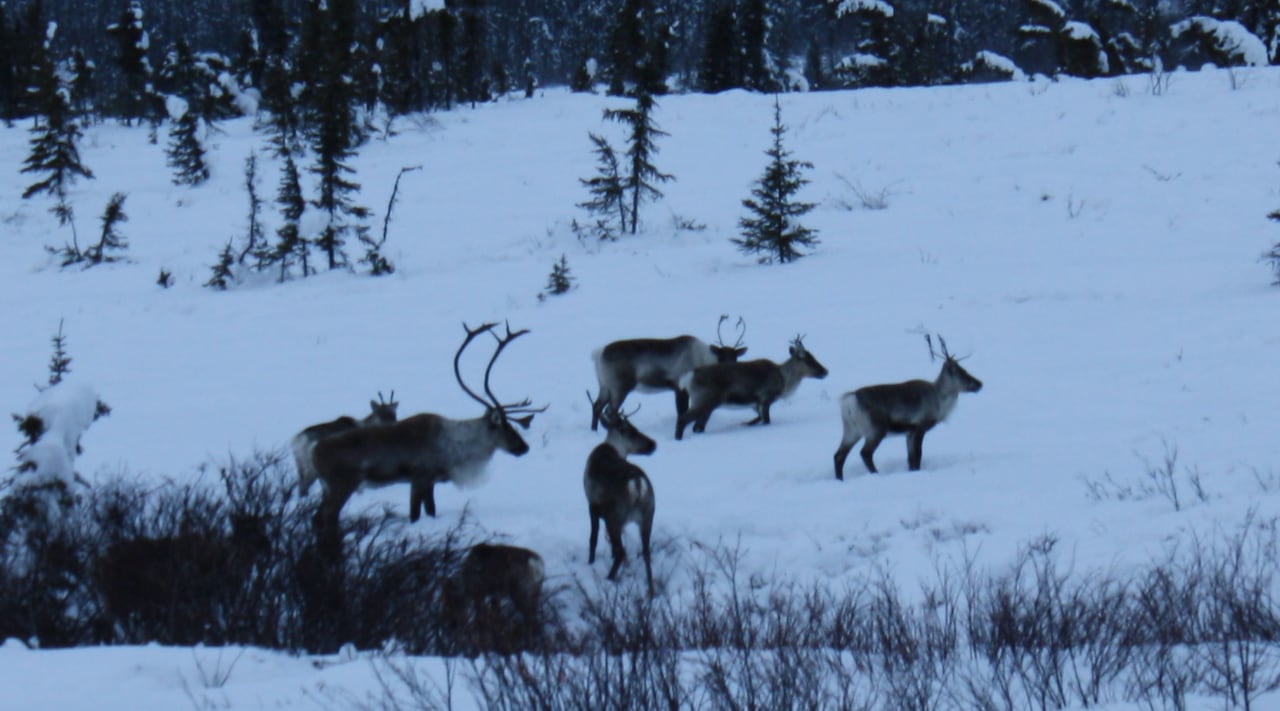 Caribou from the Porcupine herd seen along the Dempster Highway near the Yukon/N.W.T border. (Meagan Deuling/CBC)
The management board’s latest annual report says research indicates that there has been a small decrease in lichen cover over the herd’s range.
In addition to birth rates, survival rates are also an important indicator of population health and what direction the herd size is trending.
The board’s latest report says adult female survival was the lowest since 2015 and below the threshold for a stable or increasing herd, and calf survival was also lower than average. Both indicate the herd is in decline and will continue in that direction.
“From the Indigenous side, we’ve had our local experts out on the land saying that, you know, there’s less cow caribou, they see less calves in the spring,” Tetlichi said. “So that’s something that we really rely on.”
‘Everything has to line up’
Collecting data on the herd’s size is important for informing the board’s management measures, but making as population estimate is not easy.
“We try to do the population count every two years, but everything has to line up,” Tetlichi said.
In order to survey the herd, biologists sometimes have to wait years for the right conditions. Before last summer, the last time that happened was in 2017 when biologists were able to photograph the herd from an airplane and use those photos to estimate its size.
“That’s our best method to figuring out how many caribou are in the herd,” said Nelson. “That is accomplished by having collars in the herd and knowing a little bit about caribou behavior, especially right following their calving time when they group up into these big post calving aggregations or groups.”
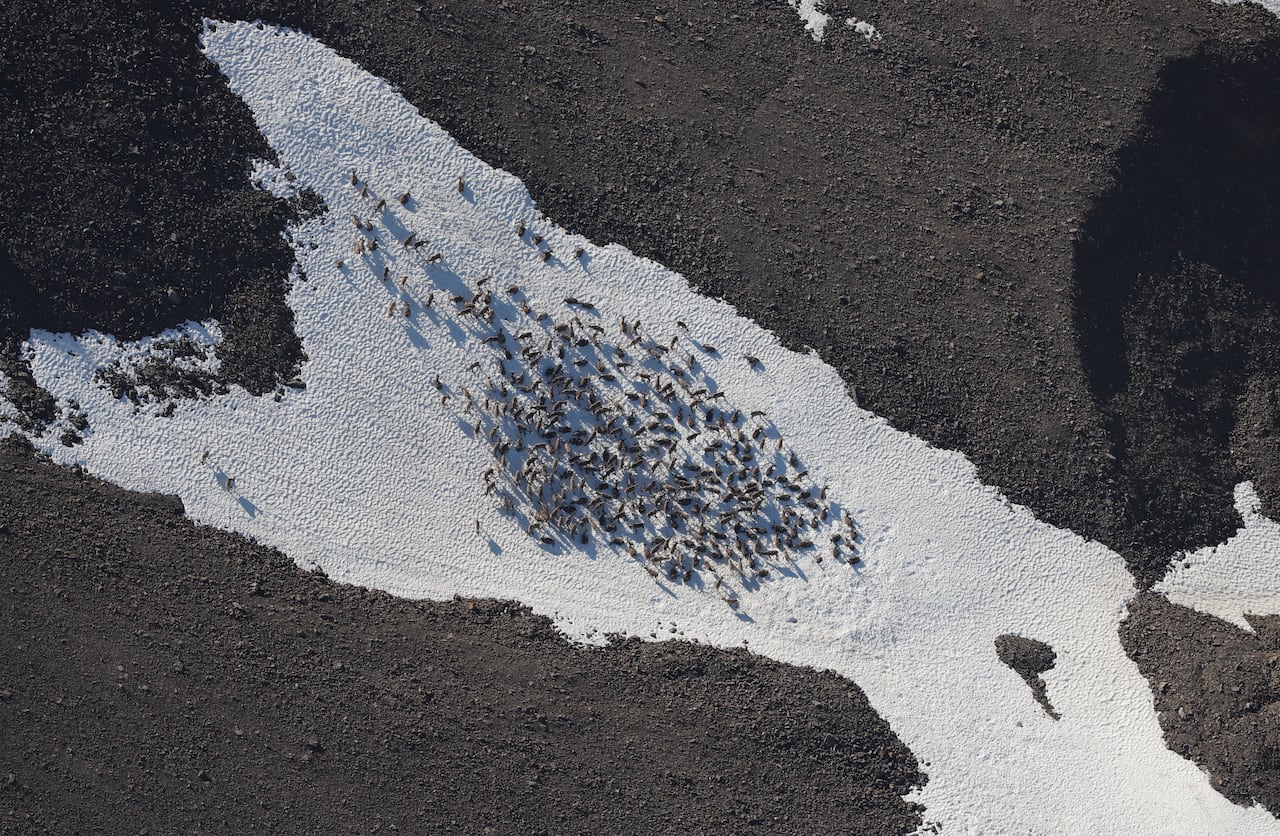 Caribou from the Porcupine herd are seen during an aerial population survey in Alaska. (Alaska Department of Fish and Game)
Everything from mosquitoes to weather can affect the herd’s movement and biologists’ ability to conduct an aerial survey, Tetlichi said.
In summer when mosquitoes are most abundant, the caribou will often group together and seek refuge in the hills and mountains, he said. That’s when biologists have a window to get aerial photos, if the other conditions align.
“Sometimes it’s cloudy and that’s not good for taking the count. Sometimes it’s smoky and that’s another reason we don’t get a count,” Tetlichi said.
Harvest won’t change, says board chair
The Porcupine herd is ecologically and culturally significant and provides food to many northern communities.
The board has had a harvest management plan in place since 2010, which includes guidelines for hunters about how many caribou they can harvest based on the latest population estimates and other factors, like birth rates and calf survival.
Right now the herd size is in the green, which means it is above 115,000 caribou. As long as the herd stays above that threshold, hunters are permitted to harvest what they need and the harvest data is collected and shared at the board’s annual harvest meeting.
“I call it ‘business as usual,’” Tetlichi said.
However, if the herd’s population dips below that threshold, harvest management measures would kick in, he said.
If the population dips below 115,000 animals, the board would implement a voluntary hunting ban for cows. A population under 80,000 means that ban would become mandatory, and under 45,000 means no hunting would be permitted, with the exception of harvesting small bulls for subsistence or ceremonial purposes.
The board will host its annual harvest meeting Feb. 6.