
Despite its relative rarity and massive expense, and despite its Marcello Gandini-designed shape going back to the early 1970s, the Lamborghini Countach was one of the most culturally relevant automobiles of the Reagan era. The quintessential “poster car,” it made its maker a household name even though it was still a boutique, low-volume company then. In terms of automotive excess, the Countach simply could not be outdone, either. Nothing else on the road at the time could touch its combination of looks, speed, price, and charming impracticality.
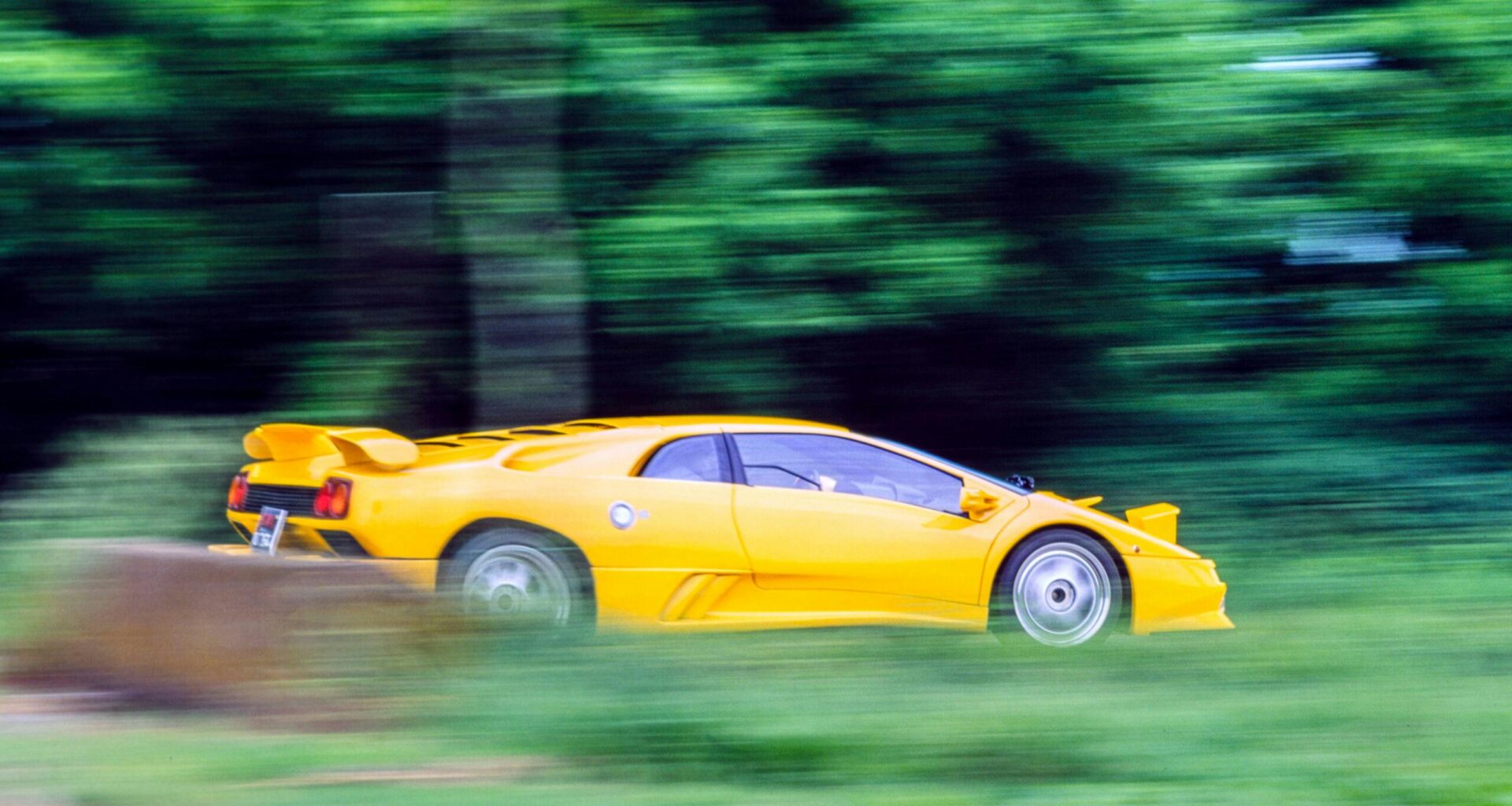
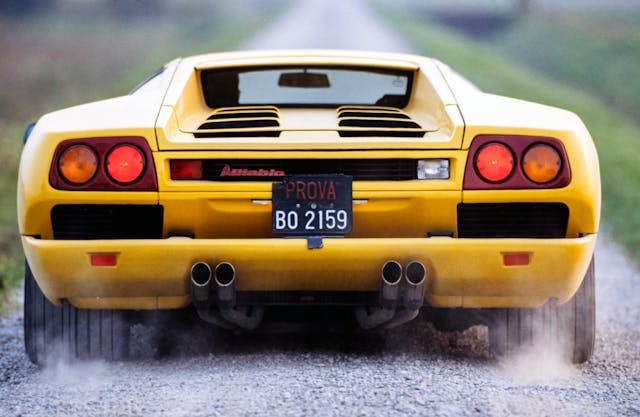
The Countach was a tough act to follow, then, but it would be hard to argue that the Diablo didn’t make a worthy sequel. It sold well, weathered multiple corporate shakeups, and easily matched its predecessor for sheer outrageousness, all while being an easier car to live with and consistently improving. And even though it wasn’t quite the same kind of cultural icon as the older Lambo, it was still on many a ’90s kid’s dream car list. It even had its own game on Nintendo 64. The Diablo was also the last Lamborghini built before the still flamboyant but cleaner, more efficient, German-ized Lambos of the Audi era that we see on the roads today. With many 1990s-2000s supercars making the transition from cool used exotic to serious modern collector car over the past several years, the Diablo has also been one of the big winners, and has gone from pricey to seriously expensive.
 Lamborghini
The backdrop of this car is important because, at the corporate level, big, rapid change came at Lamborghini throughout both Diablo development and Diablo production. This was an international affair: French brothers Jean-Claude and Patrick Mimram, who had bought the company in 1980, sold it to Chrysler in 1987. In 1994, the Americans sold it to MegaTech, a Bermuda-registered firm owned by Indonesian businessmen. The following year, the company was restructured with Indonesian Group V’Power controlling 60% of the business and a Malaysian concern called MyCom Bhd controlling the other 40%. Then, in 1998, VW chairman Ferdinand Piëch went on a shopping spree and acquired Lamborghini along with Bentley and Bugatti. Lamborghini then went under the Audi umbrella, and it is with the Germans that Lamborghini has enjoyed its longest—and, from a production perspective, most fruitful—era.
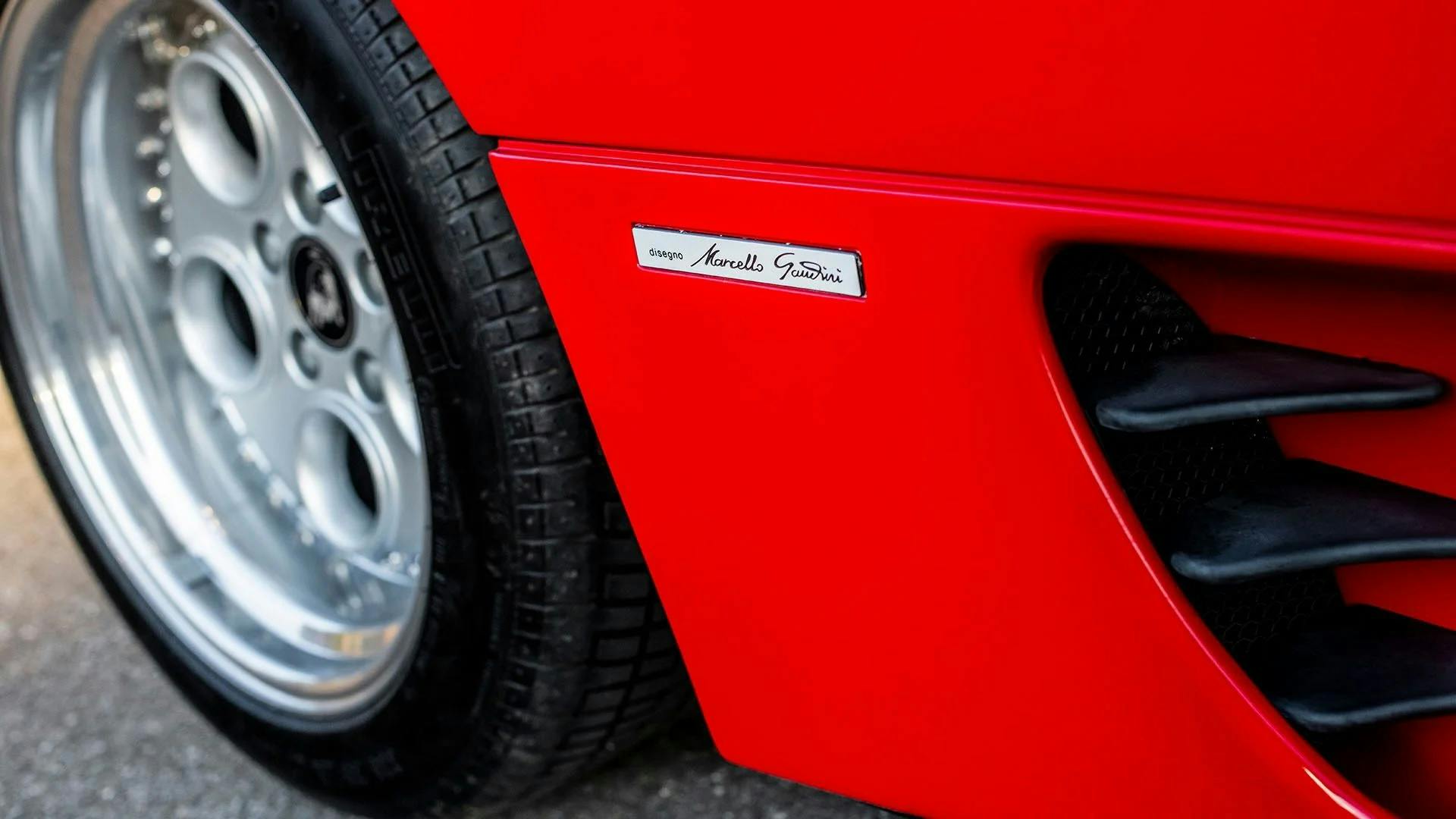
Development for the Diablo went back to the mid-1980s, and early designs for the bodywork came from Marcello Gandini, who had penned both the Miura and the Countach. According to most sources, Chrysler’s design team under Tom Gale significantly altered Gandini’s shape into the one that made it to final production. Even so, the Diablo retained the sharply angled, wedge-shaped, cab-forward look that has characterized Lambos since the 1970s.
 Broad Arrow
 Broad Arrow
 Broad Arrow
 Broad Arrow
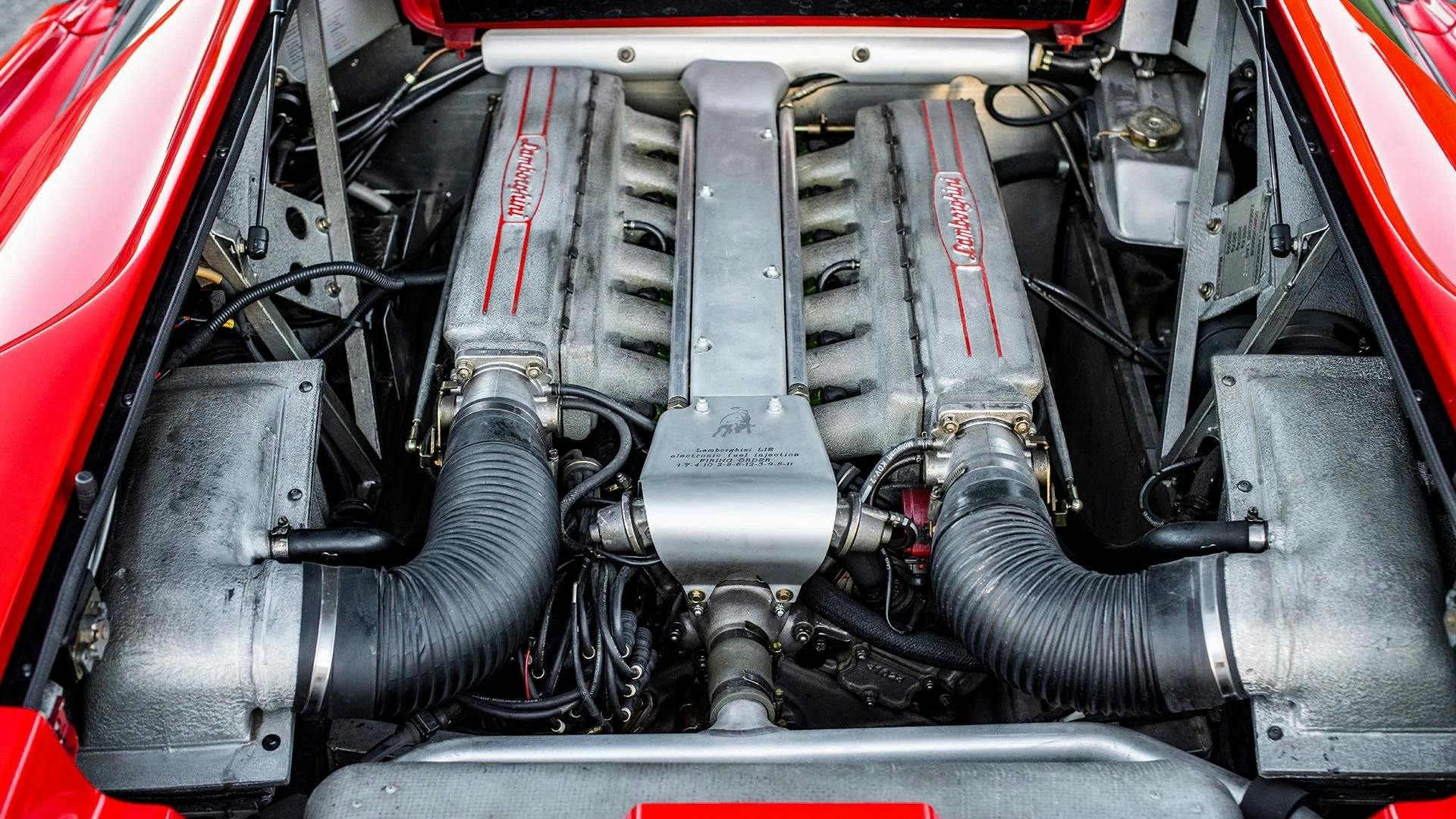
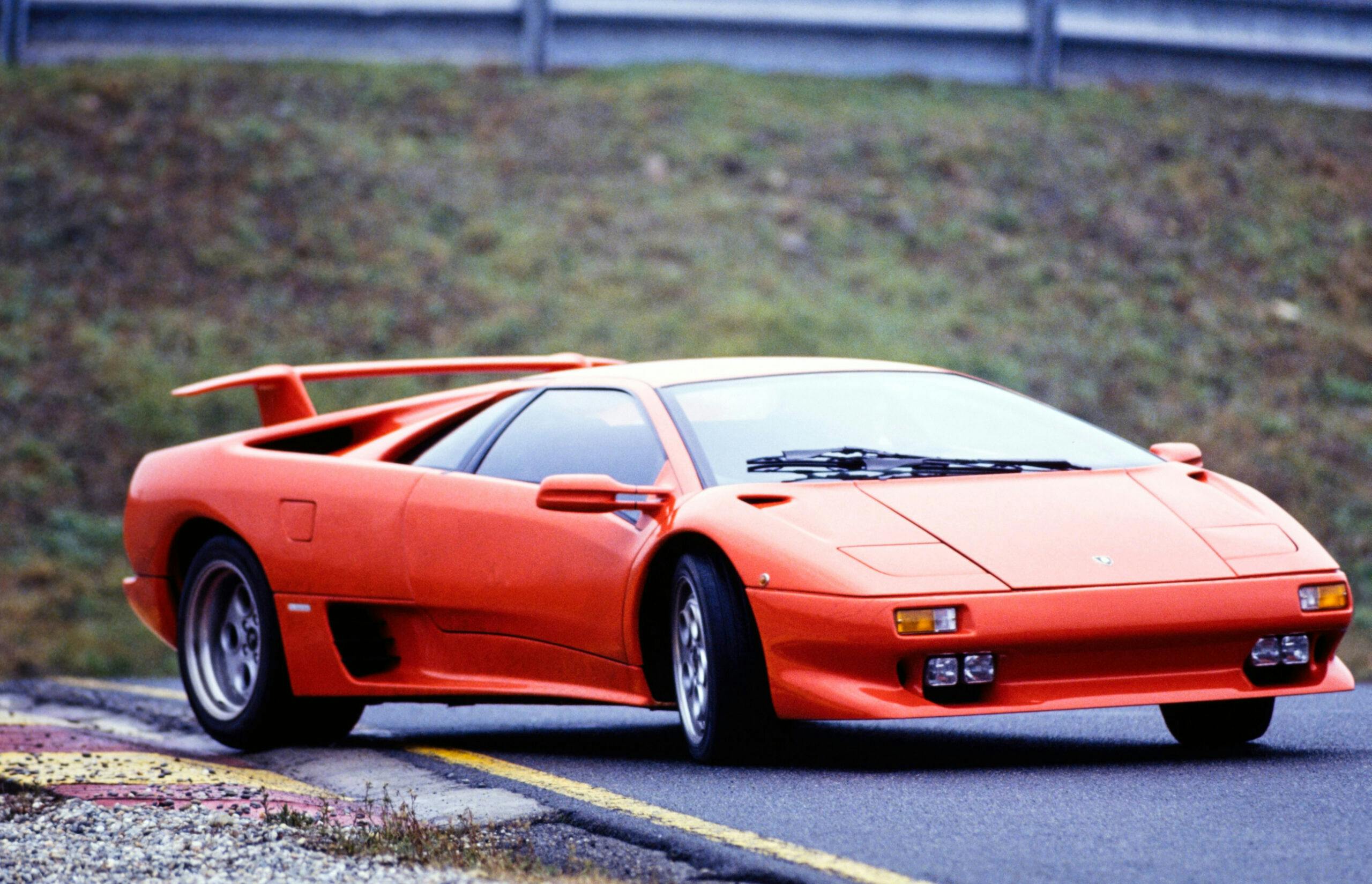
Diablo does, of course, mean “Devil” in Spanish, but in true Lamborghini tradition, it was also the name of a fighting bull. The production version was first available in early 1990. Like its predecessor, it utilized a tubular spaceframe chassis underneath as well as an updated version of the original Giotto Bizzarrini-designed four-cam V-12, in this case displacing 5.7 liters and putting out 485 horsepower and 428 lb-ft of torque. The transmission was still a five-speed manual and would remain so throughout the Diablo’s production. While early Diablos came with better ergonomics and creature comforts than the Countach, they still did without conveniences like anti-lock brakes and power steering. And it still wasn’t a car to use every day.
Testing a Diablo against an F40 on the streets of Miami in 1992, Car and Driver noted the “aural trauma” produced by the engine and concluded that the F40 was both more solidly built and less demanding around town. In the Diablo, “[a]fter one hour’s drive, no man among us could any longer hold the clutch depressed for the time required to outwait a red light. Under 10 mph, the steering is so heavy that you occasionally wrench your upper torso … Lane changes require abiding faith in an omnipotent and benevolent being.” To be fair to the Diablo, though, the test also concluded that both cars “deliver a determined dose of driver discomfort found in few confined spaces this side of a Bangkok debtors’ prison.” So, it wasn’t a car to commute in, but at 203 mph, the Diablo was the world’s fastest production car when it came out. That title didn’t last long, though.
 Lamborghini
Alex Ahlgrim, an appraiser, broker, and exotic car expert who monitors the Diablo market for the Hagerty Price Guide, echoes the demanding nature of driving these monsters, which are two inches wider than a Ferrari Testarossa: “It’s raw and demands an active driver to control the wheel, plus it’s challenging to see out of. There is a learning curve … They lacked driver aids before the ’93 VT, which brought new systems to assist with control, but even then, it is an early-tech aid in a big car. Driving a Lamborghini isn’t about the next set of hairpins; it’s about the next stoplight. Anyone who complains about a track day in a Diablo didn’t take it to Starbucks before.”
For 1993, the Diablo saw its first and one of its biggest updates with the all-wheel drive VT (“Viscous Traction”) model. By the ’90s, all-wheel drive was de rigueur in rally racing. Porsche 911s had been available with it since 1989, and it’s fairly common in performance cars today. But a mid-engine Italian with AWD was unusual stuff at the time. The VT could direct up to 25% of torque to the front wheels (only if the rear ones slip) via a viscous center differential developed from Lamborghini’s old LM002 truck. It also got minor engine changes, an ergonomically improved interior, and larger intake holes and scoops in the bodywork. Testing a VT in 1994, Car and Driver called it “a better, more distinctive, more driver-friendly exotic car than its predecessors,” noted its improved build quality, and praised its neutral, predictable handling: “Purists may whine that it’s too unchallenging … But we’re fairly certain the Diablo VT will cover twisting pavement faster and more effectively than a Testarossa driven at the same level of drama. Can that be bad?”
The SE30 and SE30 Jota were other Diablo additions for 1993, introduced to celebrate 30 years of Lambo. These were rear-drive models with engine power raised to 523hp and lightweight touches like Plexiglass side windows, carbon-fiber seats, and an absence of air conditioning, stereo, or power steering. SE30s also got a number of cosmetic changes, like a different front fascia and a range of exclusive colors, the most famous of which is a lovely light metallic purple. Lamborghini built 150 SE30s, and a handful of these got the “Jota” kit that converted them to track cars.
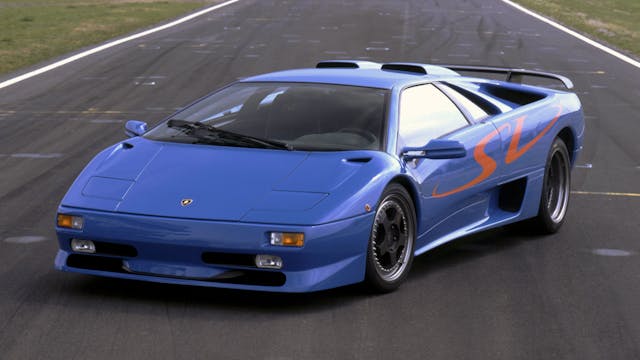
In 1995, Lamborghini finally brought open-air motoring to its big V-12 offerings with the Diablo VT roadster, topped by a carbon-fiber targa roof panel that slotted in above the engine after the driver (and a helpful passenger) manually removed it. The Diablo SV (“Super Veloce”) also arrived in 1995, a clear callback to the Miura SV of the early ’70s. A rear-driver, it boosted output to 510hp vs. the standard car’s 485hp, and it came with an adjustable rear spoiler either finished in body color or left in bare, black carbon fiber, matching the black taillight surrounds. Front brakes and wheels were larger in the SV, too. In 1998, Lamborghini shipped 20 SVs over the U.S. in “Monterey Edition” trim with 530hp, interior plaques, and special stitching in the headrests.
 1995 Diablo SVLamborghini
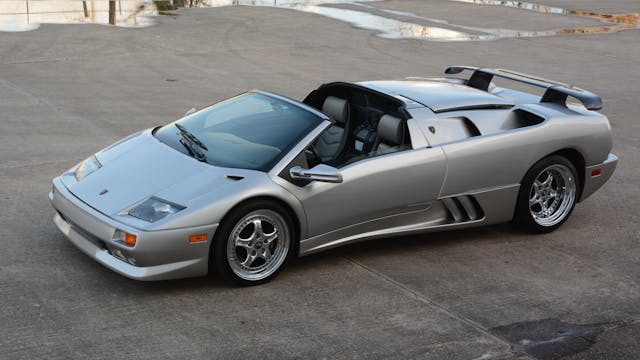 1999 Diablo VT RoadsterLamborghini
A big facelift for the Diablo came in 1999, courtesy of Luc Donckerwolke, the company’s first in-house designer. The then-passé pop-up headlights were gone in favor of fixed composite lenses, borrowed from the Z32-generation Nissan 300ZX. There was also no more “base Diablo,” and the SV assumed the role of entry-level model, though it still cost nearly a quarter-million dollars. The interior was updated and got a new, wavier dashboard, while engine output grew to 530hp and wheels grew to 18 inches. An anti-lock braking system was a Lamborghini first.
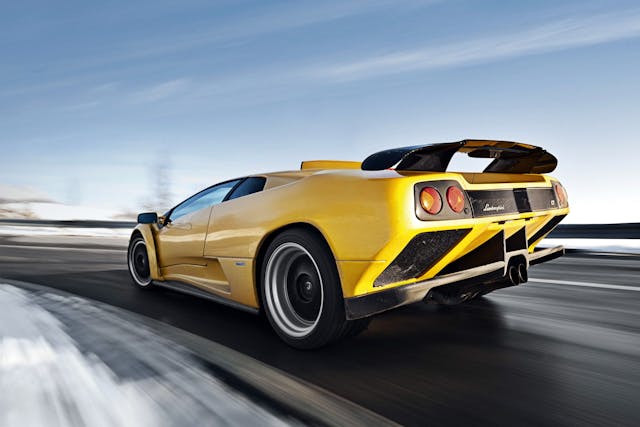
Among the special models for 1999 were a dozen “Alpine Edition” cars for the U.S. market. Named for the audio company, not the mountain range, Alpine Editions were essentially standard Diablo VTs with more carbon fiber interior trim and a higher-tier Alpine stereo with an integrated navigation system. There was also a 12-car, U.S.-market run for the “Momo Edition.” These were Diablo VT Roadsters with special upholstery, along with Momo four-point harnesses and chrome wheels. Cashing in on the turning of the calendar, Lamborghini then sold 30 copies of the “Millennium Roadster,” a VT with two-tone interior, shorter gearing from the SV model, and either yellow or Titanium Metallic paint. Thirty were built, and 10 came to the U.S.
 Lamborghini
The last of the lighter, more track-oriented Diablos was the Diablo GT, characterized by the large bulge and scoop for the oil cooler found between its headlights and the special three-piece OZ wheels. Lamborghini stroked the engine to 6.0 liters, and power rose to 575hp, driving the rear wheels only. Production was limited to just 80 units and none officially sold in the U.S., though a handful have made it to our side of the pond.
The 6.0-liter engine also made it into the all-wheel drive VT with the VT 6.0, which also got revised styling and 18-inch OZ wheels, as well as a more ergonomic interior. There were also 42 examples of the VT 6.0 SE, which was only available in either Orio Elios (Helios Gold) or Marrone Eklipsis (Eclipse Brown).
In barely over a decade, Lamborghini built roughly 2900 Diablos. That means it outsold its longer-lasting predecessor, the Countach, by over 800 units, though the Audi-backed 2002-10 Murciélago dwarfs them both at over 4000 cars sold. For additional context, the much less boutique modern Lamborghini sold 10,687 vehicles in 2024.
Diablos have always been poster cars, and they never really went out of style. Nor did they ever get cheap, but 15 years ago, there were Diablos in the Hagerty Price Guide that were worth under $100,000. Today, the most expensive ones are million-dollar cars, and the rest are much deeper into six-figure territory. The first few years of the 2020s saw the biggest growth period for Diablos, with median condition #2 value up 90% since 2019 and #2 values for VT and SV models more than doubling. This makes sense for two reasons. First, basically every ’90s European performance car with a manual transmission and a vowel at the end of its name shot up in value at that time. The second is that an increase in Diablo values naturally followed in the path of the earlier Countach, prices for which surged during 2015-16.
Diablos are rare and expensive cars, so the real audience for them is limited. So is the amount of buyer interest we can measure through insurance activity. That said, it’s worth noting that despite the Diablo being a Gen X/millennial dream car when it was new, it’s disproportionately more popular with wealthier boomers. Nearly half (47%) of insurance quotes for Diablos come from that generation, even though boomers make up just a third of the market as a whole.
“The market has been quietly on fire for the last six or seven years,” says Ahlgrim, noting that the spark did start before the pandemic. In general, Diablos get more valuable the newer they are. Our current condition #2 value for a 1990 base model is $271,000, and it goes up from there to $338K for examples the final year the base trim was sold in 1998. That early base car is also the cheapest way to get into a Diablo, but even a more used example in #3 (good) condition is still worth over 200 grand. Diablo SVs cost considerably more coin, with 1995 models at $480K in #2 condition and ’99 models at $611K. VTs carry a similarly wide range of prices, with #2 values ranging from $377K for an early 1993 VT coupe to $520K for a ’99 VT roadster. The VT 6.0’s extra oomph carries a premium, with a $550K #2 value. Stepping up to the VT 6.0 SE stretches that to $645K. The Diablo GT sits at the very top, with a #2 value of $1M. There’s clearly a wide range in Diablo prices, but they generally lag behind Countaches, which range from $517K for a 1977-82 LP400S in #2 condition to $747K for a Silver Anniversary model and $1.25M for the very early LP400.
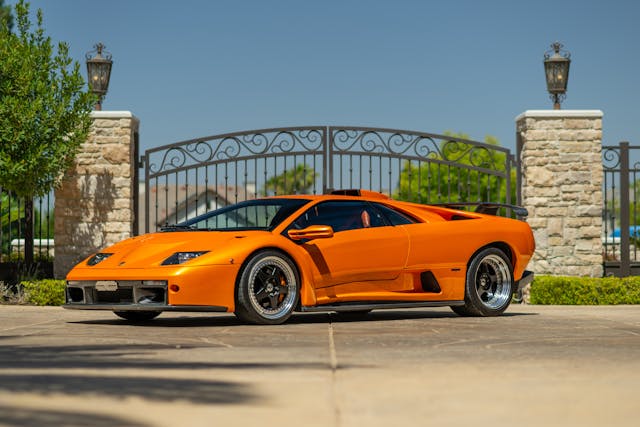 2000 Diablo GTRM Sotheby’s/Courtney Cutchen
Currently, the most expensive Diablo we’ve seen at public auction is a GT that, despite being in less-than-perfect condition, sold for $1.435M in Monterey last August. This is followed closely by an ex-Donald Trump VT Roadster that brought $1.1M in Scottsdale two years ago, and other recent highlights include a VT 6.0 finished in Verde Hydra that brought $897,500 last October.
Ahlgrim confirms that later cars command more, with the post-1998 facelifted cars more sought after and bright colors unsurprisingly being in higher demand. The biggest factor for a prospective buyer, though, is history. Ahlgrim says that the engine is fairly robust and reliable, but that “up until 1994 hydraulic timing chain tensioners along with occasional head gaskets were concerns.” In terms of service: “It’s hard to nail down an exact ‘annual service’ routine, but leaning into 7-8000 miles keeps everyone happy. Lacking a timing belt, there is no ‘engine-out’ service, but at this point in time, all normal exotic car services should be addressed, like fluids, plugs, injectors, etc. Clutches are good for 15-20,000 miles. General post-purchase sorting of a well-kept car will land in the $10K range depending on surprises.” He also advises owners to budget around $5K per year to keep a Diablo running with the occasional spike along the way, and to look for rust along the bottom door edges, sills, and front luggage compartment floor pans. Another thing to look out for is the high-touch surfaces in the interior that wear quickly and are difficult to replace. Overall, though, Ahlgrim shares that “the Diablo community is close-knit and extremely resourceful,” so if you run into a problem, chances are someone has identified a solution.
Diablo values will probably always lag behind the rarer and arguably more significant Miura and Countach, but as those models continue to appreciate, their ’90s descendants have room to grow as well. Their prices show that collectors are taking them seriously, and so is Lamborghini itself. The company’s Polo Storico division, launched in 2015, offers authenticity certification as well as parts and restoration services, and the majority of components for Diablos are available through them. Which is a good thing since, as Ahlgrim puts it, “these cars are monsters and deserve the attention.”