
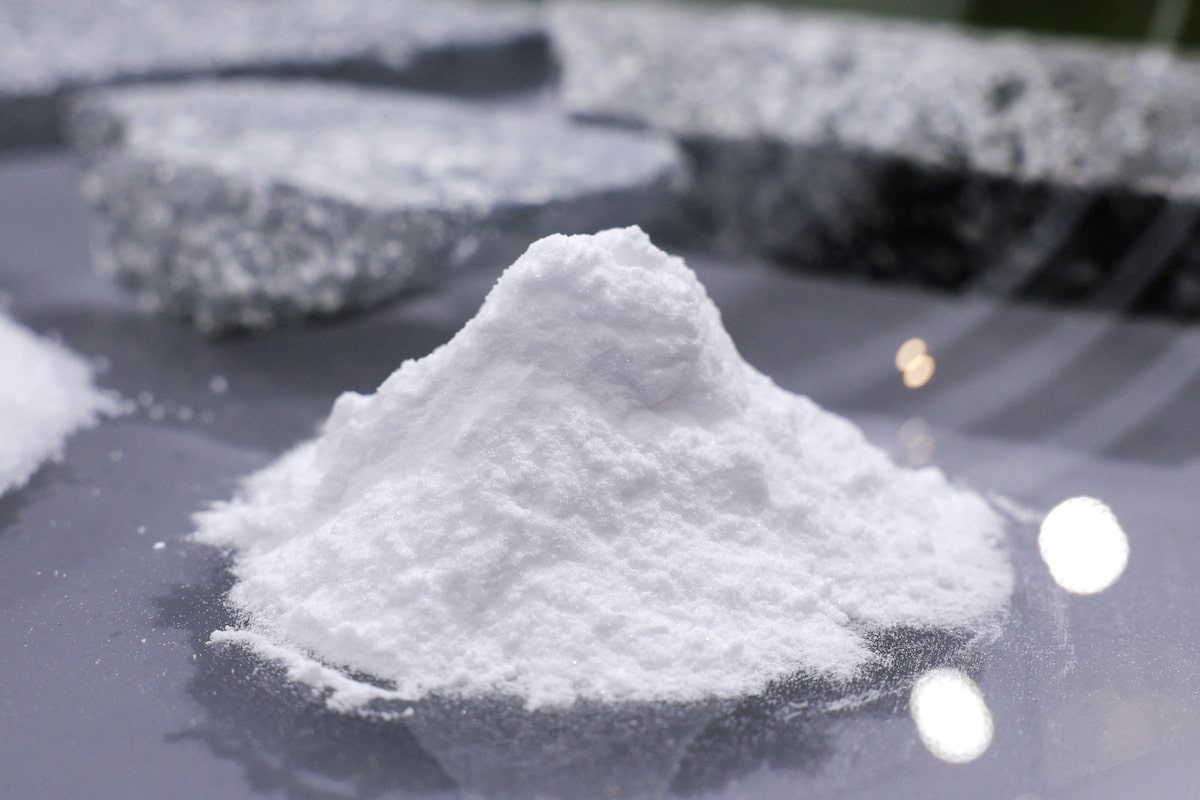
Lithium carbonate used in battery production, displayed at a mining expo in Shanghai, China, last year.Maxim Shemetov/Reuters
Ottawa is investing up to US$65-million into Canadian lithium processing company Mangrove Water Technologies Ltd. (Mangrove Lithium) as part of its efforts to bolster Canada’s critical minerals capabilities as it fights back against China’s dominance.
The investment is being made through Canada Growth Fund Inc., a $15-billion public investment vehicle. One of CGF’s mandates is to invest in Canadian critical minerals technologies that strengthen domestic supply chains for materials used in low-carbon energy such as electric car batteries.
The privately held company based in Delta, B.C., is in the process of scaling up its lithium processing plant. The current facility in Delta, which is close to Vancouver, has the ability to process enough lithium to power 25,000 electric cars, or between 5 and 10 per cent of the Canadian market. Mangrove Lithium over time hopes to build a much bigger plant in either Ontario or Quebec that would produce about 20,000 tonnes of battery grade lithium a year, or enough to power 500,000 EVs.
“This funding is going to support operations at our Delta facility,” Mangrove Lithium’s chief executive Saad Dara said in an interview. “But it will also allow us to accelerate the deployment and commercialization of the 20,000-tonnes-a-year plan.”
The company uses an electrochemical refining process that converts various unrefined forms of lithium into lithium hydroxide or lithium carbonate, which is used in electric car batteries. For now, Mangrove Lithium isn’t sourcing any lithium from inside Canada, but that could change over time, Mr. Dara indicated in the interview.
Mr. Dara co-founded Mangrove Lithium in 2017 and the company’s technology sprung out his work for his PHD from the University of British Columbia. The processing method is less environmentally invasive compared to traditional lithium refining. Instead of using harsh chemicals to extract lithium, Mangrove Lithium uses an electrical current. The technology has been used in both a pilot and commercial demonstration basis, but not yet on a fully ramped-up scale typical of a major global refinery.
Thursday’s financing is part of a bigger US$85-million funding round announced by Mangrove that also includes support from some of its earlier backers, including Breakthrough Energy Ventures, which was founded by Bill Gates, and BMW i Ventures. To date, Mangrove Lithium has raised more than US$150-million.
Ottawa in its budget late last year launched a new $2-billion critical minerals sovereign fund aimed at financing the sector.
CGF is one of several government funding arms alongside Export Development Canada and the Canada Infrastructure Bank, that are ramping up investment into Canadian critical minerals companies.
Those measures include loans and equity stakes as well as arranging price floors and offtake agreements with mining companies. Offtakes see the government buying a certain amount of a mine’s production. A price floor guarantees the company receives a minimum price for the output.
“Governments are no longer just regulators,” Pierre Gratton, president of The Mining Association of Canada said in an interview.
“They are becoming shareholders in the mining sector for economic, energy, and national security reasons.”
Mr. Gratton said that Quebec had already been a trailblazer investing heavily in its lithium sector and now the federal government is following suit with a deluge of investments in many critical minerals projects.
He said those investments should not be seen as a bailout, but as a necessary tool to help small mining companies counter unfair market practices by global players such as China.
“Many junior mining projects are “begging” for federal funding as they are desperate for capital to keep projects moving forward,” he said.
“Here’s the reality: left to the market alone, these projects will not get built. China can flood supply, drive down prices, and keep financing cheap smelting and refining, making new Canadian mines uneconomic.”
Lithium mining and processing is a prime example. China dominates the global supply chain, and Canada is a bit player, although several projects are in the works.
Canada in 2024 produced 4,300 metric tons of lithium, according to the U.S. Geological Survey, compared to 41,000 tons in China. The Tanco lithium mine in Manitoba is owned and operated by a Chinese company. China is even stronger in the processing of lithium controlling about 70 per cent of the global market, according to the International Energy Agency.
CGF has made a handful of other investments since 2023 into critical minerals companies with operations in Canada, including Nouveau Monde Graphite Inc., Foran Mining Corp. and Rio Tinto PLC’s scandium operation in Quebec.