
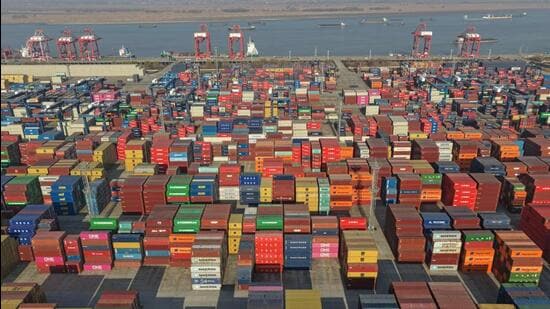
Defying global headwinds and hefty US tariffs, India’s merchandise exports increased 1.9% to $38.51 billion in December from $37.8 billion a year earlier, and 2.44% to $330.29 billion in the first nine months of fiscal 2026, which was primarily driven by double-digit export growth in key markets such as China, the US and the UAE, according to data released on Thursday.
 Crucially, shipments to the US rose nearly 10% year-on-year to $65.88 billion in April-December 2025 from $60.03 billion in the corresponding period last year. (AFP/Representational Image)
“Despite global trade turmoil, merchandise exports in December have grown by 1.86% from $37.8 billion to $38.51 billion,” commerce secretary Rajesh Agrawal said on Wednesday while releasing trade data for December and the nine-month period.
Crucially, shipments to the US rose nearly 10% year-on-year to $65.88 billion in April-December 2025 from $60.03 billion in the corresponding period last year, although December exports logged a marginal drop to $6.88 billion from $7.01 billion a year earlier and edged down from $6.92 billion in November. “US exports have grown on-year in the first nine months of the (fiscal) year,” Agrawal said, adding that “as of now” exports to the US remain in positive territory.
The resilience comes despite the Trump administration imposing a 50% additional tariff on Indian goods from August, with exemptions for electronics and pharmaceuticals helping sustain momentum. Overall exports — merchandise and services combined — grew 4.33% to $634.26 billion in the nine-month period, with services exports estimated to have jumped 6.46% to $303.97 billion from $285.53 billion.
“One thing very clear with this trajectory, we are going to cross $850 billion of exports in the current financial year,” Agrawal said. India’s exports in 2024-25 stood at a record $824.9 billion.
Federation of Indian Export Organisations (FIEO) president SC Ralhan said the performance was “particularly encouraging given the volatility in global trade flows, and reflects the effectiveness of government initiatives aimed at boosting exports and focused support to MSME exporters.”
“The performance assumes greater significance against the backdrop of ongoing geo-political tensions, supply-chain realignments, inflationary pressures and rising protectionism across major economies,” he added.
Also read: Trump slaps tariff on Iran’s trade partners. How will it impact India? | India News
China emerges as bright spot
India’s exports to China surged 37% to $14.25 billion in April-December 2025 from $10.42 billion in the same period of the previous year. “We are also doing very well in China, where the growth has been very good,” Agrawal said.
The growth accelerated sharply after the US tariff action, with December exports to China jumping 67.3% to $2.05 billion from $1.22 billion a year earlier. Indian exporters of marine products, hit by US tariffs, diversified significantly to China and other markets, the commerce secretary said.
Merchandise imports from China also rose just over 13% year-on-year to $95.95 billion in the first nine months of 2025-26.
India has also raised energy imports from the US, with purchases growing 13% to $39.43 billion in the nine-month period. December imports rose 7.57% to $3.75 billion.
Electronic goods exports increased 16.78% to $4.17 billion in December 2025 from $3.57 billion a year earlier. For the nine-month period, electronics exports surged over 35% to $35.27 billion from $26.12 billion, benefiting from exemption from higher US tariffs.
Marine products exports, despite being hit by US tariffs, registered double-digit growth through diversification. December shipments rose 11.73% to $0.81 billion, while nine-month exports grew 15.53% to $6.56 billion.
Other leading export sectors include meat, dairy and poultry products, drugs and pharmaceuticals, and engineering goods. Besides China, India’s exports are expanding in the UAE, Malaysia, Hong Kong and Spain, Agrawal said.
India’s top export destinations—the US, the UAE, China, the Netherlands, the UK, Germany, Bangladesh, Singapore, Saudi Arabia and Hong Kong—demonstrate a well-diversified and resilient export footprint, Ralhan said. “This diversification is particularly critical at a time when global trade routes are being reshaped due to geo-political conflicts, sanctions, shipping disruptions and strategic realignments,” he added.
Estimated services exports in December 2025 stood at $35.50 billion, down about 4% from $36.97 billion in December 2024. However, Agrawal said the estimate may be revised upward once actual data is collected. Services figures for December are estimates based on conservative extrapolation of the previous month’s numbers, as the central bank releases figures with a lag.
Services exports are growing faster than merchandise exports and are expected to add about another $100 billion in the last quarter of fiscal 2026, he said.
Merchandise imports grew 8.76% to $63.55 billion in December 2025 from $58.43 billion a year earlier. Cumulatively, imports rose 5.9% to $578.61 billion in April-December 2025 from $546.36 billion in the corresponding period of the previous fiscal year.
Ralhan said the higher imports of “energy products, electronics, machinery and industrial inputs are indicative of robust domestic manufacturing activity, infrastructure expansion and investment demand, which augur well for medium-term economic growth.”
While imports from China and the US surged, purchases from Russia saw a sharp fall, ostensibly because of American sanctions against the purchase of Russian crude oil. Imports from Russia declined 2.77% year-on-year to $4.16 billion in December 2025, and fell 9.41% to $44.97 billion during April-December 2025.
Globally, all countries are “re-calibrating” their supply chains, Agrawal noted.