
BEIJING — Dinner, deals and side hustles.
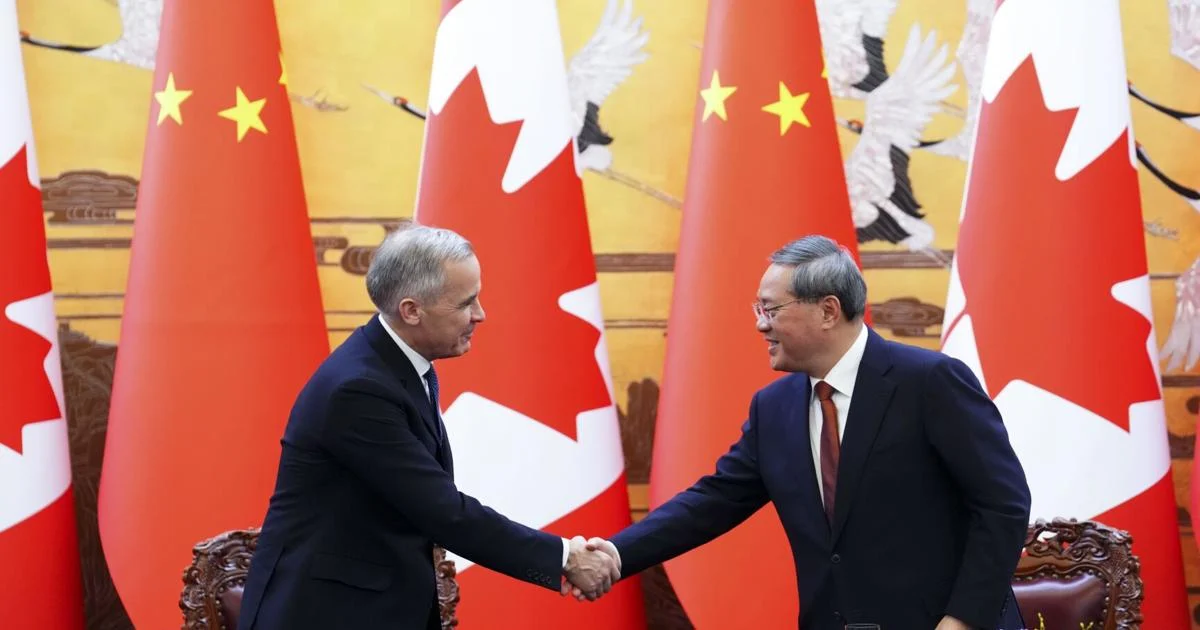
On a high-stakes trade mission to China, Mark Carney signed off on a series of deals that renewed trade ties, especially trade in Canadian oil, gas and uranium and Chinese solar and wind technology as the prime minister basked in a warm welcome he said marks a “new era.”
President Xi Jinping said his first meeting with Carney in November in Korea marked “a turnaround in the Canada-China relationship and placed it on the upward trajectory,” and said he is “heartened” by the progress.
Xi said, according to the official translator, that “a healthy and stable China-Canada relationship is in the interest of our two countries and serves the peace and stability of the world.”
Carney, in turn, said he is “extremely pleased that we are moving ahead with our new strategic partnership” that the prime minister predicted will not only deepen bilateral ties, “but will also, in my judgment, help improve the multilateral system, a system that has recently come under great strain.”
Carney underlined agreements signed here that would bring “immediate and sustained progress” in agriculture, energy and finance.
“Together, we can build on the best of what this relationship has been in the past to create a new one adapted to new global realities that will deliver greater stability, security, and prosperity to our peoples on both sides of the Pacific.”
The niceties echoed a consistent message heard throughout the past two days.
Carney, a day earlier, met Premier Li Qiang, the second-most powerful Chinese political leader, and signed off on six agreements plus two declarations to facilitate more trade inked by a slew of ministers.
One non-binding memorandum of understanding showcased their mutual objective to increase exports of Canadian oil and to boost imports of Chinese green energy technology after Carney met with a state-owned energy giant earlier in the day.
Most were renewals of agreements that had languished during the big chill in Canada-China relations for much of the past eight years.
But their renewal in what both countries said is a new geopolitical climate was hailed as a win by the Canadian side.
Carney said they will provide benefits to each nation’s people, “but also provide an example to the world of co-operation amidst a time, globally, of division and disorder” — a not-too-subtle reference to the Donald Trump-tariff-driven upheaval in global markets.
Carney’s industry minister, Mélanie Joly, put it more bluntly: “The goal is to work with China at a time when the world is full of disruption, and now, there are several countries that are more disruptive and so the goal of Canada is to work with different countries.”

As Mark Carney heads to China, Premier Doug Ford is imploring him to keep Canadian tariffs on Chinese electric vehicles.
As Mark Carney heads to China, Premier Doug Ford is imploring him to keep Canadian tariffs on Chinese electric vehicles.
“To counter the rise of protectionism, certainly American protectionism,” she said, Canada should be able to work “on approaches to free trade” with Europe, Asia and “certainly with China, because if we are not able to work in a multilateral way … we’ll be even more dependent on the United States.”
Talks went down to the wire on whether to ease Canada’s U.S.-aligned 100 per cent tariffs against Chinese electric vehicles in order to persuade China to lift punishing canola counter-tariffs launched in retaliation. It would all come down to Friday’s meeting with President Xi Jinping, the most powerful mandarin and leader of the Chinese Communist Party.
Even before any decision on the tit-for-tat tariff dispute was nailed, the Canadian team was pleased by Xi’s hosting of an official luncheon in the lush Golden Hall — a gesture not always extended to past prime ministers or other foreign leaders.
What was clear is that this trip is mostly about doing more business together.
“We’re open for business when it comes to (EV) batteries,” said Joly.
Energy Minister Tim Hodgson said the Carney government welcomes Chinese investment in crude oil production and export, saying the Chinese are “already” players in Canada’s oilsands.
But he emphasized Canada is particularly interested in innovative Chinese clean energy technology, such as that developed by Contemporary Amperex Technology or CATL, the world’s largest maker of EV batteries. “They have some of the world’s very best grid storage solutions that turns intermittent renewable energy into base load energy,” he said. The company is already involved in three large-scale grid storage projects in Ontario.
Though the agreements didn’t amount to an immediate material gain for either side, they nonetheless signal a mutual push to deepen partnerships and make progress on trade issues from both the Chinese and Canadian governments, experts told the Star.
“We basically got a political opening,” said Vina Nadjibulla, vice-president of research and strategy at the Asia Pacific Foundation of Canada. She described the early agreements of Carney’s trip as a way to create “the political tone and environment” for business opportunities to take place.
“Given the way the Chinese system works, you need that signal from the highest political level of the Chinese Communist Party, in this case (President) Xi Jinping, so that then the rest of that system can start moving. And that’s what we’re seeing here,” she said.
Lynette Ong, a professor at the University of Toronto who specializes in Chinese politics, said she’s watching for more progress during Carney’s trip — especially in areas like canola tariffs and electric vehicles.
“The oil and natural gas MOU is a good sign, it’s a good start,” said Ong, adding that it’s a sign China might be interested in importing more Canadian energy after the American raid and blockade of Venezuela, which has long sold fossil fuels to the Communist country.
As the prime minister was officially welcomed at the Great Hall of the People, a huge Canadian flag flew in Tiananmen Square next door — the first sign of China’s warm welcome to Carney, leader of a country that sharply criticized the 1989 massacre of pro-democracy protesters in the massive public square.
Inside, Carney’s arrival with a large government delegation was hailed by two top Chinese officials: Zhao Leji, chairman of the standing committee of the National People’s Congress, followed by a lengthier meeting with Li.
Both praised what Li called a “turnaround” in the Canada-China relationship and underscored what China is framing as the renewal of a “strategic partnership” — language Carney echoed.
Carney brought gifts: a spalted birch wood sculpture from B.C., and a carving of a crane made from muskox horn “symbolizing renewal, peace, partnership, and resilience,” said the PMO.
China is committed to supporting a Canadian bid to host the Asia-Pacific summit in 2029.
Carney met first with Zhao, who said that China looks forward to “new strategic guidance” from Canada on developing the strategic partnership, pointing to Carney’s upcoming meeting with Xi.
The Canadian prime minister said it was a “very important” meeting just as a new lunar year is about to begin, marking “the most auspicious start” to a “new era of relations” between China and Canada.
Carney said he is “heartened by the leadership of President Xi Jinping” and the speed with which the relationship has progressed in recent months.
He said it sets the stage for a wide range of issues where the two countries can be strategic partners, from energy, agriculture, “people-to-people ties,” multilateralism and “issues on security.”
Carney and Li said the two countries would continue to have “frank” exchanges while stressing their new-found goal of better Canada-China relations.
Ahead of Friday’s big meeting with President Xi, Carney watched as their ministers signed agreements on energy, culture, construction lumber, cultural exchanges, combating crime and easing regulatory barriers on pet food.
Li and Carney had appeared at ease together. The prime minister inspected a military honour guard and introduced the members of the Canadian delegation, which included five cabinet members. He presented Saskatchewan Premier Scott Moe, laughing as he said, “I brought a premier!” and quipping that Moe had lots of uranium.
Earlier in the morning, Carney led a string of closed-door meetings with top Chinese CEOs and executives of six leading Chinese companies, including Contemporary Amperex Technology, state-owned China National Petroleum Corporation, the Industrial and Commercial Bank of China (ICBC), which is China’s largest state-owned commercial bank and the world’s biggest bank by assets. He also met with Alibaba executives. The PMO did not provide readouts of those private sector meetings.
Li, the Chinese premier, hosted an official dinner Thursday evening for Carney after the document signing ceremony, which was marked by laughter when Agriculture Minister Heath MacDonald held his document upside down and left his counterpart hanging for the customary handshake.
The agreement on energy says deeper co-operation will “generate further commercial opportunities for the energy sectors of Canada and the People’s Republic of China” and specifies oil and gas, including crude oil, liquefied natural gas, liquefied petroleum gas and uranium.
With files from Alex Ballingall