
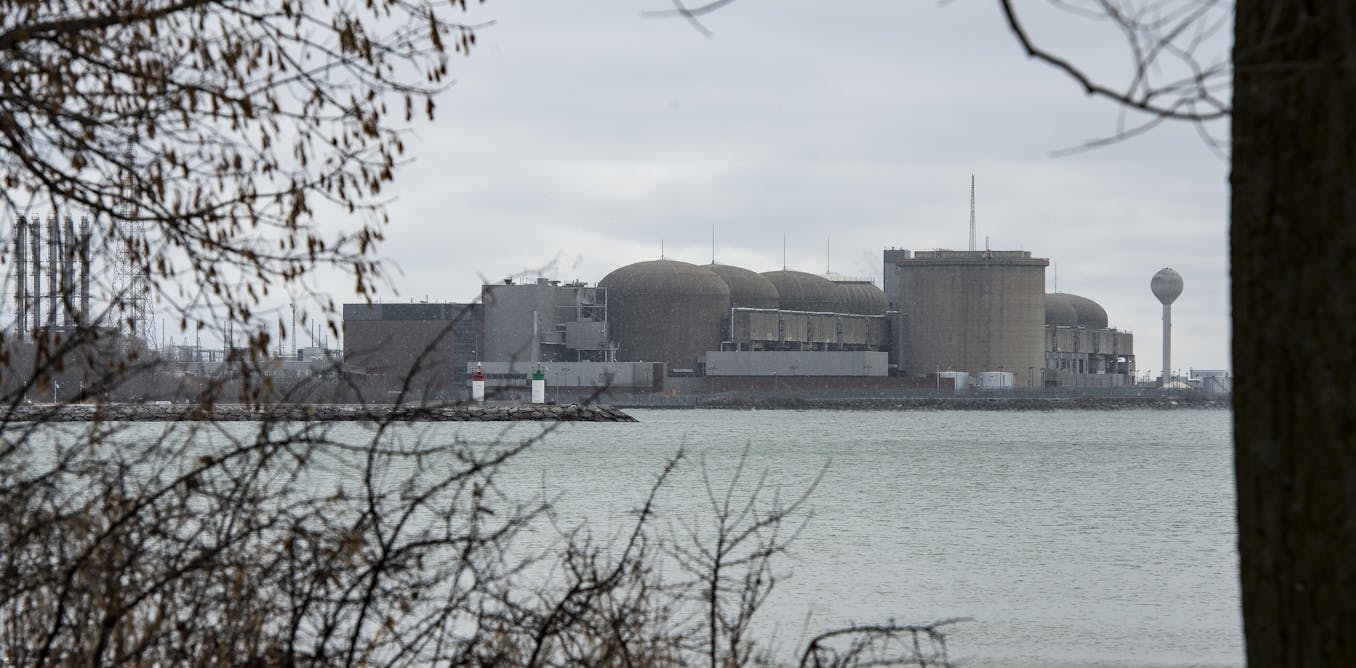
The heat produced by the radioactive waste strikes you when you enter the storage site of Ontario Power Generation at the Bruce Nuclear Generating Station, near the shore of Lake Huron in Ontario.
Massive white containers encase spent nuclear fuel, protecting me from the deadly radiation that emanates from them. The number of containers is impressive, and my guide explained this waste is stored on an interim basis, as they wait for a more permanent solution.
I visited the site in August 2023 as part of my research into the social acceptability of nuclear waste disposal and governance. The situation in Ontario is not unique, as radioactive waste from nuclear power plants poses management problems worldwide. It’s too dangerous to dispose of spent nuclear fuel in traditional landfills, as its radioactive emissions remain lethal for thousands of years.
To get rid of this waste, organizations like the International Atomic Energy Agency believe that spent fuel could be buried in deep geological repositories. The Canadian government has plans for such a repository, and has delegated the task of building one to the Nuclear Waste Management Organization (NWMO) that’s funded by Canadian nuclear energy producers.
In 2024, NWMO selected an area in northwestern Ontario near the Township of Ignace and the Wabigoon Lake Ojibway Nation as a potential site for a deep geological repository. Now, a federal review has begun bringing the project closer to potential reality.
Such repositories raise complex ethical questions around public safety, particularly given the millennia-long timescales of nuclear waste: How to address intergenerational issues for citizens who did not produce this waste but will inherit it? How to manage the potential dangers of these facilities amid short-term political cycles and changing public expectations?
Rethinking the cost-benefit calculus

The author in front of nuclear waste storage at the Bruce Nuclear Generating Station on the shores of Lake Huron in Ontario in August 2023.
(Maxime Polleri), Author provided (no reuse)
While NWMO describes the deep geological repository as the safest way to protect the population and the environment, its current management plan does not extend beyond 160 years, a relatively short time frame in comparison with the lifespan of nuclear waste. This gap creates long-term public safety challenges, particularly regarding intergenerational ethics. There are specific issues that should be considered during the federal review.
NWMO argues that the deep geological repository will bring a wide range of benefits to Canadians through job creation and local investment. Based on this narrative, risk is assessed through a cost-benefit calculus that evaluates benefits over potential costs.
Academics working in nuclear contexts have, however, criticized the imbalance of this calculus, as it prioritizes semi-immediate economic benefits, like job creation, over the long-term potential impacts to future generations.
In many official documents, a disproportionate emphasis on short-term economic benefits is present over the potential dangers of long-term burial. When risks are discussed, they’re framed in optimistic language and argue that nuclear waste burial is safe, low risk, technically sound and consistent with best practices accepted around the world.
This doesn’t take into account the fact that the feasibility of a deep geological repository has not been proven empirically. For the federal review, discussions surrounding risks should receive an equal amount of independent coverage as those pertaining to benefits.
Intergenerational responsibilities and risks
After 160 years, the deep geological repository will be decommissioned and NWMO will submit an Abandonment License application, meaning the site will cease being looked after.
Yet nuclear waste can remain dangerous for thousands of years. The long lifespan of nuclear waste complicates social, economic and legal responsibility. While the communities of Ignace and Wabigoon Lake Ojibway Nation have accepted the potential risks associated with a repository, future generations will not be able to decide what constitutes an acceptable risk.
Social scientists argue that an “acceptable” risk is not something universally shared, but a political process that evolves over time. The reasons communities cite to decide what risks are acceptable will change dramatically as they face new challenges. The same goes for the legal or financial responsibility surrounding the project over the centuries.
In the space of a few decades, northwestern Ontario has undergone significant municipal mergers that altered its governance. Present municipal boundaries might not be guarantees of accountability when millennia-old nuclear waste is buried underground. The very meaning of “responsibility” may also undergo significant changes.
NWMO is highly confident about the technical isolation of nuclear waste, while also stating that there’s a low risk for human intrusion. Scientists that I’ve spoken with supported this point, stating that a deep geological repository should not be located in an area where people might want to dig.
The area proposed for the Ontario repository was considered suitable because it does not contain significant raw materials, such as diamonds or oil. Still, there are many uncertainties regarding the types of resources people will seek in the future. It’s difficult to make plausible assumptions about what people might do centuries from now.
Communicating long-term hazards

Current governing plans around nuclear waste disposal have limited time frames which do not fully consider intergenerational public safety.
(Unsplash)
When the repository is completed, NWMO anticipates a prolonged monitoring phase and decades of surveillance. But in the post-operation phase, there is no plan for communicating risks to generations of people centuries into the future. The long time frame of nuclear materials complicates the challenges of communicating hazards. To date, several attempts have surrounded the semiotics of nuclear risk; that is, the use of symbols and modes of communication to inform future generations.
For example, the Waste Isolation Pilot Plan in New Mexico tried to use various messages to communicate the risk of burying nuclear waste. However, the lifespan of nuclear waste vastly exceeds the typical lifespan of any known human languages.
Some scientists even proposed a “ray cat solution.” The project proposed genetically engineering cats that could change color near radiation sources, and creating a culture that taught people to move away from an area if their cat changed colour. Such projects may seem outlandish, but they demonstrate the difficulties of developing pragmatic long-term ways of communicating risk.
Current governing plans around nuclear waste disposal have limited time frames that don’t fully consider intergenerational public safety. As the Canadian federal review for a repository goes forward, we should seriously consider these shortcomings and their potential impacts on our society. It is crucial to foster thinking about the long-term issues posed by highly toxic waste and the way it is stored, be it nuclear or not.