
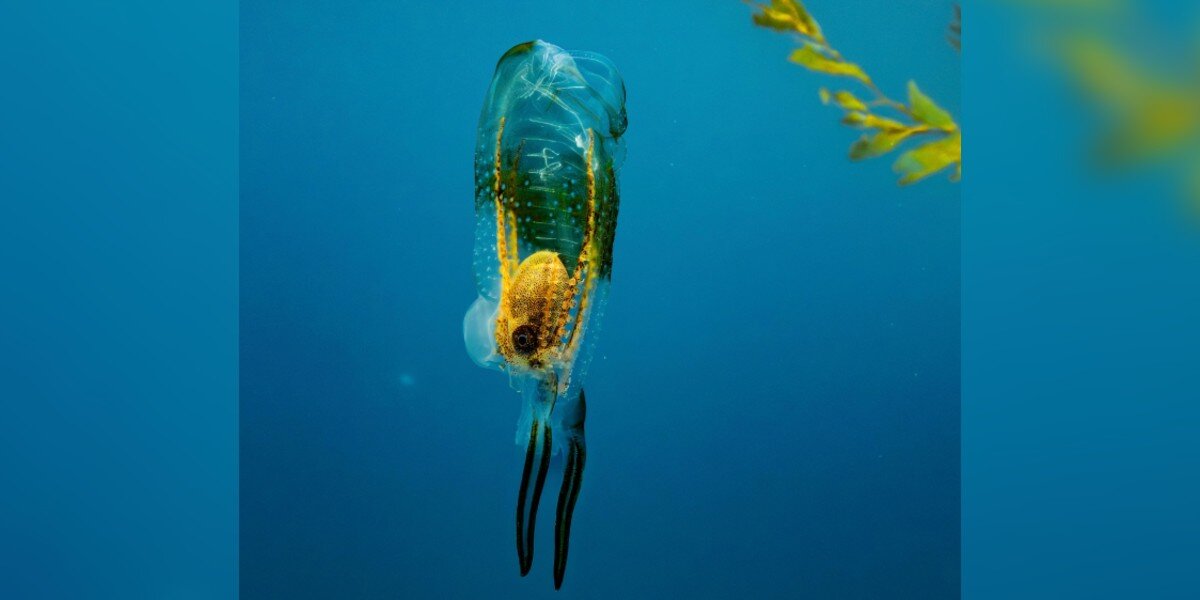
Last month, underwater photographer Henry Cooper was free-diving off the coast of Southern California when he encountered a squid-like animal. The creature had what appeared to be a clear body and an orange interior.
But Cooper, a marine wildlife aficionado, could tell there was something unusual about the “squid.” As he got closer, he realized he was actually looking at two animals: a tuberculate octopus inside of a salp.
“At first glance, it looks like a squid — but it’s actually an octopus hijacking a hollow, jelly-like salp as a drifting mobile home,” Cooper wrote on Instagram.
While everyone’s heard of octopuses, salps are less well-known, even though they’re found all over the world. Salps are filter feeders who have translucent, barrel-like bodies they pump water through to propel themselves around the ocean.
Cooper was familiar with both salps and octopuses, but had never seen an octopus living inside a salp before. After doing some research, he was shocked to learn that the behavior has only been observed a handful of times.
“It lives in open ocean — not on reefs where divers usually look — so most people will never see one,” Cooper wrote. “In 16 years of Mediterranean research, scientists only documented two.”
But what was the octopus doing inside the salp? It’s possible that the eight-legged animal was relying on the salp’s highly effective jet propulsion to get around faster. Or perhaps the octopod was looking for an extra layer of defense against predators. But no one knows for sure.
“Scientists still can’t fully explain why they do this,” Cooper wrote. “Protection? Camouflage? Free transportation? No one’s sure. The behavior has barely been documented because sightings are so rare.”
What researchers do know is that only adult males and juvenile tuberculate octopuses live inside salps. Full-grown male tuberculates are only about 10 inches long, while the females are over 3 feet long, making them too large to fit inside a salp body.
Hopefully, future studies will reveal more to us about the special relationship between tuberculate octopuses and salps. Cooper feels lucky to have witnessed such a unique and rare natural phenomenon firsthand.
“I’m still processing it,” Cooper wrote.
