

To print this article, all you need is to be registered or login on Mondaq.com.
Article Insights
Curtis A. Cusinato’s articles from Bennett Jones LLP are most popular:
within Corporate/Commercial Law topic(s)
with Inhouse Counsel
in Canada
with readers working within the Technology industries
The value of Canadian M&A transactions surged in 2025,
driven primarily by large cap deals and an acute focus on
infrastructure and resources. Total deal value last year was US$118
billion higher than 2024 on slightly fewer deals. Transaction value
hit a remarkable US$131 billion in the third quarter of
2025—the highest three-month tally since Q4 2020, according
to S&P Global Market Intelligence.
It is the same story globally. Bloomberg data highlights that
megadeals pushed M&A transaction value to a near-record US$3.6
trillion last year. This total is 38% higher than 2024 and second
only to 2021.
In our year-end update on Canada’s M&A landscape and
look-ahead to 2026, we provide key takeaways from the latest data
and market trends and examine:
the dynamics of large cap deals in Canadian M&A this past
year
challenges that remain in Canadian dealmaking
how infrastructure is taking centre stage in Canada
mid-market activity and what to watch out for in 2026 in
Canada
the Canadian credit markets in 2025 and what’s ahead in the
coming year
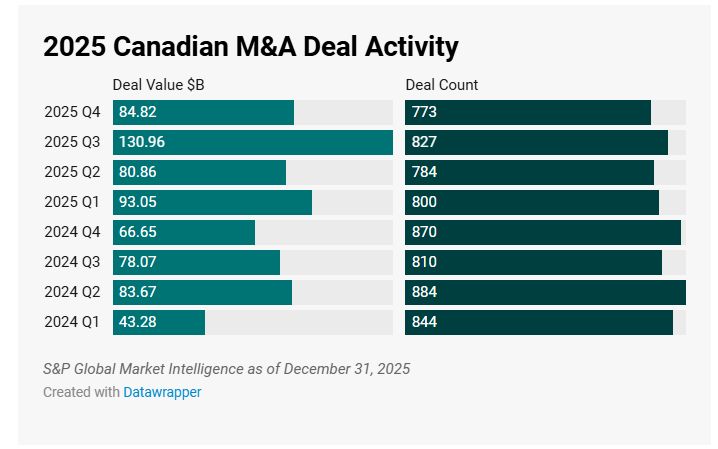
The aggregate value of announced or completed Canadian M&A
deals reached US$389.69 billion in 2025, surpassing the total from
2021. Large cap transactions drove this increase as the number of
deals decreased. We take a closer look below at the dynamics of
large cap dealmaking in Canada this past year.
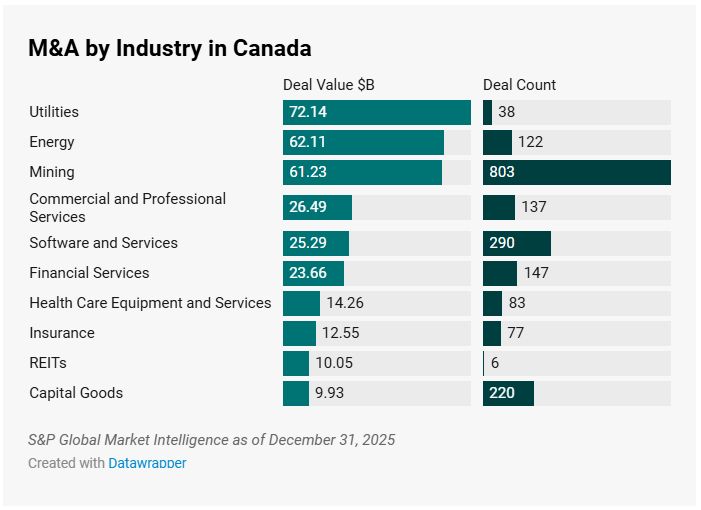
Utilities, energy and mining were the most active Canadian
industries, with a combined deal value of US$195.48 billion. This
is just over half of total Canadian M&A value in 2025. The
aggregate value of utilities deals rose by 82% in 2025 YOY, energy
is up by 257% and mining increased by 220%. Actual deal count
declined in all three industries last year.
The increased activity in these industries is not surprising
given the focus on digital assets and the intense demand for energy
and infrastructure resources. Globally, data center M&A and
investment set records in 2025, with more than US$61 billion
flowing into this market.
Gold had a standout year as Canadian deal value in the sector
more than tripled. In 2025 there were 8 gold transactions worth US
$1 billion or more—compared to 1 in 2024. Bloomberg reported
that globally, metals and mining M&A deal activity is up 61%
this year and 139% in North America alone.
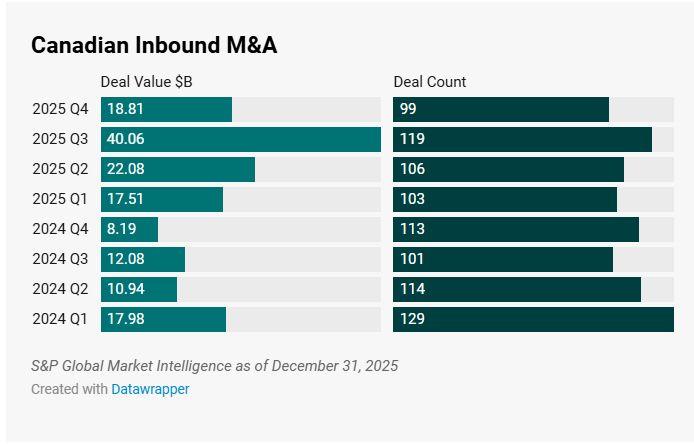
Canadian inbound M&A shot up in 2025, despite the continued
uncertainties and challenges to the country’s economy. Deal
value doubled to US$98.45 billion from US$49.19 billion in 2024, on
slightly fewer deals. Last year, there were 16 inbound deals worth
US$1 billion or more. In 2024, there were 12. Outbound
M&A—where a Canadian organization is the buyer or
investor and the target is outside the country—edged
higher.
Large Cap Deals Drive Canadian M&A in 2025
The surge in higher-value, strategic transactions has been the
most prominent trend in the Canadian M&A market throughout
2025. Publicly announced or completed M&A deals worth US$1
billion or more where a Canadian company is the acquirer, target or
seller totaled US$321.9 billion, according to S&P Global data.
This is an increase of 62% from last year and a staggering 130%
jump compared to 2023. The number of billion-dollar deals spiked to
78 in 2025—up from 54 in 2024 and 52 two years ago.
Key market drivers of the large-cap M&A trend include
strategic consolidation by large corporations to enhance market
positions, favourable financing conditions due to easing interest
rates and increased private equity investment as a result of
significant amounts of undeployed capital.
While large-cap M&A activity has spanned a variety of
Canadian industries this year, a particular concentration of
high-value deals has occurred in the energy, natural resources,
financial services and infrastructure sectors.
Large-cap M&A activity in the energy and natural resources
sectors has been fuelled by significant investment in energy
transition and critical minerals, the strong balance sheets of
large industry players, efficiency-driven consolidations aimed at
operational synergies and enhanced scale and the strategic desire
of companies to secure reliable supply chains amidst ongoing
geopolitical uncertainty.
Major energy transactions this year included:
A notable large-cap renewable infrastructure deal in the year
was
British Columbia Investment Management Corporation (BCI)’s
£1.0 billion take-private acquisition of BBGI Global
Infrastructure S.A.
Challenges Remain in Canadian Dealmaking
Despite the rise in large-cap M&A deals in the year,
dealmakers in Canada continue to navigate ongoing regulatory
scrutiny, tariff uncertainty and economic and political volatility.
High-value deals are being creatively structured and carefully
drafted to pre-empt and mitigate these risks.
New deal protections have been introduced into the Canadian
marketplace to address new risk profiles for possible national
security reviews under the amended Investment Canada
Act, to quell uncertainties around tariffs and
tariff-related legal issues, and other specific industry deal
protections where regulatory, trade, economic or other
uncertainties continue to prevail.
Infrastructure Takes Centre Stage
The vision for infrastructure development in Canada is an
ambitious one. The country’s strategy to be globally
competitive now depends on getting massive projects built quickly
and attracting billions of dollars in private sector
investment.
The federal government abruptly shifted its policy in 2025 on
advancing nation-building projects and launched the new Major
Projects Office (MPO) in late August. Since then, two tranches of
projects have been referred to the MPO in energy, critical minerals
and trade corridors.
Investors are keenly aware of the opportunities in Canada. The
head of North American Infrastructure for US private equity giant
KKR told The Globe and Mail in December,
“In the key sectors that are driving the biggest growth, be
it energy, digital infrastructure, both Canada and the U.S. should
play a really big role going forward. You have these two
mega-themes that are probably the two biggest ones bearing down on
the economy broadly, and they both squarely hit on
infrastructure.”
We similarly view the Canadian infrastructure industry as
remaining a key barometer of foreign investment and a leading
driver of M&A activity in Canada in 2026.
Canada’s Mid-Market
M&A activity in Canada’s mid-market (US$20
million
Mining was the most active industry by far with US$10.58 billion
in mid-market deals in 2025—with gold accounting for 54% of
this activity. Financial services came next, followed by software,
energy, capital goods and pharmaceuticals, biotechnology and life
sciences.
The defence industry will be one to watch in 2026, especially in
private capital dealmaking. Investment in defence and dual-use
technologies is accelerating as government policy initiatives push
the industry into the mainstream. We have previously written on
the
spike in global VC deftech deal value in this new era for
defence.
Trends in the Canadian Credit Markets
As we look back at 2025 and into 2026, we see several trends in
credit markets and M&A financing which have been developed over
the past decade and continue to reshape how acquisition debt plays
through M&A.
The practical takeaway is that credit is increasingly accessible
and available on economic and deal terms that are conducive to
transacting for both strategic and financial buyers. What that
credit looks like, and from where it is sourced, may differ
depending on several factors, including transaction value and
nature of the buyer (corporate strategic vs sponsor).
Today, private credit has a seat at the table in almost any
discussion around acquisition financing options in Canada. South of
the border, PE direct lenders have emerged as a viable and robust
option to traditional banks in financing acquisitions of all types
and sizes, from mega deals to small-cap. It is now common to see
US-based direct lenders as the sole financing source (either in
club structures or unilaterally) on inbound cross-border M&A
transactions.
In Canada, our banks continue to be comparatively conservative
in their leveraged acquisition underwriting standards. However,
they remain the usual acquisition financing option for their key
relationship large corporates and top tier Canadian sponsors. That
said, hybrid debt financing stacks are often seen in Canadian
middle market sponsor-driven transactions, with banks providing a
senior financing solution and private credit filling in the junior
or mezz piece required to complete the transaction. The private
credit option, which is now an entrenched part of the broader
credit market, offers buyers an alternative that fills gaps left by
banks constrained by regulation, risk tolerance or other
underwriting limitations, and terms which may be more flexible and
buyer friendly.
With rates continuing to improve (even if still above their
Covid historical lows) and credit markets continuing to be robust
and evolving in ways which will help facilitate transactions,
access to credit will be a key driver to continuing strength in
M&A activity in 2026.
Looking Ahead
Predictions for M&A activity in 2026 are positive but
nuanced. Many dealmakers expect to see the trends of larger
transactions and certain key industries in Canada remain in high
demand in 2026. The AI boom is driving growth far beyond the
technology sector and the level of investment in data centres and
the infrastructure that supports them is astounding. In particular,
we expect there will be continued growth in AI for certain
participants in this industry, including equipment, cooling
systems, structural and other integral products.
That said, the outlook for the global economy is unsettled and
trade tensions continue. In Canada, regulatory scrutiny remains a
concern and our economic relationship with the US is still in flux.
And as we saw in 2025, unexpected policy announcements can change
the dealmaking landscape quickly and profoundly.
While the path ahead requires a steady hand, the abundance of
high-quality opportunities suggests that 2026 is well-positioned to
be a year of strategic growth in dealmaking.
The content of this article is intended to provide a general
guide to the subject matter. Specialist advice should be sought
about your specific circumstances.