
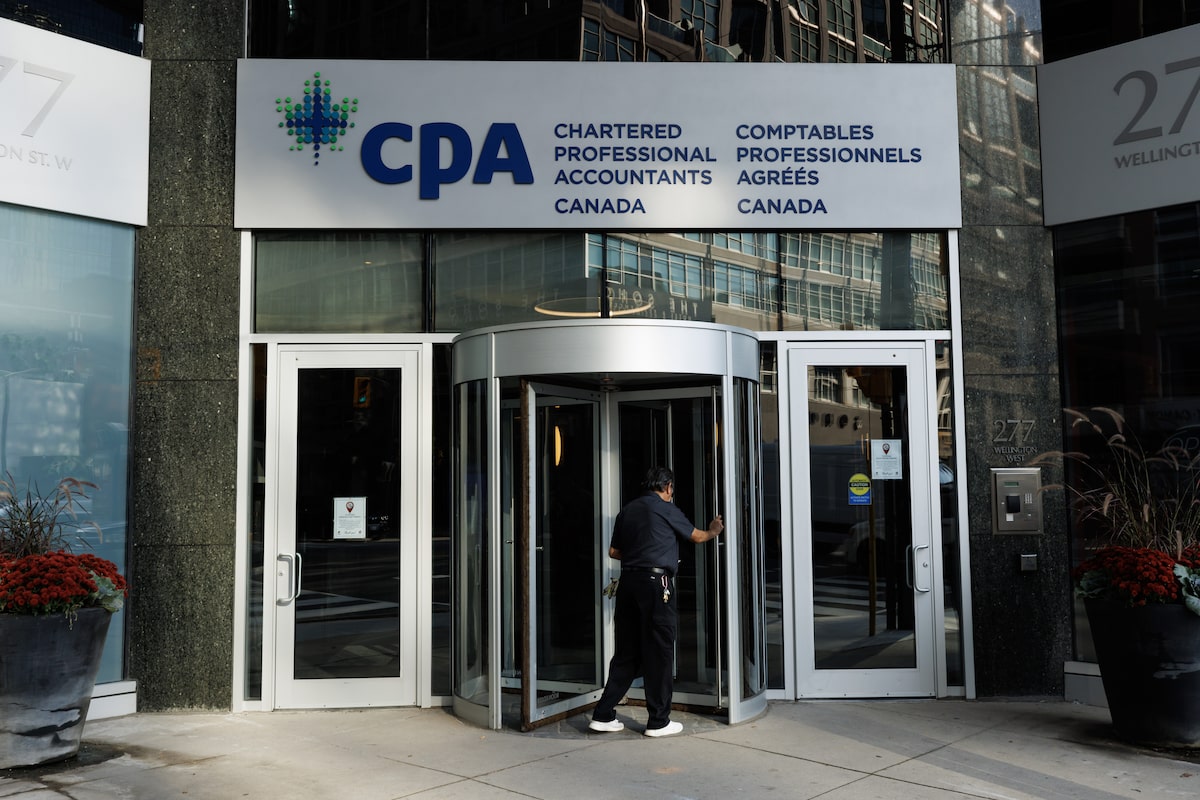
Chartered Professional Accountants of Canada’s headquarters in Toronto on Oct. 6, 2023.Cole Burston/The Canadian Press
Canada’s seven largest accounting firms will sign up their employees to join the national umbrella organization under a new membership model this spring.
The move comes as individual accountants will be able to sign up directly with the Chartered Professional Accountants of Canada, or CPA Canada, as of April 1. In the past, they had to be registered with a provincial regulator. It’s a major shift for the accounting industry, which represents more than 220,000 CPAs.
Currently, under a legal agreement between the provincial and territorial regulators and CPA Canada, the regulators are direct members of CPA Canada and pay fees for all their registrants, the CPAs, to have access to CPA Canada services.
But after a contentious departure of two provincial regulatory bodies – CPA Ontario and Quebec CPA Order – from CPA Canada’s membership at the end of 2024, the national organization’s funding drastically declined.
After months of discussions with the remaining provincial and territorial bodies, all parties – including CPA Canada – agreed last fall to end the collaboration accord for all provinces and territories as of April 1, 2026.
2024 Opinion: It’s for the best that CPA Canada is rid of Ontario and Quebec bodies
Going forward, the CPA Canada will no longer receive any member dues from the provinces or territories directly. Instead it will shift its operational model to become a fully voluntary national body.
The move was widely supported by the overall industry, including the seven largest accounting firms in the country.
On Thursday, CPA Canada announced accountants who are employed at BDO Canada LLP, Deloitte LLP, Doane Grant Thornton LLP, Ernst & Young LLP, KPMG LLP, MNP LLP and PricewaterhouseCoopers LLP, will now become individual members of CPA Canada as of April 1.
For $200 annually, plus voting rights, CPA Canada will offer all individual chartered professional accountants across the country a membership. Accountants are no longer able to go through their provincial regulatory body to qualify as members of CPA Canada.
“A unified national body gives CPAs a strong voice and reinforces trust – ensuring Canadian CPAs remain globally respected,” CPA chief executive Pamela Steer said in an e-mail to The Globe and Mail.
In addition to the firms, the Canadian Public Accountability Board (CPAB), a regulator that oversees public accounting firms that audit publicly traded companies and FP Canada, a non-profit trade association with about 17,500 certified financial planners, said they also support their individual CPAs in remaining members of the national CPA body.
Ontario accountants advocate for tax system overhaul in new report
Carol Paradine, chief executive of CPAB, said her organization will fund CPA Canada membership fees for all CPAB members who hold a CPA designation.
“CPA Canada provides important guidance and practical support on the application of auditing standards,” Ms. Paradine said in an e-mail to The Globe.
FP Canada chief executive Tashia Batstone said as a national professional body, CPA Canada plays “a critical role in advancing harmonized standards and elevating Canada’s influence on the global stage.”
Provincial accounting groups, such as CPA Ontario, using the CPA banner are responsible for protecting the public through regulation and discipline of accountants. (In Quebec, the provincial government does this.) CPA Canada oversees the exam for chartered accountants, manages the CPA Canada Handbook – a national reference point for Canadian accounting and assurance standards, and advocates for accountants nationally.
The departures of Ontario and Quebec financially affected CPA Canada’s operations, because the terms of the collaboration accord only allowed CPAs to join CPA Canada through their provincial regulators. In early 2024, CPA Canada had to cut 20 per cent of its staff in advance of the pullout of all its Ontario and Quebec members.
2024: CPA Canada cuts staff in advance of Ontario, Quebec exit
Following their departure, Ontario and Quebec agreed to continue to separately pay fees to CPA Canada for educational services.
CPA Canada was born Jan. 1, 2013, with a new “chartered professional accountant” designation. Previously, the profession in Canada was divided by function: Certified general accountants, certified management accountants and chartered accountants had different jobs, certification programs, regulations – and their own national associations.
The three groups proposed a unification framework in 2012, and by late 2014, all three had become part of the new CPA Canada.
That agreement began to crumble in June, 2023, when Quebec CPA Order and CPA Ontario separately announced their intentions to end their formal relationship with CPA Canada.
As of April 1, all provinces will continue to pay for education and practice standards.
“A national member body ensures CPAs have a collective voice in shaping their profession – supporting excellence and global relevance,” CPA Canada’s Ms. Steer said.
Bruno Suppa, CEO of BDO Canada, told The Globe he believes it is important for all of its CPAs to be connected to both the provincial and territorial CPA bodies and CPA Canada.
“BDO acknowledges the important role of the provincial and territorial CPA bodies in the regulatory oversight of the profession, as they uphold the high standards required of CPAs while advancing confidence in the profession,” Mr. Suppa said.
EY Canada partner, Darrell Jensen, said the firm remains committed to supporting “the important yet distinct roles” of a strong national member-based professional body, and the provincial and territorial CPA bodies, as “they support the integrity of the public accounting and auditing profession and Canada’s capital markets.”