
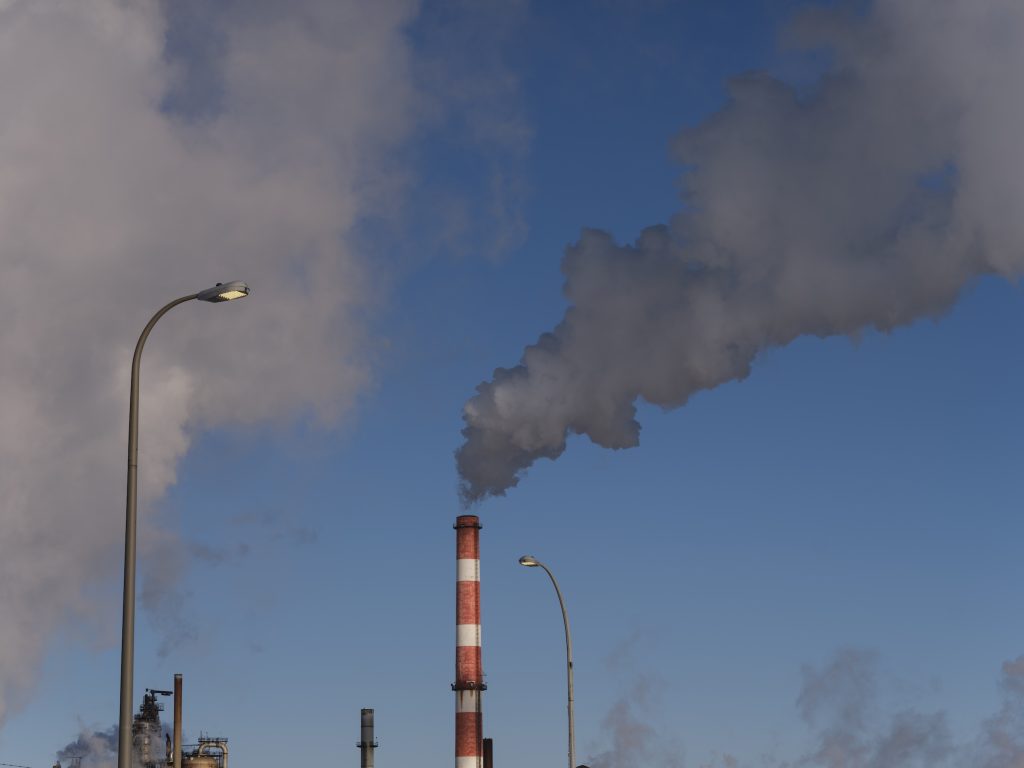
Alberta can have another pipeline to the West Coast — at least theoretically — but only if the oil and gas industry puts carbon capture systems in place to ensure the bitumen that flows through it is “low-emission.”
That tradeoff is at the heart of the “grand bargain” unveiled by Alberta Premier Danielle Smith and Prime Minister Mark Carney in November 2025, when they both expressed support in principle for a new pipeline to connect Alberta’s landlocked oilsands to international markets.
What will make this bitumen cleaner than what currently flows through Alberta’s pipelines? The answer has nothing to do with the product itself, but with the processes that will be used to create it.
According to the terms of Smith and Carney’s memorandum of understanding, the federal government’s support for Alberta’s new pipeline is contingent on the success of a massive carbon capture project being pitched by the Pathways Alliance, a coalition of Canada’s major oilsands companies.
If Pathways companies build the carbon capture infrastructure they’re promising, and use it to “decarbonize the production of their bitumen,” to use Smith’s words, then they can have their new pipeline and ship their product to their collective hearts’ content, the prime minister has promised. (That is, of course, if a company or consortium signs on to acquire the necessary approvals and actually build it — the memorandum stipulates the pipeline will be built by the private sector, with opportunities for Indigenous co-ownership.)
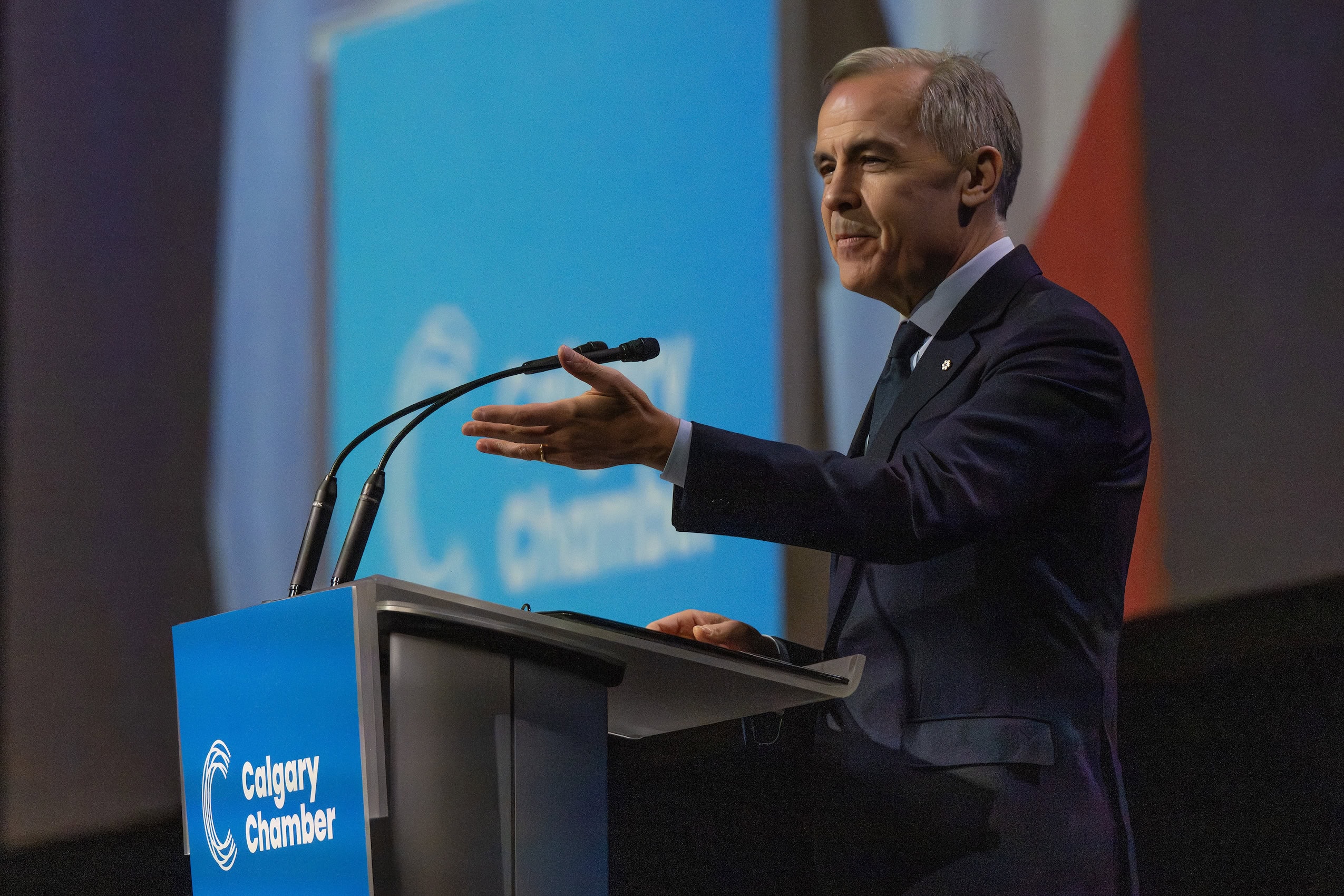 Prime Minister Mark Carney speaks at the Telus Convention Centre in Calgary on Nov. 27, 2025, the same day he signed a memorandum of understanding with Alberta Premier Danielle Smith expressing support for a new pipeline that would increase bitumen exports from the oilsands. Photo: Gavin John / The Narwhal
You’re likely to hear a lot more about carbon capture technology, now that Carney has adopted it as a key strategy to thread the needle and reduce Canada’s emissions without forgoing the economic benefits of the nation’s number one export. His office identified the Pathways carbon capture project as a contender for a federal “major project” designation late last year, meaning it could see fast-tracked federal approvals, and his government has extended Trudeau-era subsidies for constructing carbon capture projects.
So, what is carbon capture? And can it really save our planet from the worst impacts of climate change? Read on to find out.
What is carbon capture and storage?
Technologies to lower carbon emissions from industrial processes, which Carney and other politicians are embracing, are known as carbon capture, utilization and storage — often abbreviated as CCUS or CCS.
These technologies capture carbon before it escapes into the atmosphere, and then bury it deep underground (“storage”) or repurpose it to make other products (“utilization”). These systems are often designed with the goal of capturing 90 per cent of the emissions produced by an industrial process — but early carbon capture projects in Canada have failed to achieve that threshold.
Captured carbon can’t be stored just anywhere. The process requires a porous rock formation deep underground into which the carbon can be injected. On top of that, an impermeable “cap-rock” layer is necessary to seal the carbon in for centuries to come.
In many cases, sites where oil has previously been removed prove suitable for carbon storage. That’s one reason why the Prairie provinces have so far been the epicentre of carbon storage activities in Canada. According to one estimate, Saskatchewan and Alberta are home to approximately nine per cent of the total onshore carbon storage capacity in North America.
But the search is on for “pore space” elsewhere, too. The Ontario government has identified the lakebeds and shorelines of lakes Erie and Huron as potential carbon storage locations.
In addition to projects that capture carbon as it’s emitted, there is also technology under development that sucks carbon right out of the air. That’s called direct air carbon capture. It is a less developed and less proven technology, but some companies are trying to make it work — including Deep Sky, a venture capital-funded startup that wants to build a direct air carbon capture facility in rural Manitoba.
What projects already exist? And what is the Pathways Alliance planning?
There are a few dozen carbon capture, utilization and storage projects in operation around the world, but they’ve yet to reach a scale that would make a meaningful dent in emissions. According to the Global CCS Institute, existing projects have the capacity to capture about 64 million tonnes of carbon per year — that’s about 0.1 per cent of global emissions. A recent study estimated that more than 383 million tonnes of carbon dioxide have been stored underground worldwide since 1996.
Comparatively, the latest federal figures show annual emissions from Alberta’s oilsands were 89 megatonnes in 2023, with the broader oil and gas sector in Canada contributing 208 megatonnes of carbon emissions in that year.
The Pathways Alliance proposal doesn’t include the actual capture of any carbon. Rather, it’s a plan for a shared carbon transportation network and storage facility, with individual companies expected to build their own infrastructure for capturing carbon at their facilities and feeding it into the Pathways network. The companies stated in 2023 that their project could lead to a net reduction of between 10 and 12 megatonnes of emissions per year by 2030.
A handful of the world’s carbon capture and storage projects are already located in Canada.
Cumulatively, Canadian carbon capture and sequestration projects stored roughly five megatonnes in 2023, according to federal figures. That is a small fraction of what the projects were predicted to store. That number doesn’t account for all the carbon that was captured: some is injected into the earth to help extract more oil, a process known as enhanced oil recovery.
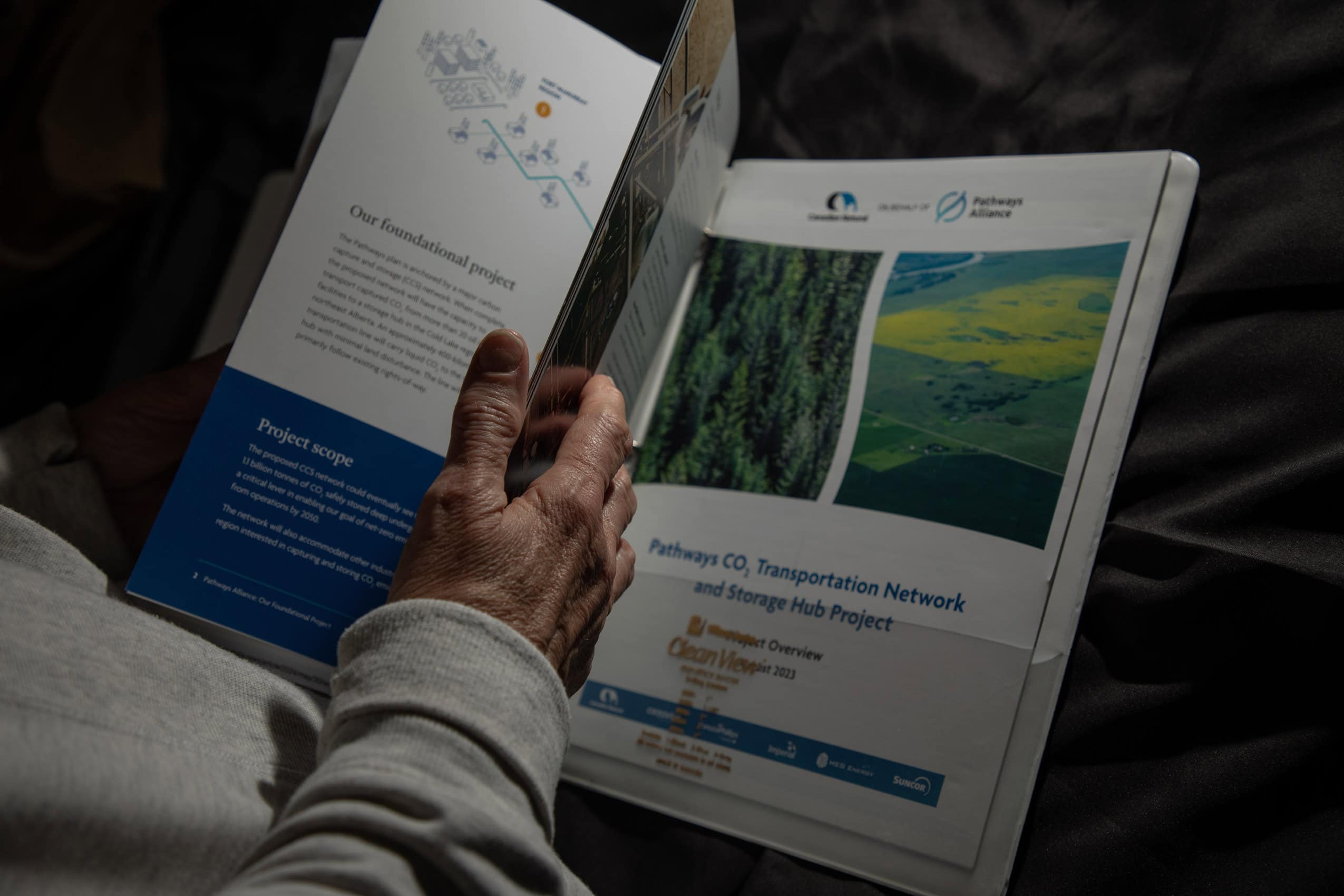 The Pathways Alliance is pitching its plan for a carbon transportation network and storage facility as a way to lower the environmental impact of oilsands operations in Alberta. But the plan does nothing to address the majority of emissions produced by their oil products. Photo: Amber Bracken / The Narwhal
In Alberta, Shell Canada’s Quest project has been in operation for just over a decade. Quest syphons carbon from one of the company’s Edmonton-area plants and transports it by pipeline to a storage area where it’s injected and stored more than two kilometres underground. The project, which cost more than $1 billion to build, captures and stores about one million tonnes of carbon each year.
Also in Alberta, the Carbon Trunk Line hauls captured carbon from a fertilizer plant and a refinery and pipes it 240 kilometres south to old oil reservoirs. The pipeline has the capacity to transport up to 14 million tonnes of carbon per year, though it only transported 1.5 megatonnes in 2023.
In Saskatchewan, the best-known carbon capture project is the Boundary Dam coal-fired power plant, operational since 2014 and the world’s first commercial-scale coal plant with the technology. Carbon from the Boundary Dam is transported by pipeline to a largely depleted oil field near Weyburn, Sask., where it is injected into reservoirs to loosen up the remaining oil. The plant has never achieved its original goal of capturing one megatonne per year, but it was also an early demonstration project.
How are Canadian governments supporting carbon capture technology?
By paying for it.
The cost to build carbon capture, utilization and storage facilities typically runs into the billions of dollars. Then, there are operational expenses. A 2025 analysis found Alberta’s two major carbon capture and storage facilities each cost tens of millions of dollars per year to operate.
Alberta’s oilsands companies — which collectively posted more than $29.1 billion in profits in 2024 — find those costs too high. The Pathways Alliance has stated on its website that its carbon capture plan “will require ongoing collaboration” with governments, including “making significant investments together.” In theory, carbon pricing should encourage more carbon capture projects, as the more expensive carbon emissions are, the more likely a company is to implement emission reductions strategies.
Yet in 2024, Edmonton-based power generator Capital Power abandoned its plans for a facility, saying carbon capture and storage was “not economically feasible.”
If the industrial carbon tax is a stick, our governments are also dangling carrots in front of major polluters in the form of subsidies.
Under former prime minister Justin Trudeau, the federal government introduced a refundable tax credit that subsidizes up to 50 per cent of the cost of eligible carbon capture, storage and utilization projects. The tax credit first became available in 2022, and the Parliamentary Budget Office has estimated its cost will rise to more than $2 billion per year by 2027-28, as companies start to build their projects and take advantage of the subsidy.
The Alberta Carbon Capture Incentive Program, meanwhile, provides additional provincial grants to companies building carbon capture projects in Alberta.
In Carney and Smith’s memorandum of understanding, both the federal and Alberta governments committed to extending their respective incentive programs to support the Pathways project, which means a significant portion of the megaproject’s $16-billion price tag is likely to be publicly funded. That agreement also included a provision that tax credits for carbon capture extend to projects for enhanced oil recovery — which was previously excluded, as the Trudeau government responded to critics pointing out that extracting more oil results in more carbon emissions not just during production, but when the fossil fuel is eventually used by consumers.
Can carbon capture technology make a dent in climate change?
On its own? No.
Combined with other efforts, especially an overall reduction in fossil fuel use? It might help a little.
The United Nations Intergovernmental Panel on Climate Change has said the technology has the potential to decrease global emissions, but not by anywhere near as much as transitioning to renewable energy sources such as wind and solar. It’s also a more expensive mitigation strategy than moving to renewables.
According to the International Energy Agency, carbon capture, utilization and storage could achieve eight per cent of the emissions reductions needed to reach net-zero in the energy sector by 2050.
In Canada, the oil and gas sector accounted for 30 per cent of the country’s greenhouse gas emissions in 2023; reducing the sector’s emissions through carbon capture, utilization and storage would be a win.
But there’s a catch. That accounting only considers carbon emissions from the industrial processes that make oil and gas products — not the emissions associated with their use.
It’s important for an oil refinery to reduce its own emissions, but carbon capture projects don’t address the emissions produced by the car that eventually burns the fuel produced by that refinery. This is a big deal, because most of the carbon footprint associated with a barrel of oil — 70 to 80 per cent, according to one estimate — comes from the oil product’s end use. In Canada, the highest emitting industry after oil and gas is transportation.
That’s why carbon capture and storage isn’t a silver bullet in the fight against climate change. According to the World Resources Institute, the Intergovernmental Panel on Climate Change’s latest report makes clear there are “no scenarios in which [carbon capture, utilization and storage] would allow continued use of fossil fuels at current levels, let alone expanded oil and gas production.”
The Alberta government estimates the province has about 160 billion barrels of oil still available for extraction in the oilsands. The new pipeline — if it ever gets built — will drastically increase the amount of bitumen that can be shipped to international markets.
By that time, Canada’s billion-dollar investments into carbon capture, utilization and storage technologies might have helped clean up the industries that produce oil in Alberta. But they will have done nothing to address the bigger problem: the use of the oil products themselves.
— With files from Drew Anderson and Carl Meyer