
Last fall, I was invited to a boxing class for blind adults. The invitation sparked a lot of questions, both logistical and personal. I wondered how you demonstrate proper form for people who can’t see what a punch looks like. I thought about navigating a boxing ring with low vision. But mostly, I asked myself whether I was comfortable attending at all.
When I started losing my sight in my teens, athletics was one of the first things to go. A lack of depth perception meant it was harder to catch a ball or throw with any accuracy. I stopped being able to reliably find a puck on the ice. Frustrated with the changes, I dropped out of all organized sports. While I exercise on the regular as an adult, sports still feel out of reach.
I have an eye condition called keratoconus. It causes the cornea to thin and bulge outward, resulting in an irregular astigmatism. My eyesight is like looking through a car window in the rain. There are light halos and fuzzy edges. A slight double vision and bleeding colours.
Coach Pharrell Shaymar, left, helps Kamini Rodhan find the right pair of gloves at a boxing class for individuals who are blind or living with sight loss.
My keratoconus has advanced to the point where my vision can no longer be corrected through glasses or contacts. I can’t drive and need some access modifications to my phone and computer. But I’ve organized my life so that most of the time, my vision loss isn’t that big of a deal. Still, when pushed outside of my comfort zone – navigating an excel spreadsheet or finding a gate at the airport, for example – I’m easily frustrated. I get short-tempered and defensive. My impulse is to avoid those situations entirely.
I wasn’t invited to the boxing class because of my eyesight. I was invited because of my accessibility coverage for The Globe. After a lot of internal back and forth – I didn’t want to misrepresent myself as legally blind or bring personal baggage to a morning workout – I decided to go. The thought process being that if there was any place I’d be able to actively participate in a sport, this was probably it.
The boxing class was offered by Balance for Blind Adults, a Toronto-based non-profit that supports people with sight loss. Some of their standout programs involve physical activities – think dance, yoga and self-defence classes. Before attending, I spoke with the Balance team to talk through some of the logistics.
“Boxing is one of those things that can be made accessible pretty easily,” said Michelle McQuigge, the organization’s chief executive. Many of Balance’s clients struggle with gyms owing to touch-screen fitness machines and busy spaces with cramped equipment. Because boxing is a body-weight workout with minimal gear, most drills can be modified by emphasizing sound and touch. “All you have to do is describe things differently,” she said.
McQuigge – who has been blind since she was nine months old – participated in the boxing program herself. She talked me through how the class is run. The program’s instructors, Savoy Howe and Pharrell Shaymar, offer a series of drills on heavy bags and in the boxing ring, with an emphasis on non-visual language. They can modify the exercises based on each individual’s needs.
Many people still have the misconception that blindness means complete darkness, but vision loss exists on a spectrum. According to research from the Royal National Institute of Blind People, the majority of legally blind people experience some visual stimuli. That can mean everything from experiencing only light and shadows to large spots covering a portion of your sightline to extremely blurred vision. McQuigge noted that the boxing training felt significantly different from her day-to-day movements.
She mentioned dropping extra tension in her shoulders and attempting to find a fluidity while throwing punches. She also said the best way to understand the class was probably by experiencing it for myself.
Many people still have the misconception that blindness means complete darkness, but vision loss exists on a spectrum.
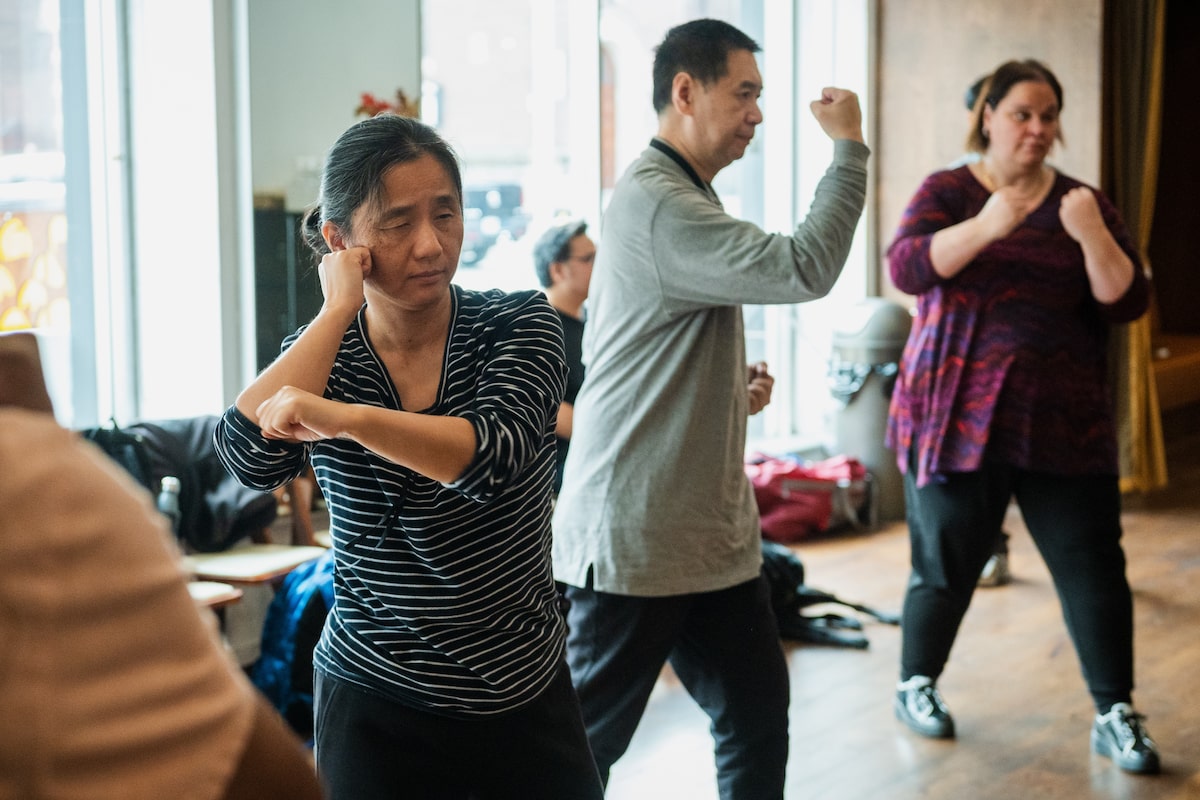
The class took place at United Boxing Club in Toronto’s west end, which hosted Balance for the duration of the six-week program. After arriving at the gym, the instructors situated us in the space. A few guide dogs sat patiently in the corner as the 10 participants were spaced out arms-length apart to make sure no one caught any unintentional blows. From there, Howe and Shaymar began calling out instructions for punches, footwork and body movements.
Some descriptions resonated with people more than others. But any time a verbal cue was unclear, participants would ask for help. A coach would then clarify, walking over to re-explain the drill using different language or physically guiding the person through the movement.
After 10 minutes, we were all working in sync. From there, we split up into two groups. In the boxing ring, participants navigated the perimeter by pushing our backs against the ropes. At regular intervals, we were asked to step into the centre of the ring with “dukes up” for defence.
On the heavy bags, each person measured out punching distance with their arm before running through intervals of jabs, upper cuts and crosses, with an emphasis on the movements rather than hitting a specific target. A few times, people bumped into one another. Sometimes, a heavy bag would swing and knock someone off balance. But my overall take-away from doing the class was just how normal everything was.
Even as a person with vision loss, I’d internalized an idea that a sport or sport-adjacent activity wasn’t something I could easily participate in. But with a few simple modifications, a room full of people who see even less than I do were able to get in a great workout. Trying the boxing class was a nice reminder not to limit myself because of my sight and of the possibilities that open up when accessibility is prioritized. Making something accessible requires thoughtfulness, but doesn’t always mean rebuilding from the ground up. That idea is central to the mission of Balance for Blind Adults.
“It’s important that we don’t treat people with kid gloves, and give them the tools they need to engage with the class,” said Cristina Lopes, Balance’s program co-ordinator. “The hope is that classes like this can also show gyms they can engage with blind and low-vision people without totally having to reinvent everything.”
Editor’s note: A previous version of this article incorrectly stated that Michelle McQuigge has been blind since birth. She has been blind since she was nine months old.