
Vancouver’s housing market is in a transition year and heading toward recovery, predicts economist Benjamin Tal, a key figure in Canadian real estate for identifying market trends and advising industry leaders and government.
“The way I look at it, I see 2026 as a transition year between something bad to something better,” said Mr. Tal, managing director and deputy chief economist for CIBC Capital Markets Inc.
Economist Benjamin Tal: “I think that you will see more people entering the market, realizing that that’s the bottom as far as the Bank of Canada is concerned.”Tijana Martin/The Globe and Mail
“I think that the fundamentals are there. And the minute you have the supply story ending in the condo market – which would be two or three years from now – we will start to see some upward pressure.”
People had been hesitant to buy because they expected more rate cuts, he said.
“I think that the Bank of Canada made it very clear that they’re not going to cut any more. Something really bad will have to happen for them to cut. So, I think that you will see more people entering the market, realizing that that’s the bottom as far as the Bank of Canada is concerned. That will add a little bit to the spring market,” said Mr. Tal.
“The minute you reach this point, with interest rates more or less where they are, I think the housing market can show nice recovery in 2027.”
2026 in Charts: Where’s the housing market headed in 2026? Keep an eye on these seven charts
However, Metro Vancouver is a tale of two markets, and the presale and newly built condo market is far different than the “low-rise segment,” such as townhouses and detached homes. That latter segment is resilient and will continue to be popular with millennials. The only factor that could lower the prices of ground-oriented housing is if boomer-age homeowners were to vacate their houses and add to supply, but that’s not going to happen any time soon, said Mr. Tal.
“Unfortunately, I don’t see prices [of houses] going down in any significant way,” said Mr. Tal. “The supply story is different; the inventory story is different. The demand is still there, and with interest rates stabilizing, the demand will continue to be there. So, I think that this market will not be surging by any stretch of the imagination, but it will remain relatively elevated. It’s definitely a tale of two markets.”
Part of the reason he sees 2026 as the year of improvement is that U.S. President Donald Trump has the pressure of midterm elections coming, and he’ll face resistance from his base because of the perceived negative effects of tariffs. For Canadians, the uncertainty around tariffs will disappear as trade barriers reduce. Time is not on the President’s side, said Mr. Tal.
“Of course, you never know. But I think that’s a reasonable scenario,” he added.
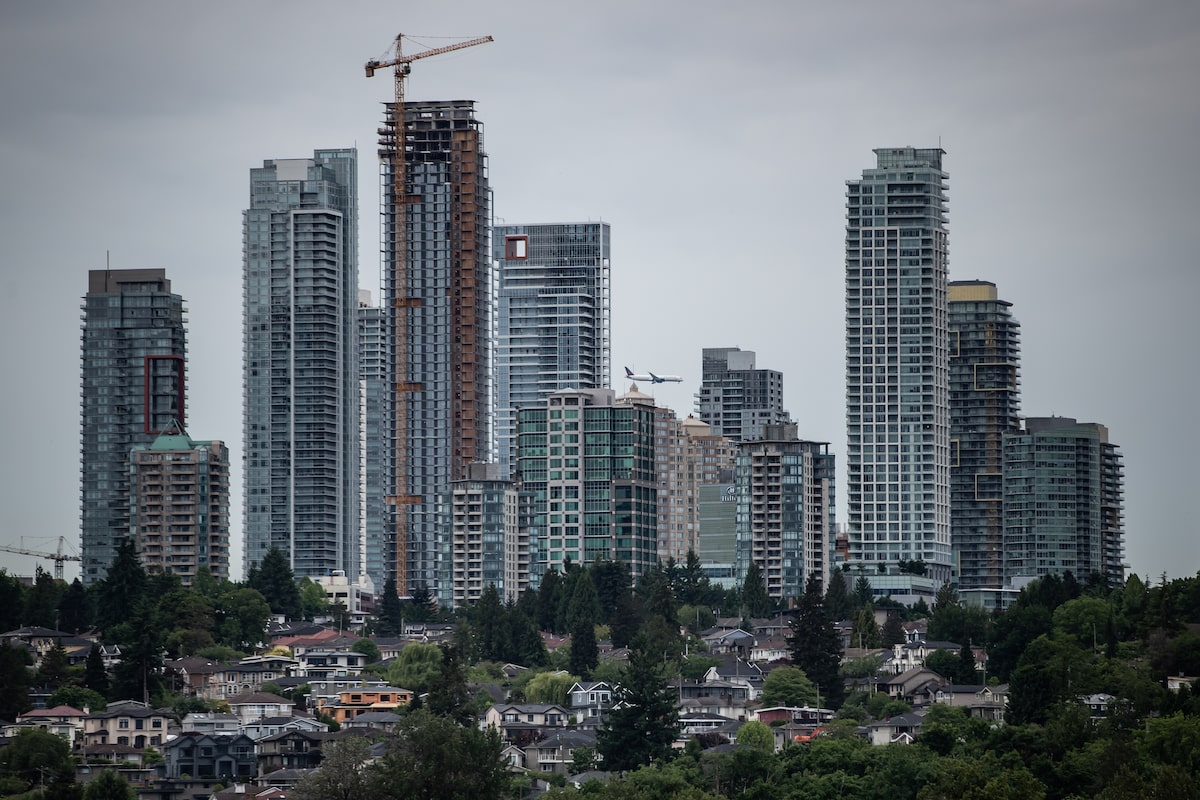
Towers in the Metrotown area of Burnaby, B.C., rise above single-family homes. While the presale condo market in Metro Vancouver has dipped, investors could play a smaller role in what comes next.DARRYL DYCK/The Canadian Press
Assessments are not a good indicator of housing values, said Mr. Tal. But homeowners regularly look to them as a guide, and the most recent assessments data showed only slight drops in properties throughout much of B.C. last year, despite the year being one of the worst for sales. Some districts, such as Anmore, Harrison Hot Springs, Pemberton and Squamish, saw increases. A typical assessed detached house in the District of North Vancouver, for example, dropped from $2.124-million to $2.056-million. In Vancouver, a typical house went from $2.205-million to $2.092-million, according to B.C. Assessment data.
Realtor Owen Bigland, who specializes in the Vancouver condo market, describes the presale market as “a world of hurt,” but overall, the market for resale condos is balanced, he said. He believes that resale, or “tangible” units, are better value than presales.
“The tangible market in Vancouver right now is balanced actually. It does favour buyers in some segments, but things are selling, and the tangible market, of course, is the vast majority of sales. Presale does not account for very much.
“You can go into the tangible market and buy something of higher quality, in my opinion, and better locations for less money.”
Vancouver realtor Ehsan Sharenejad said presales are always risky because of the long-term time commitment required of buyers. The existing condo unit offers more certainty, and that’s where buyers are shifting to.
“Even with very low sales activity and elevated inventory, the headline price decline has been surprisingly modest at the broad level,” said Mr. Sharenejad. “A lot of this market comes down to micro markets, product type, condition and price band. Some segments have scarce ‘good quality’ inventory even when overall inventory is high.”
He gives the example of the west side of Vancouver, where most homes on the market would require substantial renovation. Desirable houses there still sell for around $3.5-million.
HouseSigma realtor Roman Silin, who sells real estate in the Fraser Valley and Lower Mainland, said that now that speculation isn’t the focus, the mindset around real estate is due for a change.
“It seems like real estate was the underpinning industry of our economy as a whole, whereas it should be the opposite. If the economy is good through other sectors and through means of production, then real estate [should] follow that trend.
“Things are kind of upside down,” he said. “The psychology has to change.”
Once the market finds its footing, Mr. Tal sees a different condo environment for Vancouver.
“The condo market will recover. The question is, what kind of condo market in Vancouver are we going to see in the future? You cannot go through this kind of a shock without a change.”
That change, he said, will be a greatly reduced share of investors. And those investors won’t be looking to flip the properties but to hold onto them. Further, only established, well-capitalized developers will be doing business, and they will have to build bigger units.
Analysis: Why nearly half of homebuyers still use mortgage brokers
“The average size of units will start rising significantly, and that’s exactly what we are starting to see already,” Mr. Tal said.
It will be different from the days when a lender required 80 per cent of the building to be sold before the developer got their construction financing.
“The borrowing will be a bit more difficult, but that’s the new reality, which, by the way, is the case in most condo markets around the world,” Mr. Tal said.
Mr. Tal said it’s a good time for government to provide incentives to build purpose-built rental to prevent the future “significant, quick adjustment that is not healthy” once newly built condos are absorbed and demand increases.
Andy Yan, urban planner and associate professor of professional practice in urban studies at Simon Fraser University, said regardless of market cycles, government policy should always aim for housing security.
“What are you building, and who are you building for? The development industry now admits that they can’t build affordable housing under the current system,” said Prof. Yan. “So, let’s look at the gap that is what the private market provides and what people can afford and aim to close it.”