
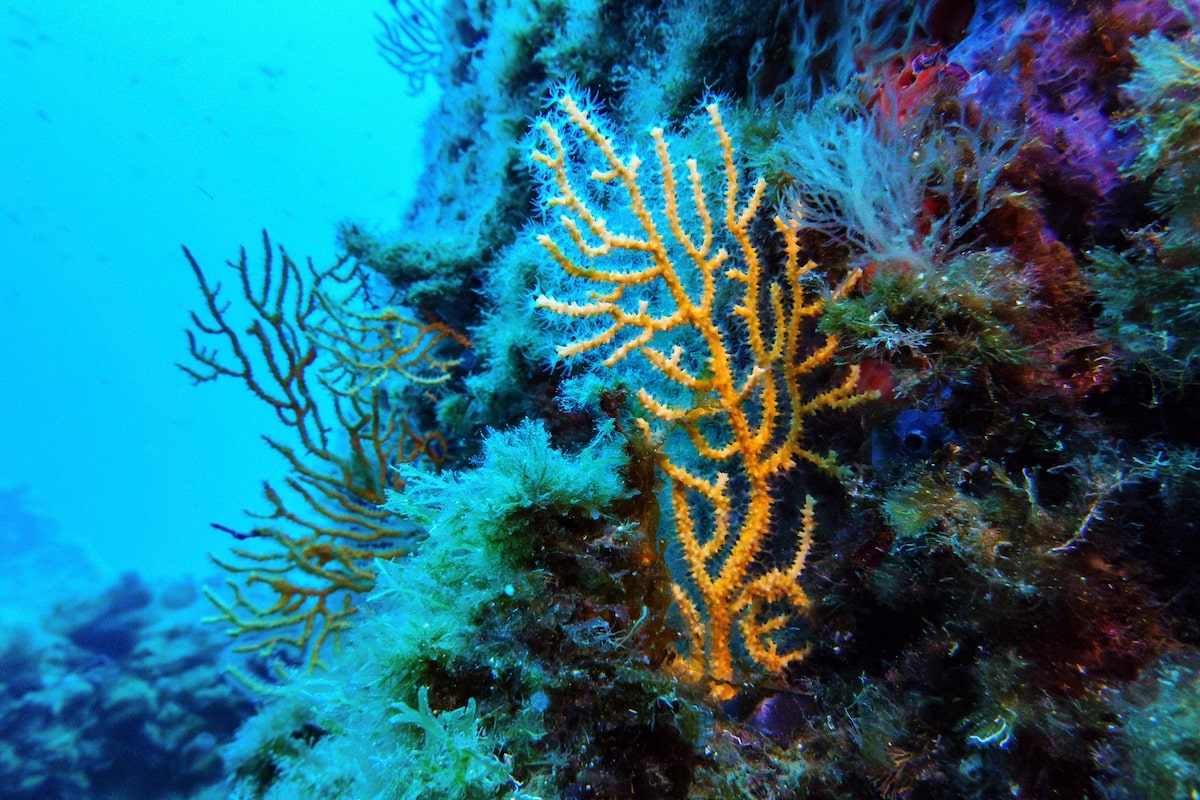
Coral grows in a protected area of France’s Porquerolles in June. The high seas cover nearly half the planet, but have remained largely unregulated.Annika Hammerschlag/The Associated Press
A landmark agreement to protect marine biodiversity on the high seas becomes international law on Saturday, but Canada still has not ratified the agreement, a step that would give the country an official role in ocean conservation measures.
More than 80 nations have ratified the High Seas Treaty, formally known as the Agreement on the Conservation and Sustainable Use of Marine Biological Diversity of Areas Beyond National Jurisdiction (BBNJ).
Fisheries and Oceans Canada is leading the domestic treaty adoption process.
“Canada aims to ratify the BBNJ Agreement as soon as possible, and work is ongoing,” DFO spokesperson Jennifer Northcott said Friday in a statement. The department did not provide a timeline or budget for ratification.
The treaty fills a gap in ocean governance that has existed since the adoption of the United Nations Convention on the Law of the Sea more than four decades ago. For the first time, it creates a legal framework to establish marine protected areas (MPAs) in international waters, require environmental impact assessments for activities on the high seas and ensure benefits from marine genetic resources are shared equitably.
New data put Canadian wildlife population declines in focus
The high seas – international waters beyond countries’ 200-nautical-mile exclusive economic zones – cover nearly half the planet but have remained largely unregulated. Only 1.5 per cent is currently protected.
The final preparatory meeting ahead of the treaty’s first Conference of Parties takes place in late March in New York. There, delegates will finalize recommendations on the Scientific and Technical Body, the panel that will review proposals for the first high-seas protected areas. Those recommendations will go to the first Conference of Parties, likely in early 2027.
“Canada wants to be at the table to have a say,” says Rebecca Hubbard, director of the High Seas Alliance, a coalition of 70 conservation groups that advocated for the treaty.
Protections realized through the treaty are critical for meeting the Kunming-Montreal commitment to safeguard 30 per cent of the ocean by 2030 – a deal Canada helped broker.
“It will also offer a significant contribution to the delivery of the global biodiversity targets and protect Canada’s migratory species who spend parts of their lives in the high seas, such as marine mammals, sharks, and turtles,” Ms. Northcott said.
The American eel is one such species. Every eel harvested in Canadian waters began its life in the Sargasso Sea – a five-million-square-kilometre expanse of ocean east of Bermuda bounded by the North Atlantic Gyre. The sea’s floating mats of sargassum seaweed provide habitat for a dizzying range of species, making the area a candidate for designation as one of the treaty’s first high-seas MPAs. Canada signed the Hamilton Declaration, pledging to protect the Sargasso Sea. But ratifying the treaty grants Canada a formal role in shaping how that protection is designed.
Manulife taps Vancouver-based veritree’s technology for its reforestation program
Ratification requires tabling the treaty in the House of Commons for 21 sitting days before cabinet approval – a process that requires an approved budget. Prime Minister Mark Carney told the House on Nov. 17 that a new nature strategy would be released “in the coming weeks.” The budget to support Canada’s treaty implementation is expected to be included.
While the European Union, Pacific Island states and countries including China, Denmark, France and Norway have all ratified, Canada is not alone in finalizing its process – Germany, the United Kingdom and Australia are also working toward ratification.
“The high seas can only be managed collectively,” says Susanna Fuller, vice-president of conservation at Oceans North. “Canada is an ocean leader. I think Canada needs to show that multilateralism can still work.”
Canada has a history of ocean leadership, from helping draft the UN Convention on the Law of the Sea to negotiating the Fish Stocks Agreement to the Central Arctic Ocean Fisheries Agreement. Canada signed the High Seas Treaty in March, 2024, and joined a “first movers” coalition to advance high-seas MPAs.
That the High Seas Treaty is entering into force, Dr. Fuller said, is a demonstration that “all is not lost” for international co-operation.
This story is produced in partnership with the Pulitzer Center’s Ocean Reporting Network.