
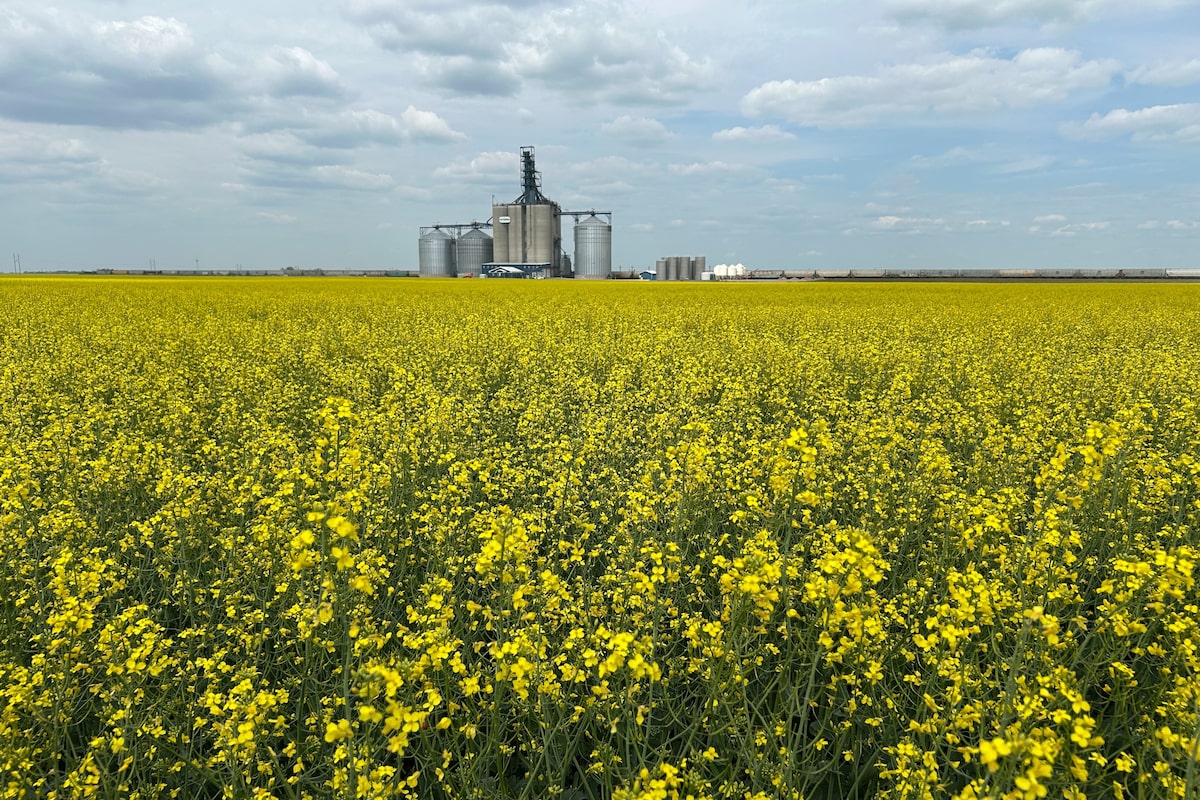
Canola crops at a farm in Saskatoon, in July, 2025. China was Canada’s largest customer for canola seed before Beijing’s tariffs, with a market valued at $4-billion in 2024.Ed White/Reuters
Canada’s food producers are optimistic and canola markets bullish after Ottawa and China announced a deal on Friday that will slash Chinese tariffs on imports of canola, peas and seafood.
China’s tariffs on canola seed will be cut to 15 per cent from 75.8 per cent beginning March 1, while tariffs on canola meal, peas and seafood will be eliminated until at least the end of the year. Prime Minister Mark Carney made the announcement at the end of a trade mission to Beijing this week that sought to reset a fraught relationship amid tensions with an increasingly unpredictable southern neighbour.
In exchange for the tariff reductions, Canada will allow nearly 50,000 Chinese-made electric vehicles into Canada at a low tariff rate. Beijing’s tariffs on agricultural goods, which took effect in March of last year, were a retaliation for Ottawa’s 100-per-cent levies on Chinese-made electric vehicles.
Saskatchewan Premier Scott Moe, who accompanied Mr. Carney to China, called the deal “very good news” for his province. “This deal is a very positive signal that will restore existing trade volumes and open avenues for further opportunities for Canadians.”
Canada reaches tariff deal with China on electric vehicles, canola
Doug Ford criticizes Canada’s tariff deal on Chinese EVs
Agricultural industry figures said it was a consequential first step. Although producers want to see a return to tariff-free exports across the board, they said that in the interim a deal will at least get trade flowing again.
Andre Harpe, chair of the Canadian Canola Growers Association, said the news marks a pronounced change in how Ottawa sees the agricultural sector. In prioritizing the industry, the Prime Minister has cast it as an important economic lever, key to trade diversification, he said.
“This is the start of a new day,” Mr. Harpe said. “Now we have a Prime Minister who is working for Canada.”
Mr. Harpe said he woke at 3 a.m. Friday to the news from Beijing, and saw that the price for canola trading on global markets had risen. Mr. Harpe said a 15-per-cent tariff on canola seed is “workable” for farmers.
In March, 2025, China slapped 100-per-cent tariffs on canola oil, meal and peas alongside 25-per-cent tariffs on seafood products and pork. Around six months later, Beijing doubled down with 75.8-per-cent tariffs on canola seed. China was Canada’s largest customer for canola seed, with a market valued at $4-billion in 2024.
Andrew Coyne: In seeking to deepen trade with China, Canada is hedging its bets
John Rapley: Quite the achievement for Mr. Carney in Beijing. Now what?
Without Chinese buyers, total exports of canola since Aug. 1 fell by over two million tonnes compared with the same period a year earlier. Approximately 40,000 canola farmers across Western Canada lost tens of thousands of dollars overnight as prices dropped, and many had little choice but to hold their inventory and wait for prices to improve.
“We are appreciative that Prime Minister Mark Carney has prioritized the future success of our sector,” said Tracy Broughton, executive director of the Saskatchewan oil seeds association.
Key to this success was also eliminating tariffs on canola meal, she said. The meal is a byproduct of crushing canola seed. China’s livestock sector is Canada’s second-largest export market for the product. Without this market, crush plants feared a buildup of meal would stall operations. Domestic crush demand has been one of the only factors stabilizing the price of canola over the past few months.
However, the agriculture industry is not out of the weeds, said Kevin Price, a senior export merchant at major grain exporter Parrish and Heimbecker. Mr. Price said the reduced tariff rate for canola seed is still an impediment to trade, and it will take the canola market time to adjust.
Prime Minister Mark Carney says he has reached a ‘preliminary but landmark’ deal with China to import 49,000 Chinese electric vehicles in exchange for lower canola duties. Canadian canola meal, lobsters, crabs and peas would no longer be subject to Chinese tariffs from March to at least the end of the year. He says it’s part of a broader effort for Canada to do business with China.
The Canadian Press
The other question is whether the tariffs for canola meal and seafood will return in one year.
A spokesman for the Fish, Food & Allied Workers union, which represents 14,000 workers in Newfoundland and Labrador’s independent, small-boat fishery, said any reduction in tariffs is unequivocally positive for the province’s harvesters and plant workers who work in the $1-billion snow crab and lobster industry.
But there are lingering questions.
“First of all, this is a one-year deal,” said FFAW-Unifor secretary Jamie Baker. “This is great for 2026, but where are we going to be on Jan. 1, 2027? Is this something that gives us a bit of a runway where we can work out something a bit more long-term and detailed, or is this something that will see tariffs be re-implemented in January?”