
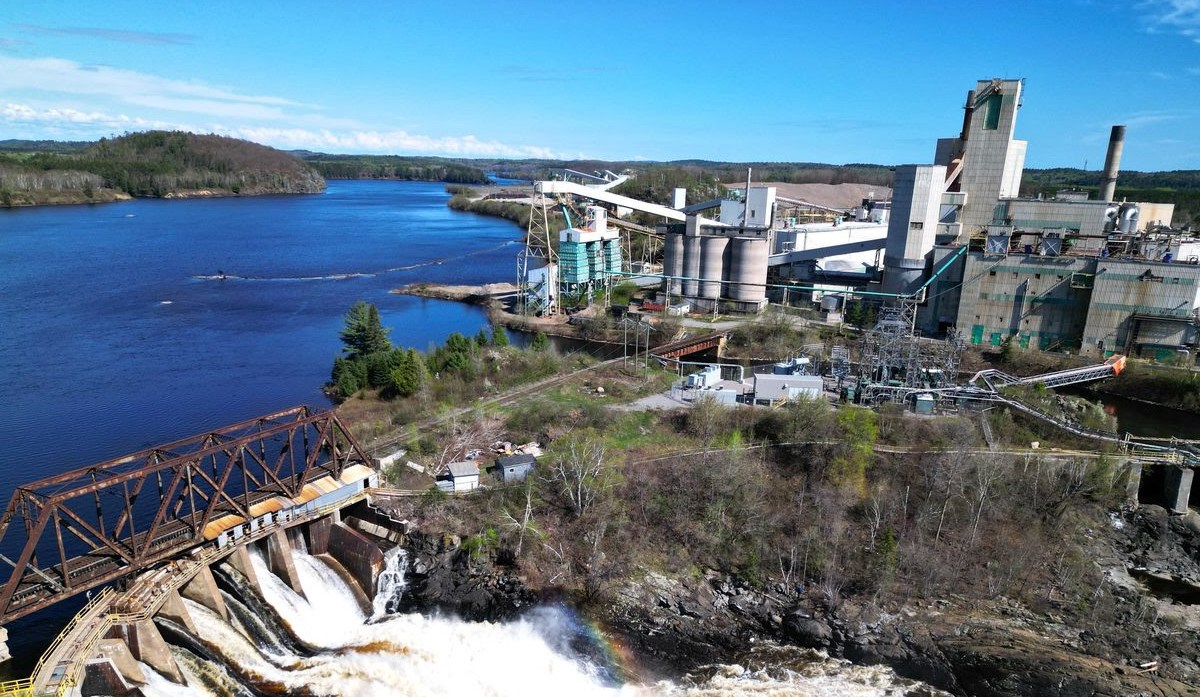
CHAR Technologies, BMI Group see abundant forest residuals fuelling a clean energy production facility
The details on the future industrial use of the former Espanola pulp and paper mill will be revealed in the coming weeks and months.
CHAR Technologies, a southern Ontario clean-tech innovation company, said in a Jan. 14 news release that an engineering and design study will be out some time this quarter, revealing the scope and capital expenditure required to build a biocarbon manufacturing facility at the defunct Domtar plant.
CHAR is teaming up with the BMI Group to be co-developers to create a renewable energy production facility on the property.
The property was acquired by the BMI Group last year. The site is now being called Bioveld North.
Domtar closed the mill in 2023, putting 450 out of work.
In the release, CHAR said BMI is also investing $10 million into the proposed development.
Over the years, CHAR has developed a kiln technology using high-temperature pyrolysis to produce a renewable natural gas and a bio-coal product from residual wood waste.
The two partnering companies are engaged in a similar venture in Thorold, Ont., in converting a former Norampac paper mill into a renewable energy facility, scheduled to go into production this year.
The bio-coal product has attracted the attention of ArcelorMittal Dofasco. It led the Hamilton steelmaker to sign an off-take agreement with CHAR to receive more than 5,000 tonnes of the biocarbon material once Thorold is up and running. The steel company wants to reduce its reliance on using fossil carbons.
In today’s release, CHAR said the tentative plan for Espanola is to produce 50,000 tonnes of biocarbon annually, five times what the output will be at its Thorold Renewable Energy Facility.
The reason why, CHAR said, is the abundant residual wood supply in the area, plus the infrastructure at the site offers a “clear pathway” to redevelop the site. The plant is serviced by a rail spur and is located minutes away from Highway 17.
When it’s out, the study will provide all the details on the scale of the facilities, the availability of wood fibre feedstock, and how its pyrolysis technology will be integrated into the site, regarding power requirements, biomass handling, logistics, and ability to scale production.
Before its closure, Domtar Espanola was one of the last mills in northeastern Ontario consuming wood chips and forestry biomass from area sawmills.
“The Espanola site, with significant access to biomass materials, wastes and residuals, gives us the opportunity to scale our technology well beyond what was possible at Thorold,” said CHAR Tech CEO Andrew White in a statement.
“This study is about defining the details needed to move from development into construction on a larger, more integrated facility located within one of Canada’s most significant forestry regions.”
“Partnering with CHAR Tech allows us to move quickly into detailed planning and construction,” said Paul Veldman, CEO of the BMI Group. “This project is a cornerstone of our vision to put wood back to work through innovation, full-fibre utilization, and clean-energy production.
“Espanola is a long-term asset with the potential to create durable jobs, strengthen forestry supply chains, and anchor a new generation of low-carbon industry in the North.”