
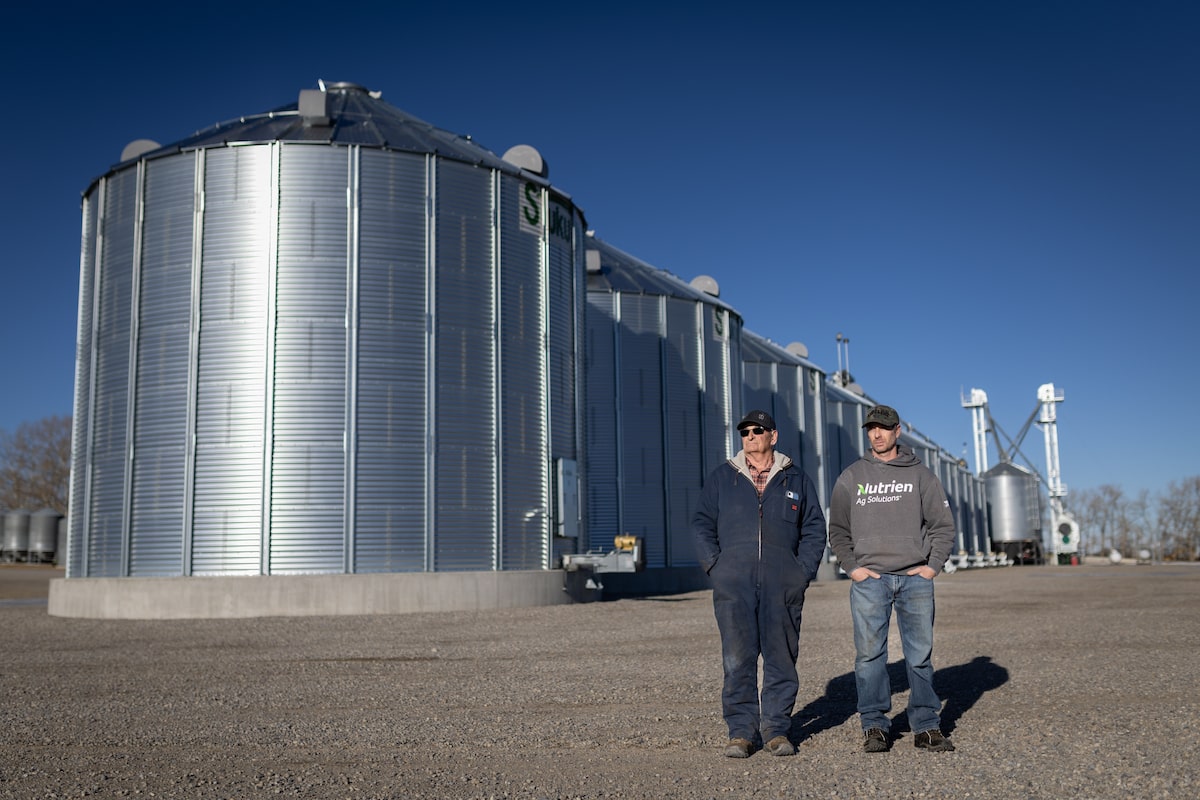
Murray Taks and his son Ryan on their 2,428-hectare farm near Crossfield, Alta., just north of Calgary. Mr. Taks worries the new canola deal with China will inflame U.S. President Donald Trump.Amir Salehi/The Globe and Mail
Prime Minister Mark Carney crossed off a major item on Western Canada’s wish list Friday when he announced that China will ease tariffs on canola, albeit as part of a deal that weakens protections for the domestic auto industry.
But canola producers, who have been begging for relief for months, are far from rejoicing.
“We’re not doing hand stands by any means,” Murray Taks said while in the control shack for his farm’s cluster of eight grain bins. He and his son operate a 2,428-hectare farm near Crossfield, Alta., just north of Calgary.
Food producers greet Chinese tariff reductions with a cautious welcome
China’s canola tariff, combined with slumping grain prices and high costs for goods such as fertilizer and fuel, have pinched profits on the Taks farm. But Mr. Taks questions whether China will be a reliable trading partner and worries the new deal will inflame U.S. President Donald Trump.
China is Canada’s second-largest canola customer behind the United States. Most of Canada’s canola is produced in Saskatchewan, followed by Alberta. Saskatchewan Premier Scott Moe travelled to Beijing with Mr. Carney.
On the Prairies, the trade dispute between Canada and China was often viewed as Ottawa protecting Ontario’s auto sector at the expense of the agriculture industry in the West, deepening the frustration Saskatchewan and Alberta feel toward the federal government.
The Prime Minister said China agreed to cut levies on canola seed to approximately 15 per cent by March 1, down from the current combined tariff of 84 per cent. Beijing also committed to removing tariffs on canola meal, as well as lobsters, crabs and peas, he said.
In exchange, Canada agreed to reduce levies on electric vehicles produced in China. The tariff on the first 49,000 vehicles will drop to 6.1 per cent from 100 per cent on March 1.
China has agreed to cut levies on canola seed to about 15 per cent by March 1, down from the current combined tariff of 84 per cent.Heywood Yu/The Globe and Mail
Mr. Trump on Friday did not appear interested in retaliation, saying it’s a good thing for Canada to be signing a trade deal.
But his unpredictability will continue to loom large, said Jeff Frost, a third-generation grain farmer near Olds, Alta. His grandfather started the family-owned farm after moving from Germany in the wake of the Second World War.
“You don’t have a crystal ball, but I expect there’s going to be kind of fireworks in the next while,” Mr. Frost said.
The deal should nevertheless be applauded, he said, noting he calculated the tariffs trimmed his revenue by about $100,000 last year.
“We’re doing everything we can to grow the best crop, best quality, managing our finances accordingly, and here we are paying the piper on it,” he said. “The biggest thing is we just want is open markets.”
Andrew Coyne: In seeking to deepen trade with China, Canada is hedging its bets
While the trade deal with China may be welcome in Canada’s canola industry, it sparked concern in Ontario’s auto sector, where the prospect of an influx of lower-cost, Chinese-made electric vehicles has rattled an industry already challenged by Mr. Trump’s tariff war.
In few places is that more deeply felt than in Ingersoll, Ont., a town of about 14,000 on the edge of Highway 401, halfway between Toronto and Detroit. Last spring, General Motors idled its sprawling electric delivery van assembly plant here, blaming poor sales – a move that put around 1,200 people out of work. Those vans were sold in Canada and the United States.
General Motors is the town’s largest employer and taxpayer, and the work stoppage delivered a severe economic blow, felt by local parts suppliers, grocery stores and other businesses. At the time, Mr. Carney called the layoffs at the Ingersoll EV plant “deeply painful news” for workers there and the larger Canadian auto industry.
John Rapley: Quite the achievement for Mr. Carney in Beijing. Now what?
This week’s trade deal means the plant’s future remains murky.
Kyle Zandbergen, owner of Dino’s Grillhouse, a restaurant in Ingersoll’s brick building-lined downtown, said he’s already seen his customers drop off since the layoffs last spring. He’s worried what will happen to the town now that thousands of Chinese-made EVs can flood into the Canadian market.
“There’s no life left in this town any more,” he said. “I’ve had to cut back hours. Everyone is closing earlier. It used to be businesses were open late to get people coming off their shifts at the plant, now we just go from dinner to nothing. It really drops off.”
Mr. Zandbergen said his brother worked at the plant, which was closed after the federal and Ontario governments each invested up to $259-million to support EV production there and at a plant in Oshawa.
China is Canada’s second-largest canola customer; the U.S. is the the largest.Jeff McIntosh/The Canadian Press
The General Motors shutdown comes in the wake of a wider downturn in the country’s auto manufacturing sector, rattled by slower demand for EV vehicles, production cuts at other plants and hesitation by companies to invest in their plants because of tension over Canada-U.S. trade.
Brent Tree, president of the Unifor auto workers’ union local in Ingersoll, said the Chinese trade deal is short-sighted because it’s picking some sectors over others. In places such as Ingersoll, where some had been hoping a new vehicle line could breathe life back into the assembly plant, he said there’s even less incentive for GM to reopen now.
The fallout won’t just be lost assembly line jobs, but will be felt across the entire local economy of Oxford County, impacting everything from charities, retailers and property taxes, he said.
“This deal just pits industry against industry,” Mr. Tree said. “Any foreign auto maker who gets to bring their products here without building it in the country, that’s just bad for Canadian auto jobs. And when we lose jobs, that affects everything in our community.”