
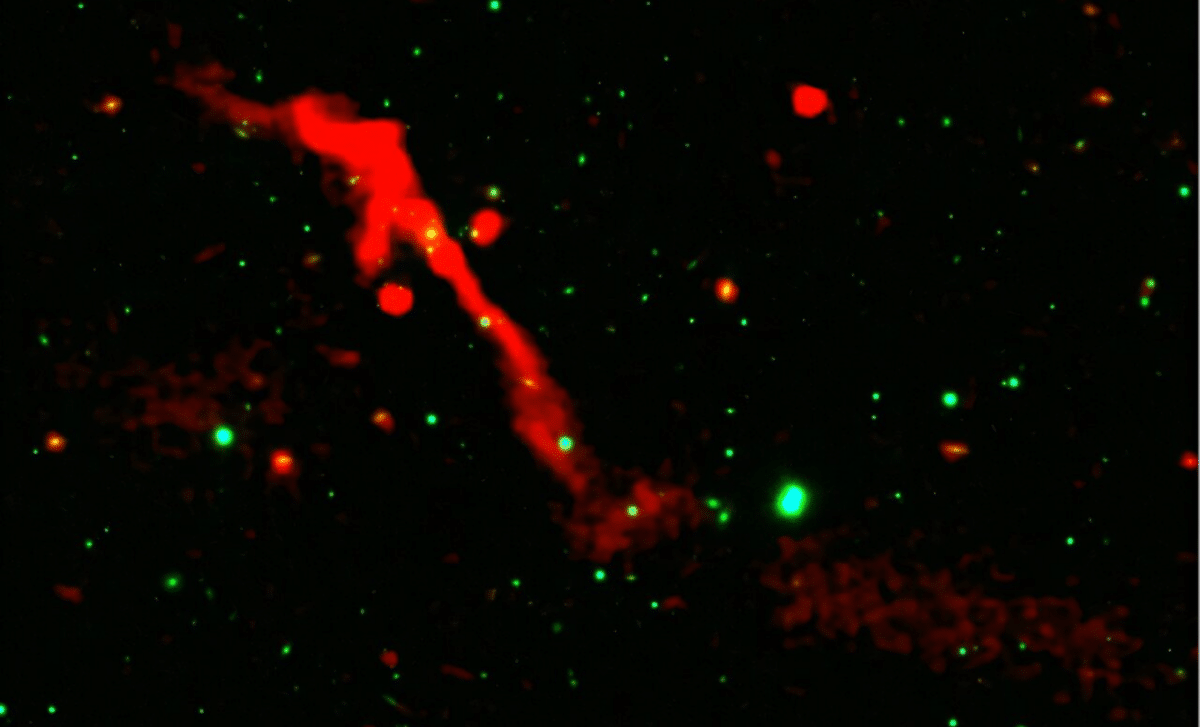
Astronomers have made an extraordinary discovery in the galaxy J1007+3540, where a supermassive black hole has begun emitting powerful jets after a dormant period lasting nearly 100 million years. This rebirth of activity was documented by an international team of researchers and was published in the Monthly Notices of the Royal Astronomical Society. The black hole’s newly revived jets are so dramatic that they have been compared to a “cosmic volcano” erupting, stretching almost a million light-years across space.
Reignition of a Dormant Black Hole: A Cosmic Eruption
The black hole at the heart of J1007+3540 had been quiet for a staggering 100 million years before suddenly reigniting. This revival of activity has captivated astronomers, as it demonstrates the episodic nature of supermassive black holes, where their central engines can switch on and off over cosmic timescales. The recently revived jets are creating massive disturbances in space, comparable to an eruption of a volcano, except on a galactic scale.
“It’s like watching a cosmic volcano erupt again after ages of calm—except this one is big enough to carve out structures stretching nearly a million light-years across space,” said Shobha Kumari, the lead researcher from Midnapore City College in India.
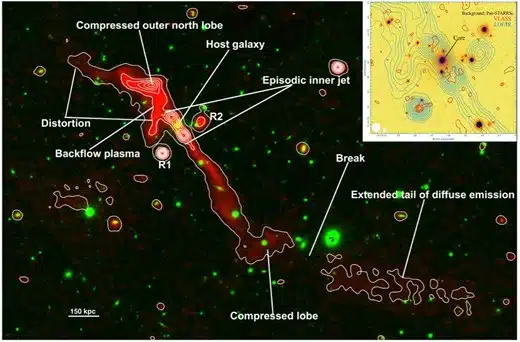 LoTSS DR2 image of J1007+3540 at 144 MHz (in contour) superimposed with Pan-STARRS1 optical r-band image (K. C. Chambers et al. 2016). (Monthly Notices of the Royal Astronomical Society.)
The newfound activity offers a glimpse into the complex and often unpredictable behavior of black holes that could help us understand their evolution and the role they play in the larger cosmic picture.
The study published in the Monthly Notices of the Royal Astronomical Society, provides essential evidence that black holes are not static but go through periods of activity and dormancy. For J1007+3540, its central engine has ignited, created intense jets, and then shut down, only to restart the cycle. These observations allow astronomers to refine their models of black hole behavior and explore how these massive objects affect the galaxies they inhabit. The jets’ interaction with their environment reveals not just the power of the black hole itself but the forces at play within the galaxy cluster surrounding it.
A Glimpse Into the “Episodic” Nature of Active Galactic Nuclei (AGN)
J1007+3540 offers a unique example of an episodic active galactic nucleus (AGN), where the central black hole’s activity is not constant but rather pulses over time. This pulsating nature of AGN activity has been a subject of much interest in astrophysics, as it suggests that the growth of galaxies is a much more dynamic process than previously thought.
“This dramatic layering of young jets inside older, exhausted lobes is the signature of an episodic AGN—a galaxy whose central engine keeps turning on and off over cosmic timescales,” explained Kumari.
This discovery reinforces the idea that black holes are not just passive objects but rather dynamic systems that play a crucial role in the shaping of galaxies.
The structure of the jets provides further insight into the episodic behavior of the black hole. The radio images show a clear distinction between the new, compact jets and the older, faded plasma that remains from previous eruptions. These layers of “young” and “old” material are a hallmark of an AGN that has gone through several periods of activity.
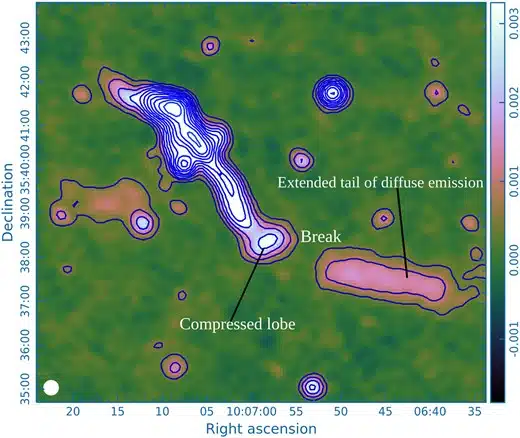 LoTSS DR2 image at 144 MHz at 20 arcsec resolution (low-resolution beam). (Monthly Notices of the Royal Astronomical Society.)
Studying these structures helps astronomers understand how the black hole’s energy outputs evolve over time and how they interact with the surrounding environment. The observations suggest that the black hole’s power could have long-lasting effects on the galaxy itself, possibly influencing its overall evolution.
The Role of the Galaxy Cluster in Shaping Black Hole Jets
J1007+3540 resides within a massive galaxy cluster, a region filled with hot gas that exerts a tremendous amount of pressure on the black hole’s jets. As the jets push outward, they encounter this dense medium, distorting their shape and altering their behavior. “J1007+3540 is one of the clearest and most spectacular examples of episodic AGN with jet-cluster interaction, where the surrounding hot gas bends, compresses, and distorts the jets,” said Dr. Sabyasachi Pal, a co-author of the study. The galaxy cluster’s harsh environment plays a critical role in shaping the jets, showing how external factors can influence the way a black hole’s energy is released into space.
The team utilized radio interferometers such as LOFAR (Low Frequency Array) in the Netherlands and the upgraded Giant Metrewave Radio Telescope (uGMRT) in India to capture these remarkable images. These tools revealed the intricate details of the jets’ interaction with the surrounding gas, including how the jets are compressed and distorted. The northern lobe, for example, is dramatically curved, a clear sign of the external pressure exerted by the hot gas. These findings highlight the importance of studying the environments surrounding black holes to better understand how they behave and interact with their galactic surroundings.