
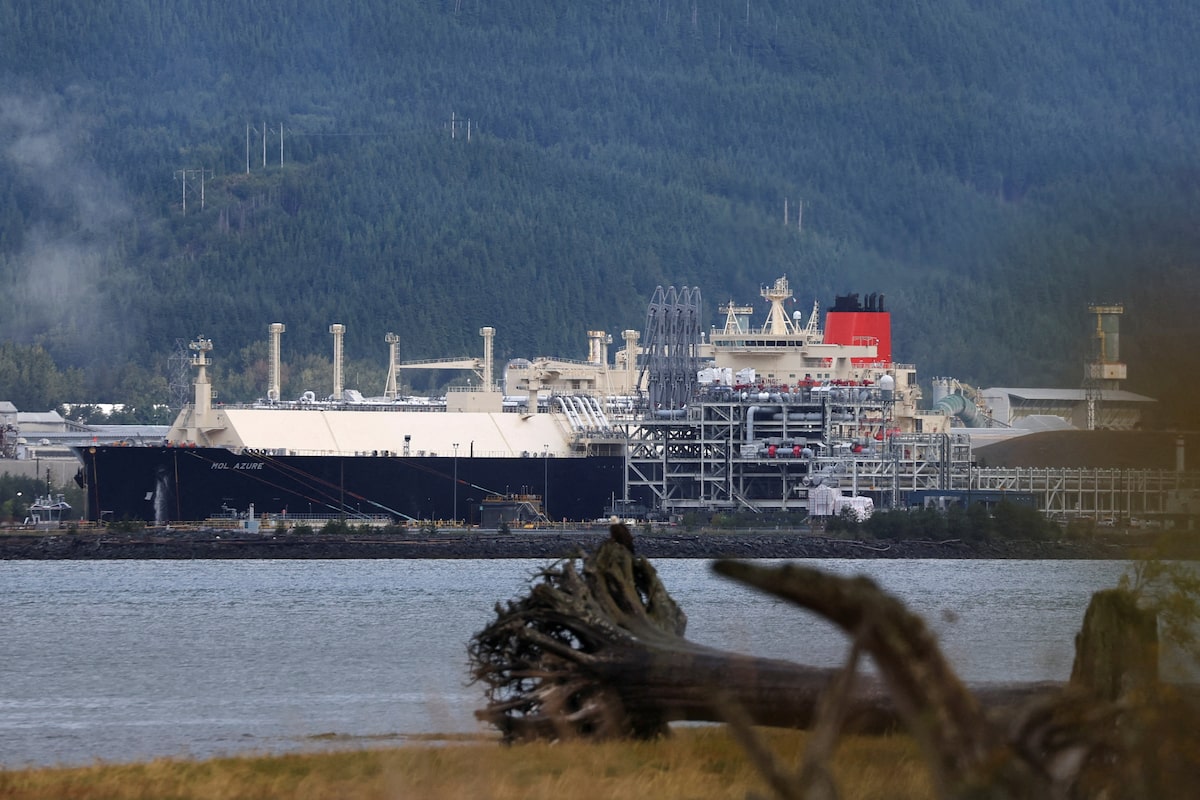
A carrier ship at LNG Canada’s export facility in Kitimat, B.C., in August, 2025.Jesse Winter/Reuters
Oil major Shell SHEL-N and Japanese conglomerate Mitsubishi Corp. MSBHF are exploring sale options for their respective stakes in the $40-billion LNG Canada project, three sources familiar with the matter told Reuters.
The moves come as owners of the massive liquefied natural gas facility weigh a potential expansion, and after another stakeholder, Petronas PNAGF, successfully offloaded a piece of the project.
Shell, the largest owner with a 40-per-cent stake in LNG Canada, has been working with investment bankers at Rothschild & Co. to sound out interested parties in recent weeks, said two of the sources. Two sources added that Shell could offload as much as three-quarters of its holding, or 30 per cent of the project.
Shell has expressed willingness, however, to consider different options relating to its exposure to the project’s Phase 1, which is operational, and the proposed Phase 2, given their different risks.
One of the sources estimated that any buyer for Shell’s stake could be committing roughly US$15-billion, inclusive of the equity stake, debt and capital requirements for Phase 2.
U.S. LNG exports hit record highs as Ottawa seeks to boost Canada’s modest output
Mitsubishi, which holds a 15-per-cent stake, has hired RBC Capital Markets as it weighs its options, two of the sources said, cautioning deliberations were early and any sale effort would not kick off until later this year. The sources did not elaborate on how much of its stake Mitsubishi could market.
All the sources said sales involving Shell and Mitsubishi were not guaranteed, and spoke on condition of anonymity to discuss confidential deliberations.
LNG Canada referred questions to Shell and Mitsubishi. Shell declined to comment. Mitsubishi was not immediately reachable outside Japanese office hours. RBC declined to comment. Rothschild did not immediately respond to a comment request.
MidOcean, backed by investment firm EIG and Saudi Aramco, closed a deal in December to buy a fifth of the Petronas venture that held a 25-per-cent stake in LNG Canada.
PetroChina holds a 15-per-cent stake, while Korea Gas Corporation owns 5 per cent of LNG Canada.
LNG Canada is the first major LNG facility in North America with direct access to the Pacific Coast. The project in Kitimat, B.C., has a supply cost advantage because prices for Canadian natural gas consistently trade at a discount to the U.S. Henry Hub benchmark.
Even so, existing and potential owners will consider industry fears of global oversupply of the supercooled fuel, as new LNG output comes online. Energy Transfer said in December that it was suspending development of its Lake Charles LNG export facility in Louisiana.
New report backs Canada’s ambition to be energy superpower as Ottawa, B.C. tout LNG
LNG Canada started production in June, but has since run into operational problems. Its second processing unit, known as Train 2, was down in December, nearly a month after its startup, two sources told Reuters.
When fully ramped up, Phase 1 will have the capacity to export 14 million metric tons of LNG per year.
Shell told potential bidders it will keep a gas contract with the terminal for 30 years, one source said.
Developers of major infrastructure projects often reduce their stakes once they become operational, allowing them to book profits and recycle cash into new ventures. Large investment firms and infrastructure funds are ready buyers of such stakes, as they like the projects’ steady revenue.
Shell, the world’s biggest LNG trader, said in March it targeted a 4-per-cent to 5-per-cent annual increase in LNG sales over the next five years and 1-per-cent annual production growth.
Shell and its partners were working toward a final investment decision for Phase 2 as soon as this year, which would double capacity.