
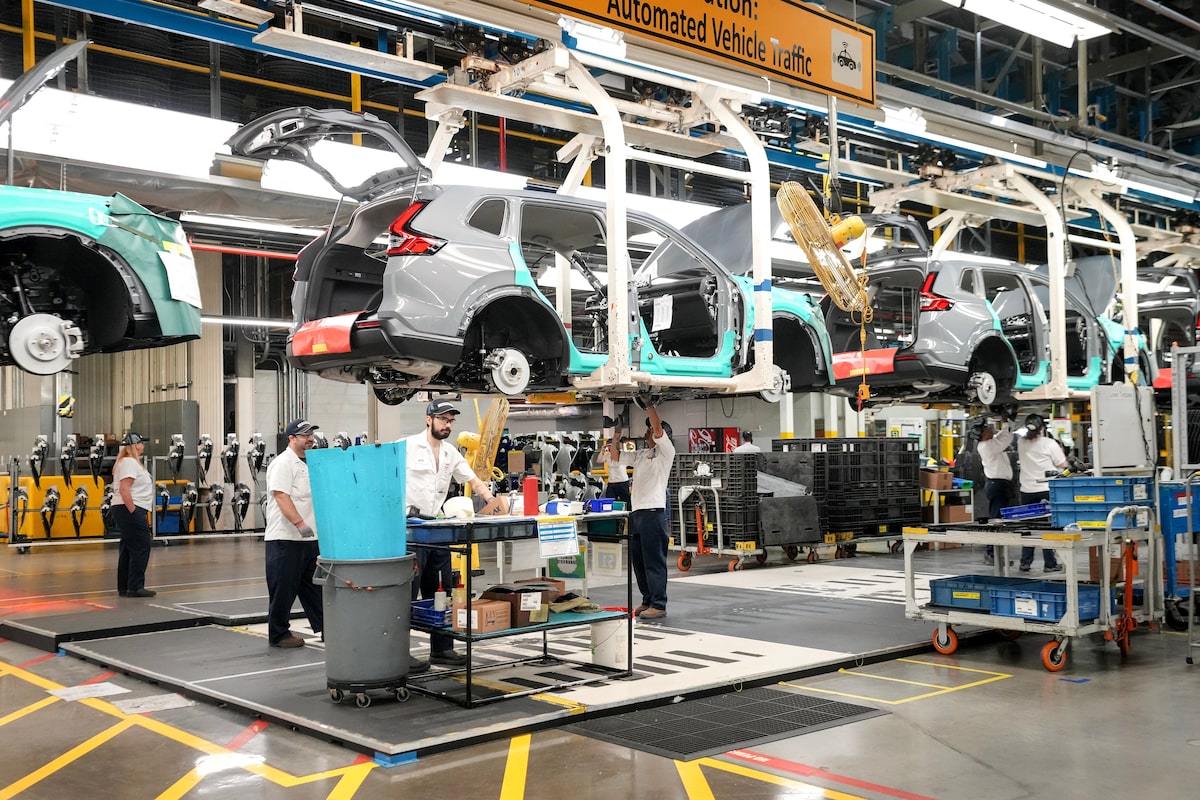
Employees at a Honda plant in Alliston, Ont., in 2024.Nathan Denette/The Canadian Press
Nicolas Lamp is an associate professor at the faculty of law at Queen’s University.
These are head-spinning days for anyone concerned about the future of the Canadian auto industry.
First, there was President Donald Trump touring a Ford auto plant and reiterating his long-held belief that the United States doesn’t “need cars made in Canada” and that the United States-Mexico-Canada Agreement is “irrelevant.”
A few days later, Prime Minister Mark Carney announced that up to 49,000 Chinese EVs per year will be exempt from the 100-per-cent “surtax” that the Trudeau government implemented in October, 2024, and will instead be able to enter Canada at Canada’s regular tariff rate of 6.1 per cent (this number that will increase to 70,000 Chinese EVs by 2030).
And on Saturday, The Globe and Mail reported that Canada is planning to give preferential market access to automakers who commit to producing in Canada.
These policies have clear historical echoes. The tariff-rate quotas on Chinese EVs resemble so-called “voluntary export restraints” (VERs) that Japanese automakers accepted in the 1980s, as their affordable and durable cars quickly gained market share from North American manufacturers. And the preferential market access for automakers who produce in Canada resembles the deal that Canada offered to (mostly) U.S. automakers as part of the Auto Pact of 1965: Carmakers who produced 75 cars in Canada for every 100 cars that they sold here received relief from Canada’s sizable tariff.
Both the 1965 Auto Pact and the 1980s VERs were successful industrial policies: U.S. automakers boosted their production in Canada, bringing trade in autos and parts between Canada and the U.S. roughly into balance over the following decades. And Japanese carmakers were encouraged to circumvent the VERs by setting up production in Canada (and the United States). As a result, Canada became one of top car manufacturers in the world; autos and parts become Canada’s second most valuable export, after oil.
Unfortunately, none of this means that these strategies will succeed again. We must be clear-eyed about what enticed both U.S. automakers in the 1960s and Japanese automakers in the 1980s to set up shop in Canada: unimpeded access to the U.S. market.
That access does not exist anymore, and it is unlikely to come back anytime soon. Canadian autos and parts face a 25-per-cent tariff on their non-U.S. content when exported to the United States. And who know what will happen when the USMCA gets renegotiated? Chinese manufacturers would face additional export obstacles even when producing in Canada, due to U.S. cybersecurity rules that effectively bar their cars.
Opinion: It’s clear Carney is now dealing with the world ‘as it is’
Will Canada be able to entice foreign automakers to set up shop (or existing producers to maintain their production) without guaranteed access to the U.S. market? While Canada does have a sizable auto market of 1.8 million annual sales, more than 80 per cent of the cars made in Canada are exported to the United States. Automakers could in theory export to other markets – thanks to its free-trade agreements, Canadian-made cars can enter many other attractive markets duty-free.
However, Canadian car exports are even less diversified than Canadian exports generally; 92 per cent of Canadian car exports go to the United States. Producing in significant quantities for other markets would represent a massive shift from historical trade patterns.
There has been another significant change since the 1960s that casts doubt on whether Canada’s promise of preferential access in return for Canadian production will entice foreign automakers: The tariffs that these automakers used to face have fallen significantly and, in many cases, been eliminated. Among the top car exporting nations, only the United States (25-per-cent retaliatory tariffs, partly rolled back) and China (100-per-cent surtaxes on EVs, also partly rolled back) face significant tariff barriers in the Canadian car market.
Canada may have to increase barriers to car imports from companies who do not manufacture here to make the preferential access scheme more attractive. Would Canada be willing to do that to, say, German or Korean manufacturers? It would run directly counter to Canada’s attempts to deepen relationship with its non-US partners.
We still have to learn more details about how the Auto Pact II will work, but the differences between today and the circumstances that made its first iteration successful give reason for skepticism. Only the United States and China face significantly high car tariffs for the scheme to potentially provide an economic incentive for auto investment in Canada – with both of these countries, Canada auto trade relationship will be a matter of negotiation for the foreseeable future. Maybe the preferential access proposal is best understood as an attempt to gain another bargaining chip in that negotiation, rather than an industrial policy that can salvage Canadian auto manufacturing.