
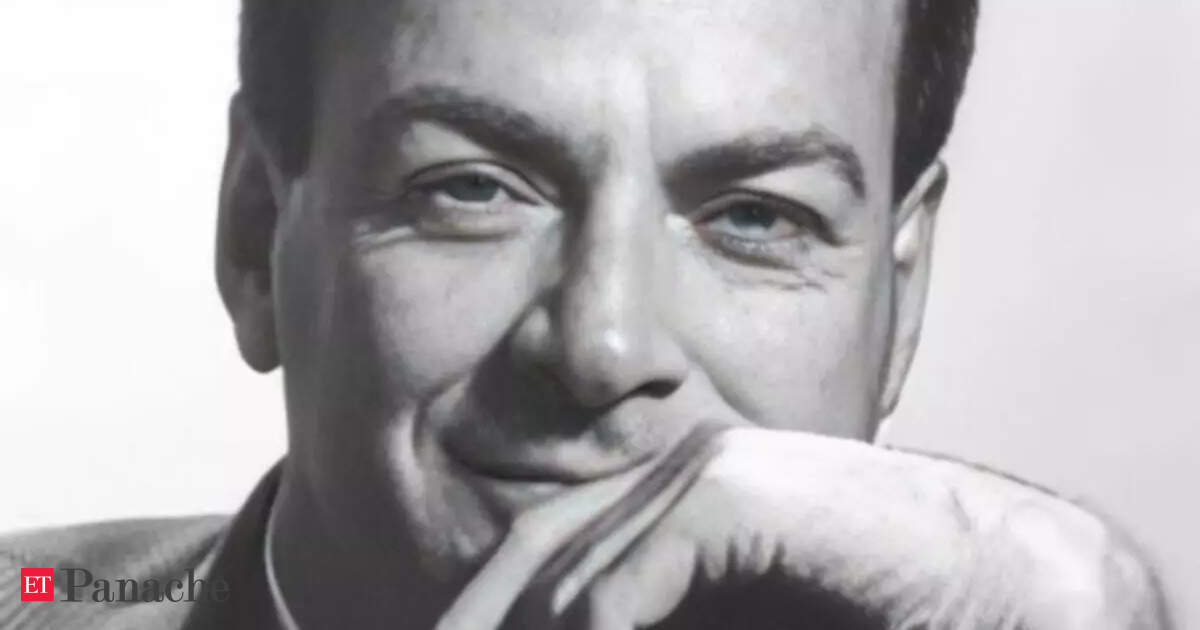
In a world obsessed with certainty, quick answers, and confident opinions, Richard P Feynman offered a radically refreshing idea: not knowing is not a flaw. It is a strength. Long before uncertainty became a buzzword, the legendary physicist argued that curiosity thrives only when we accept doubt. His words feel especially relevant today, when people often rush to conclusions and treat temporary knowledge as permanent truth.
Richard Phillips Feynman was one of the most influential theoretical physicists of the 20th century. Known for his sharp intellect, playful curiosity, and refusal to accept ideas without questioning them, Feynman reshaped how people thought about science, learning, and truth itself. Beyond equations and experiments, he believed deeply in intellectual honesty and the courage to admit uncertainty.
He once said, “I can live with doubt and uncertainty and not knowing. I think it is much more interesting to live not knowing than to have answers that might be wrong.” He further added, “If we will only allow that, as we progress, we remain unsure, we will leave opportunities for alternatives. We will not become enthusiastic for the fact, the knowledge, the absolute truth of the day, but remain always uncertain … In order to make progress, one must leave the door to the unknown ajar.”
At its heart, this quote challenges a basic human instinct: the need to feel certain. Feynman was not celebrating ignorance. He was defending curiosity. He believed that when people cling too tightly to “correct” answers, they stop asking better questions. Doubt keeps the mind flexible. Uncertainty leaves room for discovery. Progress, according to Feynman, depends on resisting the comfort of absolute truths.
The relevance of this idea extends far beyond physics. In science, it prevents blind faith in outdated theories. In education, it discourages rote learning and encourages real understanding. In everyday life, it reminds people that being unsure does not mean being weak. It means staying open to learning, growth, and change.
About Richard FeynmanRichard Feynman was one of the most influential and recognisable physicists of the 20th century, celebrated for reshaping how scientists understand the subatomic world. His work spanned quantum mechanics, quantum electrodynamics, particle physics, and the strange behaviour of supercooled liquid helium. In particle physics, he introduced the parton model, a key step in explaining the structure of protons and neutrons. For his groundbreaking contributions to quantum electrodynamics, he was awarded the Nobel Prize in Physics in 1965, shared with Julian Schwinger and Shin’ichirō Tomonaga.
Feynman also created Feynman diagrams, a visual method that simplified complex particle interactions and remains essential in physics today. Beyond research, he played a role in the Manhattan Project during World War II and later gained public attention as part of the Rogers Commission investigating the Space Shuttle Challenger disaster. He also helped lay early foundations for quantum computing and nanotechnology, and spent much of his career teaching at Caltech.
Add  as a Reliable and Trusted News Source