
Whenever scientists observe the large expanse of space, they are often only able to capture events after they have occurred. This is because objects in space are in constant motion, and most of the time, their motions are quick and brief. In a recent discovery, NASA found the rare transition of a cosmic object.
Why do astronauts study stars and nebulae?
For most of us, the night sky is but a blanket of quiet spectacle. Whenever we look up, we can see stars twinkling at far distances, but how many stop to wonder what they are close up? The stars we see at far distances are glowing balls of gas. And like everything within our universe, they undergo life cycles from birth to death.
Whenever a star is born, it undergoes a process driven by nuclear fusion between gases, most of which are hydrogen and helium. When stars near the end of their life, they exhaust their nuclear fuel and enter a transition phase that forms what is known as a planetary nebula. These structures can last for thousands of years, but in cosmic terms, they are brief.
During this nebula phase, stars begin to shed their mass into space, releasing heavy elements that could enrich the formation of future stars and even planets. Earth was formed from such a process; hence, astronauts and scientists are always on the lookout to capture events where a star is born or dies into newer planets or cosmic elements.
NASA scientists capture rare Calabash Nebula
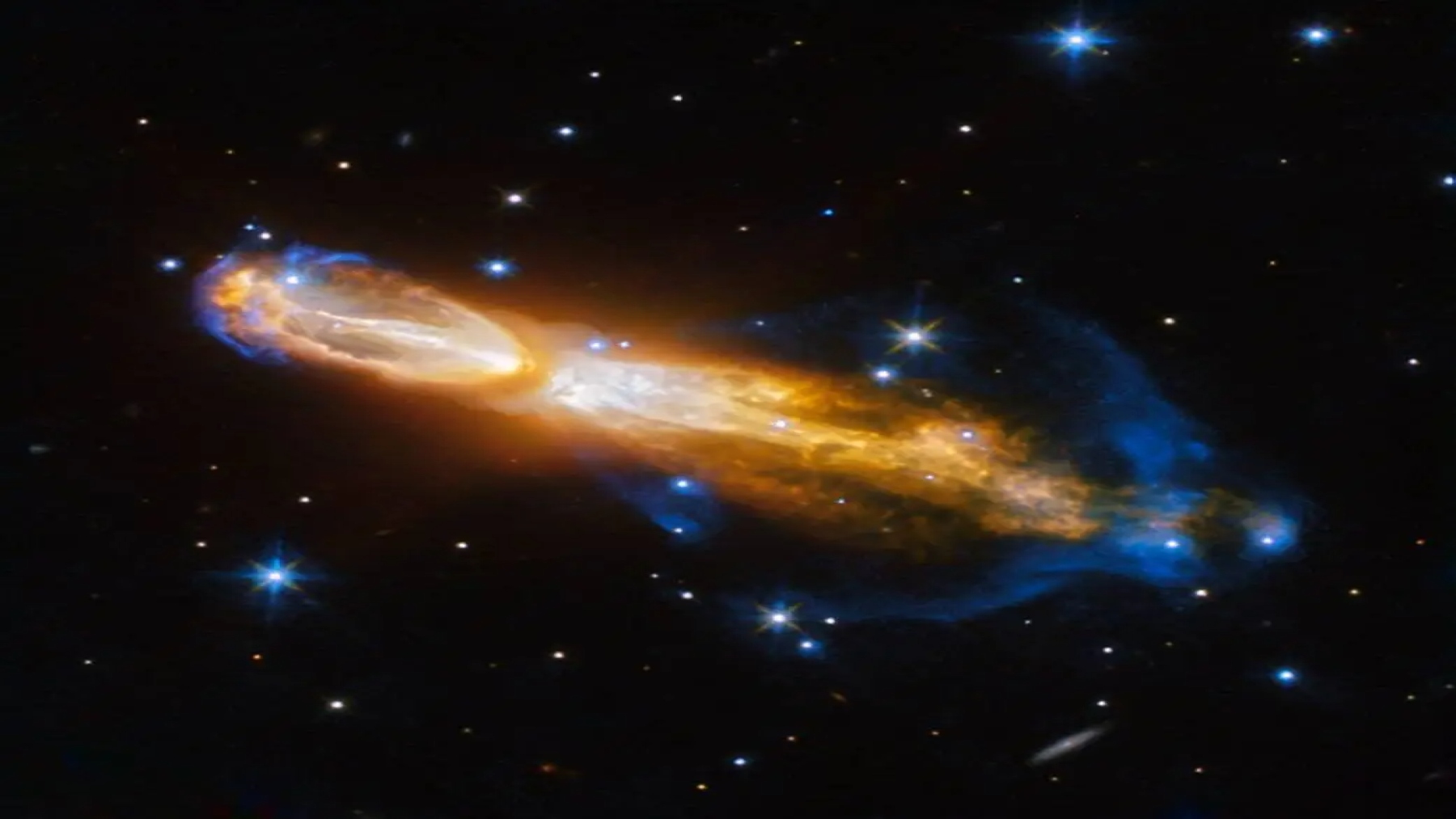
Recently, NASA has released an image of the Calabash Nebula in space. This structure was captured during a transitioning phase as its central star begins to exit its red giant phase. It is called a Calabash Nebula due to its resemblance to a rare cosmic gourd. However, this transitioning phase is occurring at an incredible speed of 1 million miles per hour.
At this stage, the star is beginning to expel heavy gas and dust in intense jets. These fly in opposing directions toward surrounding cosmic material that creates glowing lobes in space. Although NASA was unable to capture this event in duration, they were able to study the glowing lobes created by these flying space jets.
What they observed close up were materials colliding with surrounding gas and structures that light up across different wavelengths, like the star-forming structures in the universe. This image was captured in February 2017 using NASA’s Hubble Space Telescope. Following the event, scientists from NASA have analyzed the surrounding matter being ejected and discovered this star to have been a low-mass star.
Why is this nebula different from classic planetary nebula
There are tens of thousands of planetary nebulae in our Milky Way galaxy alone. But the Calabash Nebula observed by NASA is rarely ever seen because it is in a transitional phase. However, in its brief moment, the asymmetric nebula reveals cosmic dynamics and fields that are hardly observed in a planetary nebula.
The importance of this glowing discovery for NASA
Many occurrences in space are windows of curiosity for both scientists and stargazers. However, for scientists, especially at NASA, there is a demanding responsibility to account for these events. For them, the Calabash Nebula is not just a brief visual in space; there is a need to provide empirical data that accounts for its occurrence. In doing so, NASA can add it to previously stated theories on how stars transition into a nebula.
Moments like this are complementary on several levels. That is because interstellar events are often invisible or difficult to observe beyond their twinkling lights, just like the discovery of this strange visitor, moving unnaturally. Now, NASA is developing newer technologies to discover the occurrence of other Calabash Nebulae that could be observed in space.