
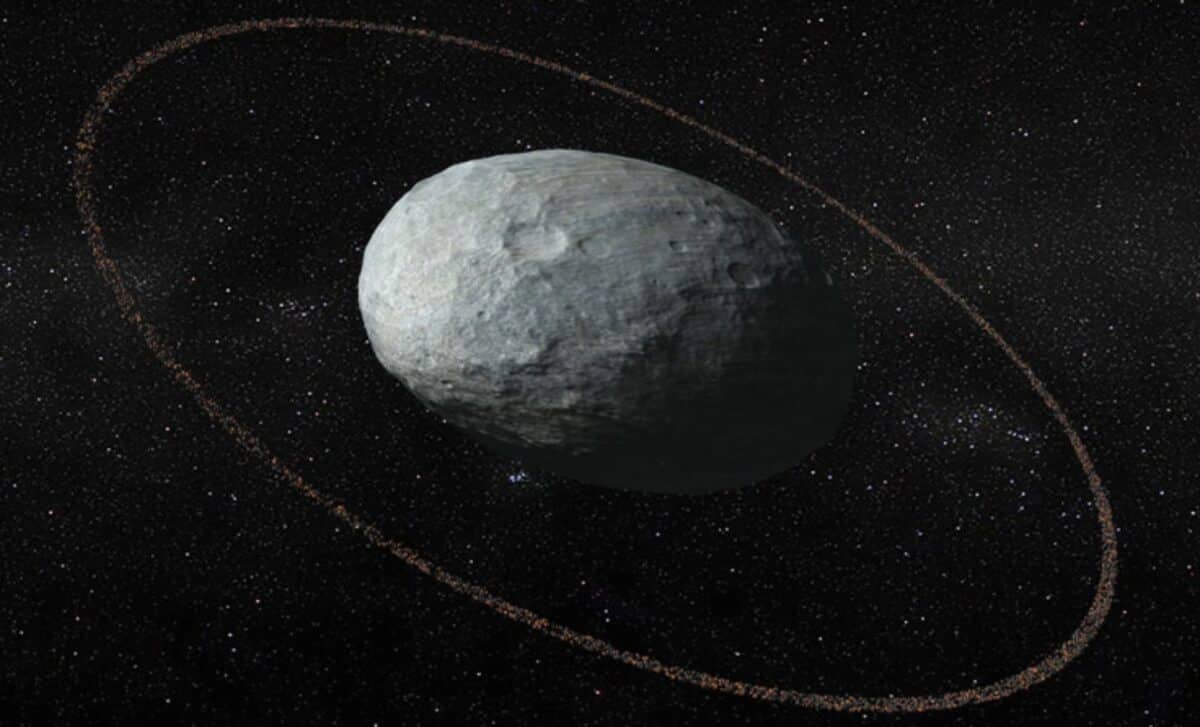
First detected in 2004, the dwarf planet Haumea quickly stood out due to its rapid rotation and elongated form. But the 2017 discovery of a ring system around it added a new level of complexity to an already puzzling object. As astronomers probe deeper into the Kuiper Belt, findings like these are revealing a more dynamic and varied environment than previously imagined.
Located more than four billion miles from the Sun, Haumea is part of a cold, dark region filled with icy remnants from the early solar system. It orbits the Sun well beyond Neptune and belongs to a group of distant objects whose composition and behavior remain largely mysterious. The detection of a ring around such a remote body, along with its unusual shape and fast rotation, has sparked renewed interest in the mechanisms shaping outer solar system objects.
Unexpected Ring Discovered During Occultation
The ring around Haumea was discovered in 2017 during a stellar occultation, when the planet passed in front of a distant star. This type of event allows scientists to study an object’s silhouette by observing how it blocks starlight. According a study, published in Nature, astronomers noticed a dip in brightness that didn’t correspond to the body of Haumea itself. These extra light dips pointed to the presence of a thin, bright ring encircling the planet.
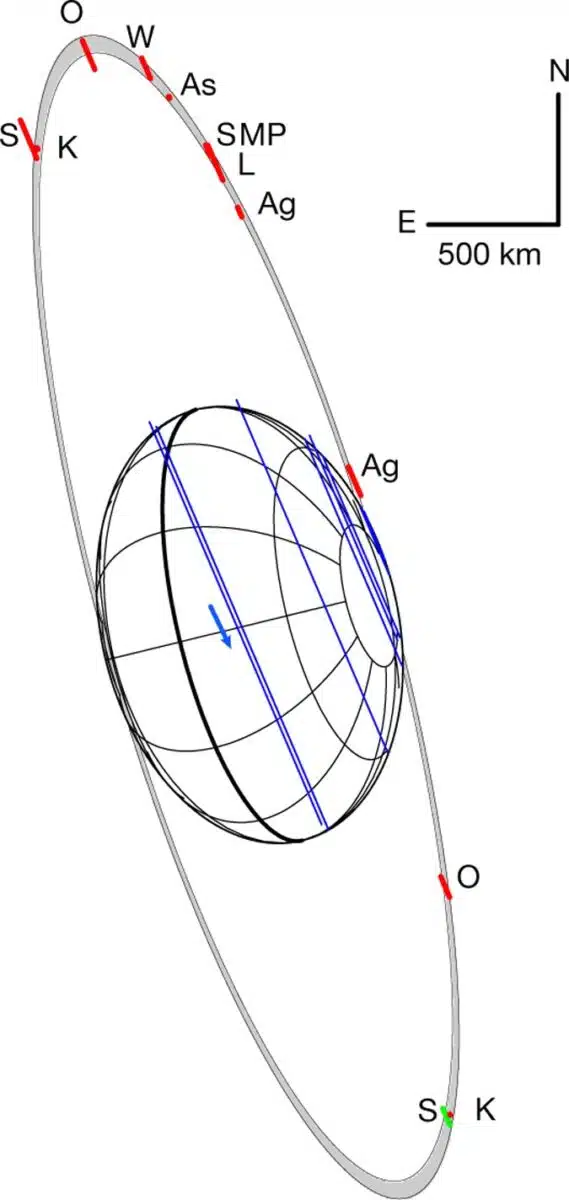 A space “shadow map” of the dwarf planet Haumea. Credit: Nature
The ring orbits roughly 1,000 kilometers above Haumea’s surface and spans an estimated 70 kilometers in width. The discovery was particularly significant because ring systems had, until then, only been observed around gas giants like Saturn or Uranus, and a handful of small solar system bodies such as the centaur Chariklo.
“Our discovery proves that there is a lot more diversity and imagination in our solar system than we had thought,” study co-author Bruno Sicardy of the Paris Observatory.
The ring around Haumea expanded the range of known ring-bearing objects and suggested that such features may not be as rare in the Kuiper Belt as once thought.
Fast Spin Creates Egg-like Shape
What makes Haumea even more unusual is its extremely fast rotation, completing a full spin every four hours. This speed is far greater than any other known large object in the solar system and causes the planet to bulge outward, giving it a stretched, oval shape.
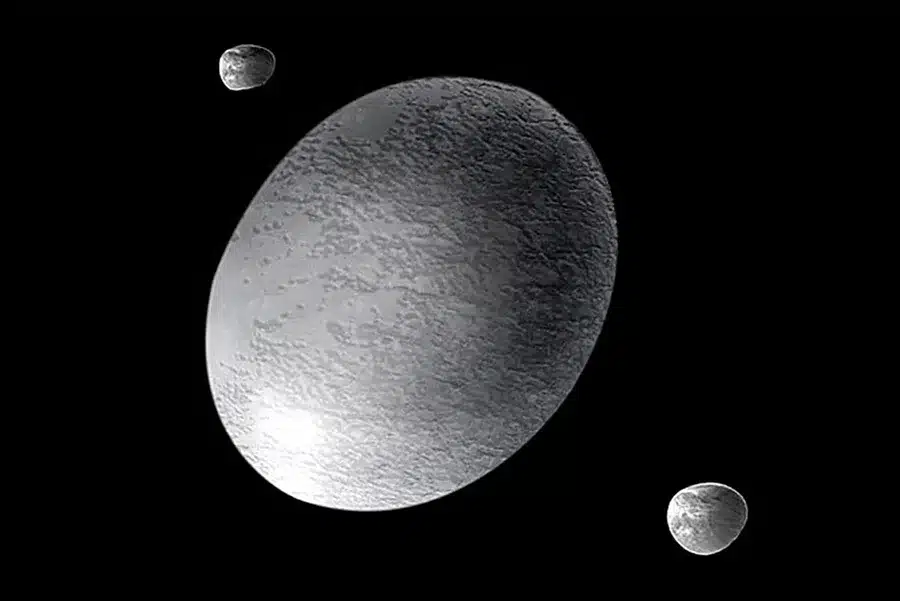 An artist’s impression showing Haumea, a bizarre, rugby-ball-shaped dwarf planet, along with at least two moons and a ring system. Credit: NASA
This violent event could have ejected material into orbit, possibly forming the ring and even Haumea’s two known moons, Hiʻiaka and Namaka. Unlike the smoother surfaces of some other icy bodies, Haumea’s is covered in crystalline water ice, making it highly reflective and further contributing to its standout appearance. The combination of spin, shape, and surface composition makes Haumea one of the most extreme objects identified in the outer solar system.
A New View Of Far-off Solar System Objects
Haumea’s discovery and unique features are helping reshape the way astronomers think about the Kuiper Belt. Once believed to be a region of simple, inactive objects, the presence of a ring around a dwarf planet suggests a more active and complex environment. It opens the door to the idea that ring systems could form under a variety of conditions, not just around massive planets.
The ringed dwarf planet stands out not only because of its bizarre shape and fast spin, but also because it forces scientists to reconsider long-held ideas about where and how planetary rings can form. As reported by BGR, its discovery is part of a growing body of evidence that challenges older models of planetary evolution in the solar system’s coldest regions.