
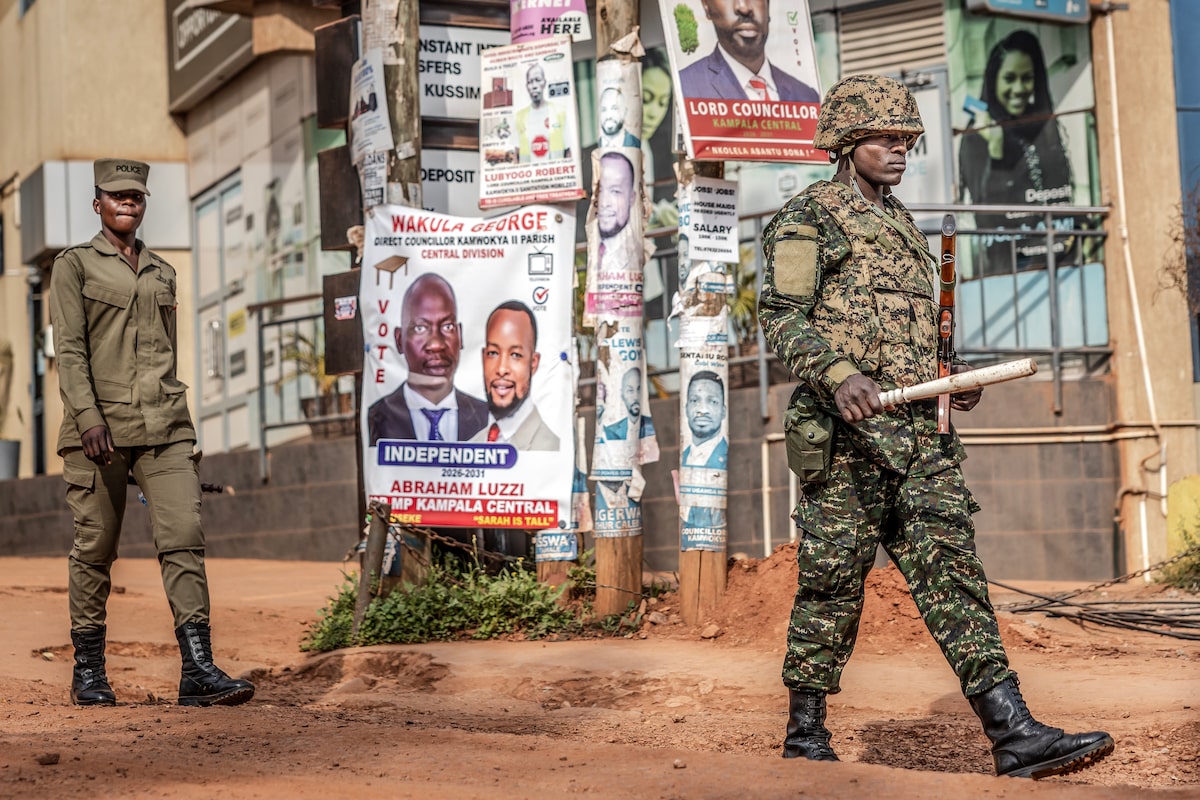
Members of Uganda’s police force and army patrol the streets two days after the country’s 2026 presidential election, in Kampala, on Saturday.LUIS TATO/AFP/Getty Images
African Union observers are questioning the fairness of Uganda’s latest election after authorities announced another landslide victory for President Yoweri Museveni, extending his 40-year grip on power.
Mr. Museveni won 72 per cent of the vote in the election, according to official results announced on the weekend. The main opposition leader, Robert Kyagulanyi, a former pop singer known as Bobi Wine, finished second with 24 per cent of the vote, the electoral commission said.
Shortly after the voting ended on Thursday, police and soldiers surrounded Mr. Kyagulanyi’s home. A day later, they scaled his fence, cut off his electricity and broke into the house to arrest him, but he escaped and went into hiding, he said in a video statement from an unidentified location on Saturday.
“Those so-called results they are declaring are fake, and they don’t in way reflect what happened in the polling stations,” he said.
The African Union observer mission, led by former Nigerian president Goodluck Jonathan, cast doubt on the election in a preliminary report on the weekend. It noted that the Ugandan government had shut down the internet, suspended human-rights groups and illegally deployed the military during the election.
Supporters of Uganda’s incumbent President Yoweri Museveni dance in celebration during a party gathering for the announcement of final election results at Lugogo Grounds in Kampala on Saturday.LUIS TATO/AFP/Getty Images
The observers also cited reports that opposition supporters and civil-society activists were arrested and abducted during the campaign. “Security forces deployed tear gas, water cannons, and, in some instances, live ammunition to disperse opposition rallies, resulting in injuries and fatalities,” it said.
These incidents instilled fear, eroded public trust in the election, infringed on political freedoms and contributed to voter apathy, the observers said.
The main opposition party told the observers that it was blocked from using the campaign venues and accommodation that it had pre-booked, and it was denied access to most of the media, the report said.
It noted that the Ugandan authorities had illegally ordered voters to leave the polling stations immediately after voting, despite laws allowing them to observe from 20 metres away. The order raised suspicions about the transparency of the voting and ballot-counting at polling stations, the report said.
The report by the observers was particularly significant because the African Union has traditionally rubber-stamped most elections across the continent.
Ugandan opposition rejects election results as President Museveni wins seventh term
Ugandan opposition leader ‘forcibly taken,’ party says, as President Museveni nears reelection
But even after the observers questioned the election, African Union Commission chairperson Mahmoud Ali Youssouf issued congratulations to Mr. Museveni and praised Uganda for its “democratic gains.”
After the official results were announced, the Ugandan government ended the five-day shutdown of the internet. Access to social media and messaging platforms, however, was still restricted, according to NetBlocks, an independent monitoring group.
The election “followed a typical authoritarian playbook,” former Botswana president Ian Khama said in a published commentary on Sunday.
The internet shutdown had made it difficult for anyone to do an independent tally of the votes or to expose fraud, Mr. Khama said. The attempt to arrest the opposition leader was similar to what the government has done repeatedly in the past, he added. “You don’t do this as a government if you are secure in your victory.”
Another prominent opposition leader, Kizza Besigye, was abducted in Kenya in 2024 and forcibly returned to Uganda to face a military trial and treason charges. He had been repeatedly jailed in the past.
Mr. Museveni, 81, seized power in 1986 after leading an armed rebellion against the government, and has ruled Uganda ever since. When he first took power, he said Africa’s biggest problem was leaders who “overstay in power.” But he has found ways to prolong his rule for decades, including the abolition of term limits and then a constitutional amendment in 2017 to remove the age limit of 75 for presidential candidates.
He is widely believed to be grooming his son, military chief General Muhoozi Kainerugaba, to succeed him as president, despite his son’s frequent threats on social media to kill opposition leaders and invade neighbouring countries.