
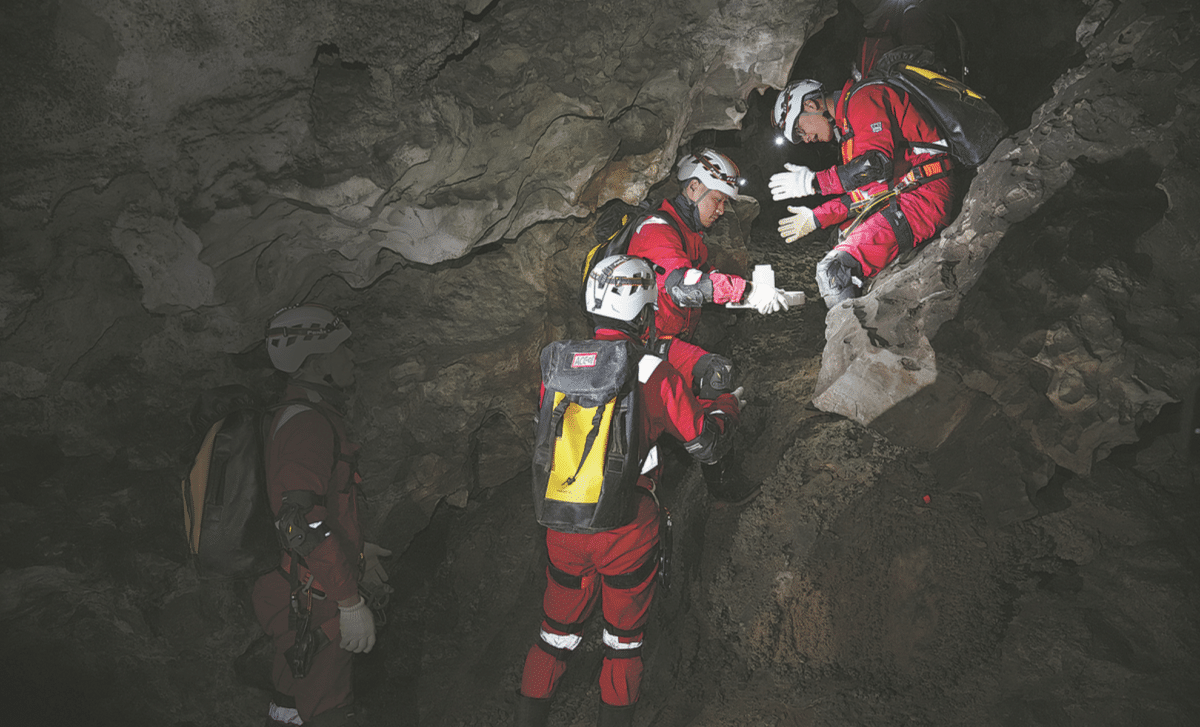
Twenty-eight Chinese astronauts have just completed a highly demanding cave-training mission designed to replicate the psychological and physical extremes of spaceflight. As reported by CGTN, the operation took place in a remote cave system in Chongqing Municipality, pushing astronauts into near-total darkness, chilling temperatures, and full isolation. Far from any spacecraft or simulator, the team immersed themselves in one of the most intense Earth-based simulations China’s space program has ever conducted.
Inside The Cave: Six Days In Darkness And Dampness
Over the course of six days and five nights, each team of astronauts lived, worked, and trained inside a naturally-formed cave where the temperature remained at 8°C (46°F) and humidity reached a staggering 99%. Conditions were extreme, to say the least. The astronauts were required to perform cave mapping, environmental monitoring, simulated space-to-ground communication, and logistical operations, all while being physically and mentally tested at every turn.
What made the cave particularly brutal was not just the physical landscape, narrow passages, vertical drops, and slippery terrain, but also the psychological weight of total darkness and isolation. Astronaut Zhu Yangzhu, of the Shenzhou-16 mission, shared a powerful insight:
“While crawling slowly, I tried to enjoy and savor the pleasure in the process. This way I could offset the difficulties in the psychological environment and the sense of pressure. Later, I even suggested turning off all the lights. Then it was truly pitch-dark, where you couldn’t see your fingers. In that state, we could feel our own heartbeat and breath. That allowed one to experience the extreme quietness in space.”
This kind of environmental immersion, devoid of light and sound, replicates the most disorienting aspects of long-duration spaceflight. It offers unique value that traditional simulators often can’t provide, particularly in testing how astronauts adapt under extreme psychological strain.
Teamwork And Leadership Under Pressure
Beyond the personal endurance required, the exercise was a test of leadership, teamwork, and communication. Teams needed to remain fully operational despite deteriorating conditions and high stress levels. Song Lingdong, astronaut of Shenzhou-19, emphasized how the cave brought the teams together:
“Throughout our training, although the external environment was quite harsh, it actually stimulated our compatibility as a team, brought us even closer and made us more passionate in the work. We all wanted to complete the mission soon and do the work well,” Song said.
The mission wasn’t just about surviving, it was about collaborating under pressure, just as astronauts must do aboard a space station or during a planetary landing. The dynamic of operating in such conditions also gave commanders a real test of leadership responsibility. Tang Hongbo, commander of Shenzhou-17 and again during this training, shared:
“This time I was the commander, and encountered many challenges and difficulties. Firstly, it was all dark underground and it was extremely cold. Secondly, it was pitch dark, where you couldn’t see your own hands. Thirdly, it was a challenge to our safety. As I was the commander and I must be responsible for everyone’s safety, I felt immense pressure on me about that.”
Commanders were responsible not only for mission success, but for ensuring their teammates’ physical safety in an environment filled with real dangers, unstable terrain, limited visibility, and the omnipresent risk of injury or disorientation.
A Realistic Simulation For Future Missions
The China Astronaut Research and Training Center (CARTC) spent years scouting suitable caves for this kind of training. According to CGTN, the selected cave in Wulong District was chosen after evaluating over ten candidates across seven provinces, with criteria focusing on geological stability, training difficulty, and life-support viability. The site ultimately offered the perfect combination of natural obstacles and space-like sensory deprivation.
Astronaut Liu Yang, China’s first woman in space and participant in both Shenzhou-9 and Shenzhou-14, highlighted how emotionally powerful the final moments of the training were:
“When we walked out of the cave mouth, it truly felt like the moment our spacecraft’s re-entry module lands on Earth safely, and everyone exits the cabin. We were all excited and thrilled,” she said. “In our past missions, it was the moment to report back to our motherland that we accomplished the mission. This time, with all our team members safely out, we could report to the training commander our success.”
The realism of this simulation, right down to its conclusion, suggests that China is deeply committed to preparing its astronauts not only for the technical challenges of space, but also for the emotional and psychological toll of deep-space missions. Future operations, whether on the Moon or Mars, may require long periods of isolation, confined quarters, and total reliance on crew cohesion. This training anticipates that reality.
What’s Next For China’s Space Training?
According to CARTC, cave training will be extended to astronauts who missed this round and all future recruits. As China moves forward with its Tiangong Space Station, lunar plans, and potential deep-space exploration, such unconventional and high-stakes simulations will likely become a core part of astronaut training.
The use of natural Earth environments to simulate extraterrestrial challenges is a growing trend worldwide. China’s initiative demonstrates how the country is innovating in astronaut readiness, blending physical training with mental resilience, and ensuring that its astronauts are prepared for the unknowns that lie beyond orbit.