

Listen to this article
Estimated 5 minutes
The audio version of this article is generated by AI-based technology. Mispronunciations can occur. We are working with our partners to continually review and improve the results.
Consumers are still feeling anxious over high prices and economic uncertainty from the U.S. trade conflict, even as several indicators improve, according to a Bank of Canada survey published Monday.
Those surveyed by the central bank for its quarterly Survey of Consumer Expectations perceived a higher likelihood of missing debt payments and a greater chance of losing their jobs. They also expect inflation to stay elevated in the near-term, citing tariffs as a primary driver.
Those worries weighed on their spending plans, with respondents pointing to high prices, economic uncertainty and higher housing costs as barriers to spending. When compared to the previous quarter, more respondents believed their financial situation had deteriorated.
There were optimistic expectations, too. Those surveyed believed they had a better chance of finding a job — or voluntarily leaving a job — this quarter compared to last. Meanwhile, their long-term outlook for inflation eased below pre-pandemic levels.
Yet overall, consumer expectations declined in the fourth quarter and are still well below their pre-pandemic levels — and are lower relative to where they were before the trade conflict with the U.S. began last year.
“This sort of growing divergence between what we call ‘soft’ data versus ‘hard’ data — which is perceived sentiment data versus what the actual economic data is telling us — has been widening pretty much throughout the course of last year,” said Claire Fan, a senior economist at RBC.
Worst of trade war has passed, say respondents
The Canadian economy has proven more stable than the worst case scenario hypothesized by some analysts and economists last year.
While job growth slowed last month and the unemployment rate ticked back up, labour data had largely bounced back in the fall; the country avoided a technical recession in November; and inflation has stayed within the Bank of Canada’s target window.
However, most respondents to the central bank’s survey see the labour market as weak, a feeling that was especially present among workers who were in trade-exposed sectors.
Notably, nearly 50 per cent of survey respondents said Canada had avoided the most serious effects of trade tensions with the U.S. Another 10 per cent believed the worst has already passed, and 28 per cent felt the worst hadn’t happened yet.
WATCH | Has Canada’s economy turned a corner?:
Has Canada’s economy begun to turn a corner?
This week’s jobs numbers will tell us whether the Canadian economy has weathered the worst of the storm
That marks a turnaround from the Bank of Canada’s previous quarterly survey, when the majority of respondents — about a third — felt the most serious effects of the trade war were still to come.
The sentiment that the worst of the trade war has passed is “largely correct on a macro level,” said Fan. But several open questions remain about the future of Canada’s trade relationship with the U.S., she added.
That includes the legal status of the IEEPA tariffs and the fate of the Canada-U.S.-Mexico trade agreement (CUSMA). “There’s still an enormous amount of fog and uncertainty [in] how we think of trade in the coming year,” she said.
Feeling grocery pains most acutely Calgary shopper Brad Berg says he’s spending less in response to rising prices. ‘You live with it. There’s not much else you can do,’ he said. (Paula Duhatschek/CBC)
The cost of living is “going up, and up and up and up,” said Brad Berg, who spoke to CBC News outside of Calgary’s North Hill Centre shopping mall. Berg mentioned that he was spending less to account for rising prices.
“Coffee, beef, everything’s on the rise. You live with it. There’s not much else you can do,” he said. “I buy stuff on sale, put it in the freezer. Just do what I need to do.”
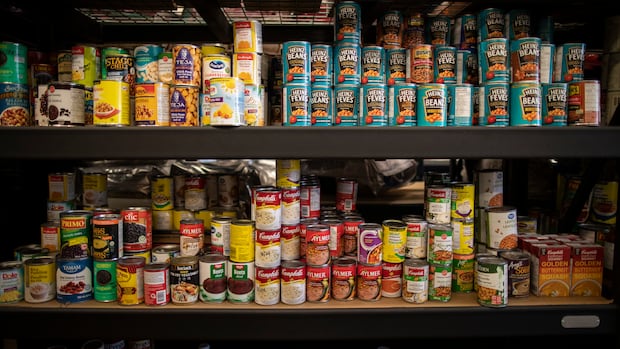
Even as headline inflation has stabilized, food and shelter costs continue to weigh on the overall number. Grocery inflation alone spiked to 3.5 per cent in 2025 on an annual average basis, against a 2.2 per cent average in 2024, according to a StatsCan report released on Monday.
“If we’re up a little bit, psychologically, we know that we respond more profoundly to bad news than we do to good news,” said Mike von Massow, a food economist at the University of Guelph.
As a result, consumers will feel price increases “more viscerally” at the grocery store — because it’s a regular expense, and most people have an idea of how much they spend on a single trip —while noticing flat prices or lower prices to a lesser extent.
“It’s not surprising that the consumer sentiment is still somewhat negative,” von Massow said. “It takes a while for us to maybe absorb the fact that the trend is at least flat and starting to go in the other direction.”
Fan made the same observation. “Having those components go up could really hurt, especially the lower income households that really have nowhere to hide when they’re confronted with these challenges,” she said.