
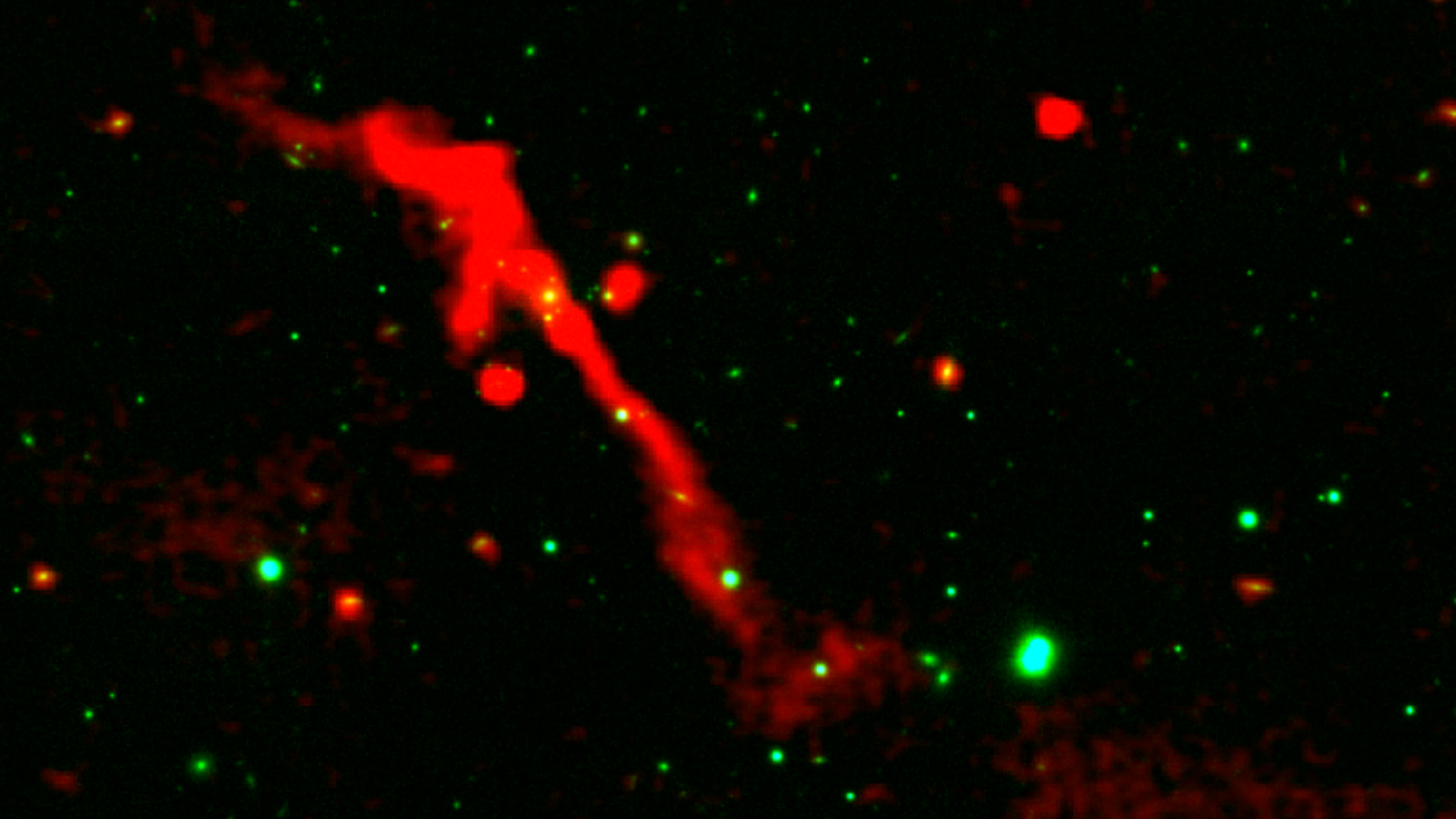
Astronomers have discovered a once-dormant supermassive black hole springing back to life in a very dramatic and spectacular fashion, acting as a “cosmic volcano” blasting out an eruption that stretched out for 1 million light-years. The supermassive black hole in question sits at the heart of the galaxy J1007+3540 and has lain dormant for around 100 million years.
The team of scientists behind these observations used the Low Frequency Array (LOFAR) in the Netherlands and India’s upgraded Giant Metrewave Radio Telescope (uGMRT) to create radio images of J1007+3540 and its incumbent supermassive black hole. These images revealed this vast black hole jet is in a tug-of-war for dominance with the gravitational force of the rest of the galaxy.
‘It’s like watching a cosmic volcano erupt again after ages of calm — except this one is big enough to carve out structures stretching nearly a million light-years across space,” team leader Shobha Kumari, of Midnapore City College, India, said in a statement.
You may like
Supermassive black holes are found at the hearts of all large galaxies, but they are far from all the same. They range in mass from millions to billions of times that of the sun, some are quiet and peaceful, like Sagittarius A* (Sgr A*) at the heart of the Milky Way, and others are actively feeding and violent.
These latter supermassive black holes are surrounded by matter in a flattened swirling cloud called an accretion disk that gradually feeds them. The immense gravity of the black hole at the center of such a disk creates powerful tidal forces in this accretion disk, which generate friction, heating it and causing it to glow brightly.
Not all of the matter in accretion disks is destined to become a black hole snack, however. Intense magnetic fields channel charged particles, or plasma, to the poles of active supermassive black holes from where it is blasted out as jets at speeds approaching that of light. These jets also glow brightly, making these central galactic regions, or Active Galactic Nuclei (AGNs), stand out from vast cosmic distances.
Even among these incredible galactic engines, scientists say J1007+3540 stands out. That is because it shows evidence of turning on and off, restarting after vast quiet periods of time, to begin once again erupting with powerful jets.
Supermassive black hole jet structure
The images collected by the researchers show the structure of the jet from this supermassive black hole, consisting of a bright inner jet and a fainter outer “cocoon” of cooler faded plasma. That indicates to the team a history of repeated eruptive episodes, with the outer sleeve of faint plasma representing the fossil remains of prior blasts.
“This dramatic layering of young jets inside older, exhausted lobes is the signature of an episodic AGN – a galaxy whose central engine keeps turning on and off over cosmic timescales,” Kumari said.
This jet debris seems to have been squashed and distorted by its surroundings due to the fact that J1007+3540 sits within a massive galaxy cluster filled with extremely hot gas. The result is an external pressure far greater than is typically experienced by galaxies of this type, known as radio galaxies due to their brightness in the radio region of the electromagnetic spectrum.
You may like
“J1007+3540 is one of the clearest and most spectacular examples of episodic AGN with jet-cluster interaction, where the surrounding hot gas bends, compresses, and distorts the jets,” team member Sabyasachi Pal, also of Midnapore City College, said in the statement.
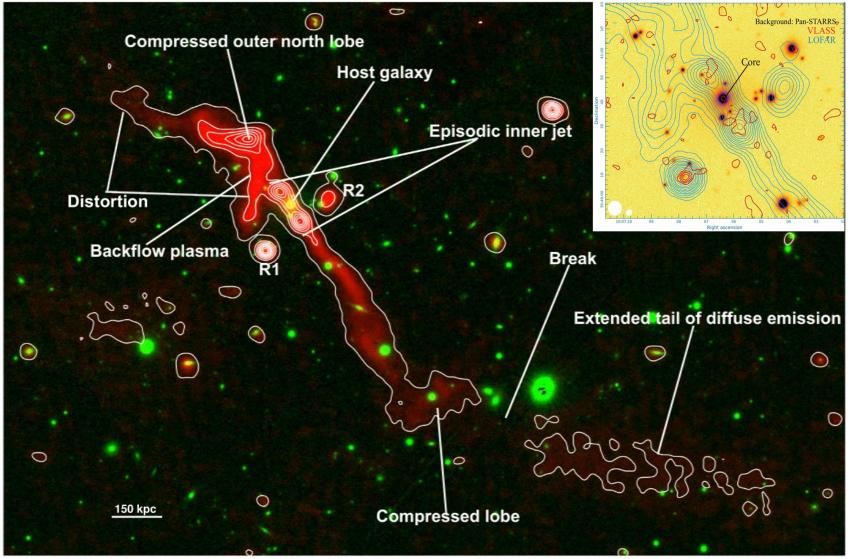
The LOFAR image of J1007+3540 annotated with labels indicating its structure (Image credit: LOFAR/Pan-STARRS/S. Kumari et al)
The image of J1007+3540 from LOFAR shows a significantly compressed and distorted lobe to the north of the structure, which represents plasma being shunted sideways by the gas the jet is trying to force its way through. The uGMRT image reveals that the compressed region consists of older particles that have lost much of their energy. That is another clear sign of the influence the cluster is having on this jet.
Further evidence of the way the harsh environment of J1007+3540 is sculpting these jets comes from a long, faint tail stretching out to the southwest of the structure. This tail consists of plasma that has been dragged through the cluster, creating a wispy trail that is millions of years old.
This galaxy and its supermassive black hole are a demonstration of just how AGNs can turn on and off and how the jets they blast out can change over the course of millions of years. Additionally, J1007+3540 is a lesson for astronomers regarding the influence galactic clusters can have on jet structures.
This could ultimately provide scientists with a clearer picture of how galaxies grow and evolve.
The team’s research was published on Thursday (Jan. 15) in the journal Monthly Notices of the Royal Astronomical Society.