
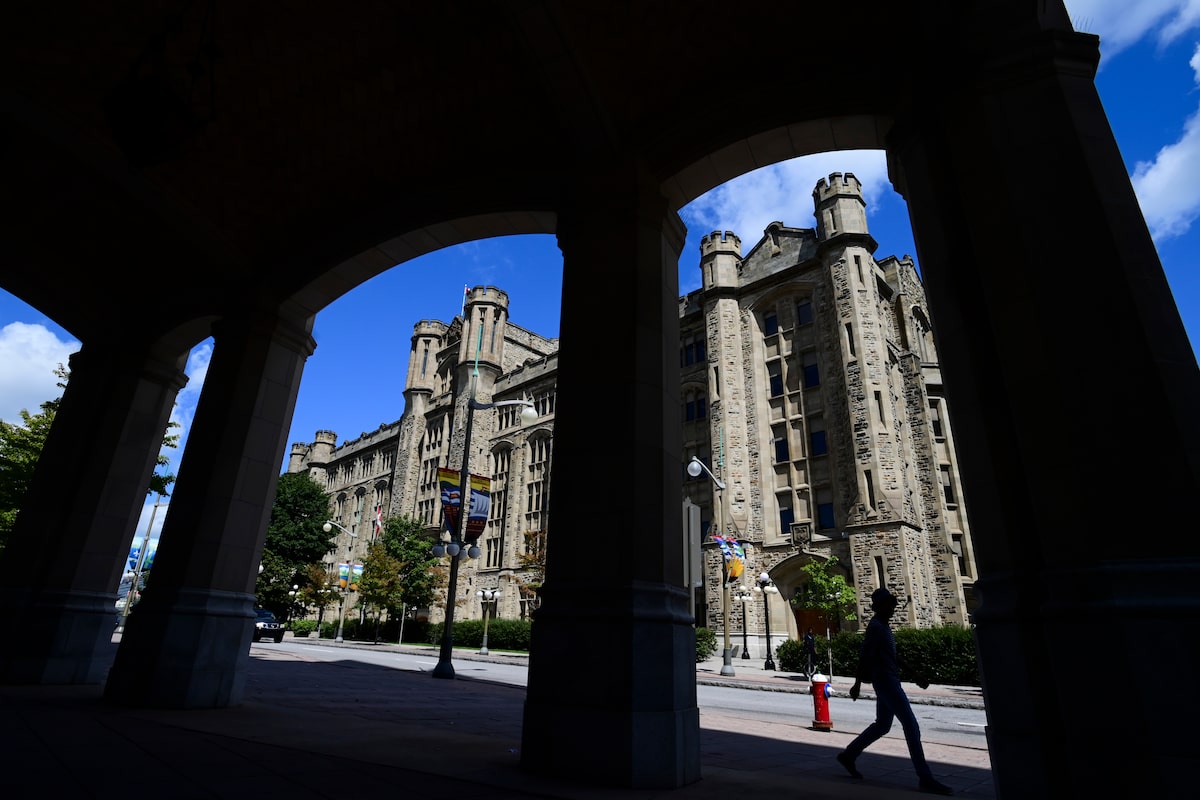
The Canada Revenue Agency headquarters in Ottawa in August, 2020.Sean Kilpatrick/The Canadian Press
The Canada Revenue Agency has reversed its long-held position that mutual fund trailing commissions are exempt from sales taxes, saying the investment industry treats these fees as compensation for taxable services.
Trailing commissions make up a portion of the costs of managing a mutual fund – measured in a management expense ratio (MER) – which can significantly affect net investment growth for investors. The fees are paid out to fund dealers and investment advisers for as long as an investor holds the fund and have traditionally been exempt from sales tax.
In a letter to the mutual fund industry dated Dec. 22 that has yet to be made public, the CRA wrote that a review of business practices indicates the investment firms have been treating these fees as payment for providing continuing asset management and advice to clients. Those types of services are subject to sales tax. That assessment prompted the agency to state that trailing commissions will be subject to GST or HST starting July 1.
“The CRA letter makes it abundantly clear that the industry was hoisted on its own petard regarding the characterization of trailing fees,” investor advocates Harvey Naglie and Ken Kivenko told The Globe and Mail in a joint statement via e-mail.
The investment industry argues that trailing commissions are compensation paid from mutual fund companies to fund dealers and investment advisers for distributing and selling the funds to the public, a service that is exempt from sales tax.
Weathering the markets in 2026: Submit your questions to our investing experts
The Globe has reviewed a copy of the CRA’s letter.
The change is likely to result in sizable administrative costs tied to the collection of the tax for fund dealers. However, experts consulted by The Globe were divided on whether the measure would also result in a significant tax burden for the sector or whether the industry would pass on added costs to individual investors.
The CRA said it wasn’t able to respond by deadline to a list of questions The Globe and Mail sent via e-mail.
Trailing commissions have been exempt from sales tax since the inception of the GST in 1991. More recently, in 2022, the CRA confirmed that trailing commissions were exempt from sales tax, except in limited circumstances.
For example, if an investment dealer receiving a trailing commission did not originally facilitate the initial sale of the mutual fund, the investment dealer would have to pay tax on that fund.
In a 2023 letter, the Securities and Investment Management Association (SIMA), formerly known as Investment Funds Institute of Canada, argued that all dealers who receive trailing commissions should be exempt from GST/HST, including those who may receive commissions from new clients with existing investments, or after buying a new book of business from another adviser.
Mutual funds on track for a comeback year as investors seek fixed income, alternative products
After a lengthy review, the CRA changed its position on trailing commissions when it found that investment firms were paid trailing commissions for “ongoing support, servicing and advice,” rather than just sales transactions, according to its formal response released two years after the industry request.
The CRA cited fund sales documents and regulatory websites, including the Canadian Securities Administrators, that identified trailing commissions as payment for continuing support and advice.
SIMA said its membership is “discussing” the CRA interpretation.
“Our understanding is that CRA’s position is informed by its review of current industry regulations and practices,” SIMA’s general counsel, Arnie Hochman, said in an e-mail to The Globe.
The tax change is likely to attract legal challenges, said Ryan Minor, director of tax at CPA Canada, which represents chartered professional accountants nationally.
But as it stands, the policy shift would result in meaningful additional costs for the sector, he said.
The extra costs would stem from anything from the cost of reconfiguring invoicing software to the need for additional tax advice, according to accounting and financial industry experts.
The added administrative burden would hit both dealers and investment advisers who sell mutual funds, because they would have to collect and remit the tax, as well as fund managers themselves, which would have to pay GST/HST to investment dealers.
And the industry faces a tight timeline to get it all done by July 1, said Tariq Nasir, partner, indirect tax at consultancy EY Canada, which participated in the discussions between SIMA and the CRA in a pro bono capacity.
It is unclear, however, to what extent the change will also result in new revenue for government coffers.
The Canadian Forum for Financial Markets, an association that represents about 100 investment dealers, said in a letter to the Department of Finance, that the tax change “may actually reduce” the amount of government revenue, as companies would be able to claim business expenses to offset the tax.
Mr. Minor said it’s uncertain whether expense claims will fully cancel out the impact of the tax.
Another question is whether the industry will pass added costs onto individual investors in the form of higher fees for mutual funds that carry embedded commissions.
Mr. Nasir said it’s unlikely the tax change will lead to higher MERs for Canadians. But Mr. Naglie and Mr. Kivenko see a risk of higher fees for consumers.
With Canada’s mutual fund industry managing roughly $2.5-trillion in assets, even small cost increases for the industry would translate into hundreds of millions of dollars annually, Mr. Naglie and Mr. Kivenko said.
With a report from Rudy Mezzetta