
Any experienced fantasy baseball manager understands the value of staying ahead of the competition. That edge is especially important in dynasty leagues, where identifying the right sleepers can provide a significant advantage in long-term roster construction.
With that in mind, Geoff Pontes and Dylan White have given fantasy managers a head start by assembling a list of 14 essential sleepers to target entering the 2026 season.
The full list below features a blend of overlooked major leaguers, high-upside prospects and under-the-radar names across the full spectrum of positions.
Dynasty Baseball Sleepers For 2026
Tyler Stephenson, C, Reds
Stephenson has lurked on the periphery of fantasy relevance for five seasons but never put together a top-five season for a catcher, though he finished inside the top 10 in both 2024 and 2021. Now entering his walk year in 2026, the 29-year-old showed tangible changes last year worth buying into.
Stephenson traded some contact for power, posting a career-best 14.4% barrel rate over 88 games. That translated to his highest average exit velocity of his career (90.5 mph) and the highest hard hit rate of his career at 49.2%. He also walked more in 2025 than in any previous season. With his looming free agency, improving power-hitting profile and friendly home park in Cincinnati, I’m buying Stephenson as a potential value in 2026 as he posts his first top-five catcher season. [Geoff]
Gabriel Moreno, C, Diamondbacks
Moreno often goes overlooked because both redraft and dynasty fantasy crowds pooh-pooh his barely double-digit home run power. To me, he’s a no-doubt fantasy asset. He enters his age-26 season as an excellent defender, meaning he’ll earn full-time plate appearances, and he’s an above-average hitter who handles all pitch types well. Even with below-average power, a catcher who doesn’t sink batting average or OBP goes a long way in fantasy. It’s much easier to improve your team’s power during the season compared to upping batting average or OBP. [Dylan]
Ryan Clifford, 1B, Mets
With the likely departure of Pete Alonso in free agency, the projected incumbent at first base is Mark Vientos. But with only 17 career major league games at first base, it’s possible that experiment doesn’t work out. Fortunately, the Mets have Clifford, who should be more than an adequate fill-in defensively, waiting in the wings.
From an offensive standpoint, RoboScout sees the 22-year-old producing, at peak, a .345 OBP with 35 home runs. Those are essentially Bryce Eldridge-type projections without the hype. Public projections have him slightly lower, which to me makes him a sleeper. [Dylan]
Alec Burleson, 1B/OF, Cardinals
In terms of real-life value, Burleson had a better season in 2025 than he did in 2024. However, in fantasy, value often deviates from real life, and Burleson wasn’t as valuable in 2025 for managers due to a dip in RBIs and runs.
Despite this drop in production, Bureleson showed several under-the-hood signs of a coming breakout. For example, he set his career high in barrel rate last season at 9.4%, a product of jumps in exit velocity and steeper angles. Additionally, all of his plate skill metrics trended up, as he lowered his chase rate and swinging-striking rate. With multi-position eligibility, Burleson is poised to potentially provide his managers value at multiple positions. [Geoff]
Chase Meidroth, 2B/SS, White Sox
Meidroth is the type of hitter who is broadly overlooked by the fantasy community on account of his relatively empty batting average. But with his potential for 20 stolen bases (and solid defense), Meidroth is more on the Steven Kwan side of the spectrum than the Nolan Schanuel side, and he comes with a more palatable fantasy profile.
RoboScout sees him as a .280/.360 12/15 type of bat for the next few years, which isn’t all too different from Caleb Durbin, who is being drafted five rounds earlier in redraft and ranked over 100 spots higher in dynasty. With his shortstop-worthy defense keeping him in a lineup, the fact that Meidroth’s floor is so high suggests the gap between the two shouldn’t be so large. He’s exactly the type of player I always find on my dynasty teams. [Dylan]
Otto Lopez, 2B/SS, Marlins
Three years ago, no one would have guessed that anyone would be promoting Lopez as a good fantasy pick. However, we remain in the strangest possible timeline, and Lopez looks like a great buy heading into 2026. Lopez produced a 15-home run, 15-stolen base season in 2025, a performance backed by a career-best barrel rate of 7.1% and a 38.3% hard-hit rate. Additionally, his expected average, slugging and xwOBA all suggest Lopez actually underperformed last year. He saw a jump in flyball rate in 2025, as well, going from 25.5% in 2024 to a career-high 34.1%.
It wasn’t just a matter of adding power for Lopez, either, as he saw improvements to all of his skill metrics, including o-swing and swinging-strike rates that both dropped and contact rates that rose. Lopez did get a little more passive inside the strike zone, but that’s likely a good trade-off for more and better quality of contact. [Geoff]
Kazuma Okamoto, 3B, Blue Jays
Earlier this month, Geoff provided a scouting report on Okamoto that highlighted how the 29-year-old six-time NPB all-star has 50 hit and 55 power grades. That translates to a .250 batting average with 20-25 home runs in MLB. As an above-average defender at the hot corner, he should have a high floor for at least three years. I’m betting that his bat-to-ball skills will translate better to the major leagues and be closer to .280 than .250, with an accompanying OBP around .340.
If Okamoto is capable of that type of production, it compares to recent-era Alex Bregman. If a top 20% outcome is to produce on par with the 11th-ranked third baseman in dynasty—while likely playing on a competitive team—that’s a sleeper. [Dylan]
Brock Wilken, 3B, Brewers
It’s been a pair of trying seasons for Wilken, who dealt with a scary injury in 2024 after being hit in the face. In 2025, Wilken was enjoying the best season of his career prior to an injury sustained while celebrating Double-A Biloxi’s first-half championship. Wilken is healthy heading into 2026 and could be on a trajectory to see time with the Brewers next season. He has plus game power and projects as a 30-home run bat. He could ascend to the majors by midsummer and produce big power numbers down the stretch without sacrificing on-base skills. [Geoff]
Ezequiel Tovar, SS, Rockies
As we mentioned in his rankings blurb, it was just a couple seasons ago as a 22-year-old when Tovar hit 26 home runs with a .269 batting average while having 99th percentile range at shortstop. Throw in the fact that he plays at Coors Field, and you should get a .280 average with 20-plus home runs for the next five years or so. In batting average leagues, that’s excellent.
But after a 2025 season plagued by hip and oblique injuries, in redraft leagues for 2026, fantasy managers are drafting him as if he has the possibility of being demoted in a worst-case scenario with .270 and 20 home runs as an equally likely upper-percentile outcome. In OBP leagues, Tovar is not as great of an asset, but I think he is definitely being overfaded for next year. I’m betting that Tovar will be ranked higher in 2026 than he is now. [Dylan]
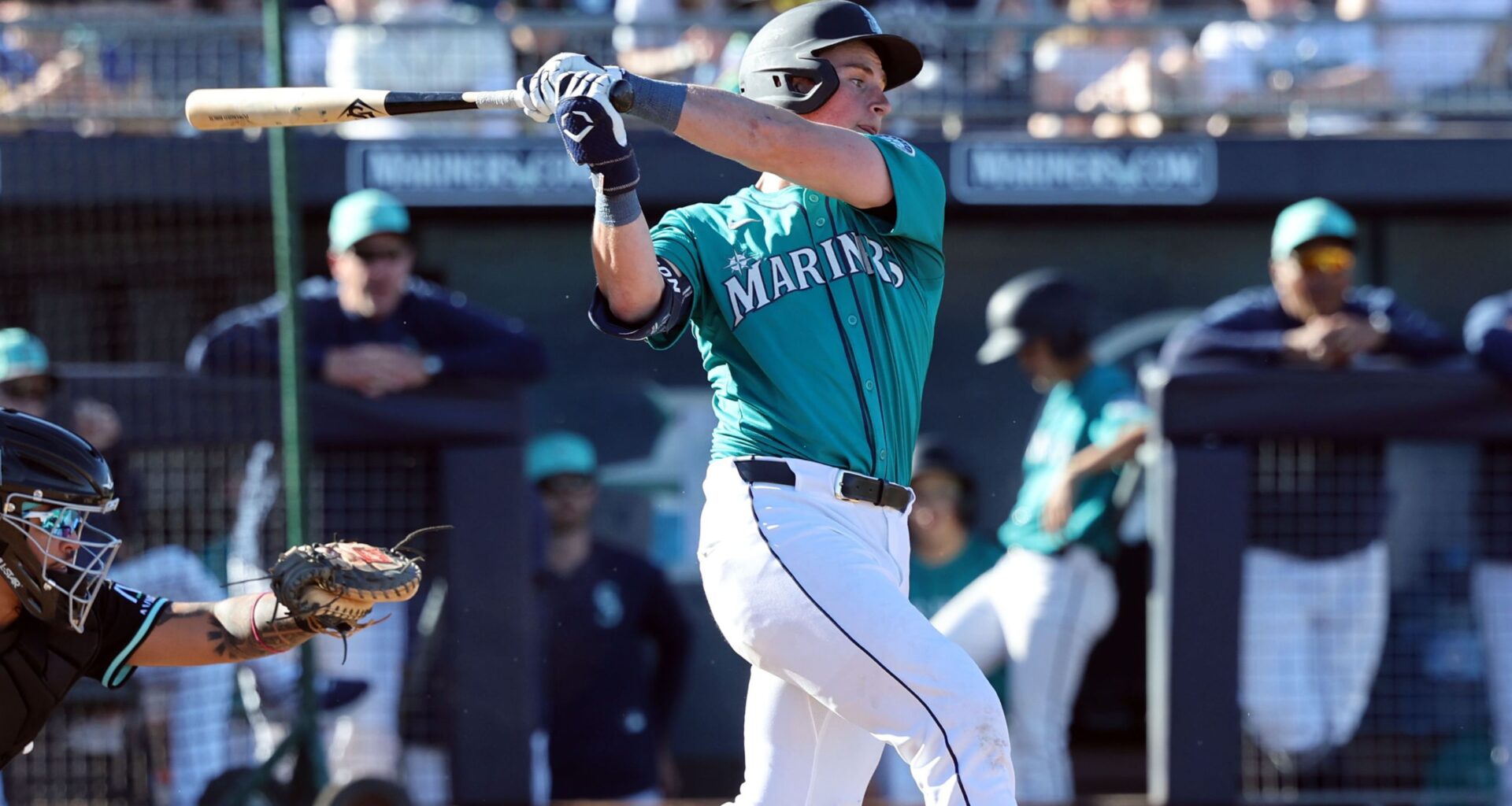
Colt Emerson, SS, Mariners
I understand that Emerson is not a sleeper in a majority of leagues, but I believe his potential 2026 impact is being undersold. He made a tweak to his swing in the first half of last season and the results that followed were impressive. So much so that he climbed to Triple-A on the wave of his second-half accomplishments. Emerson has a plus hit tool, which provides a high floor for batting average and on-base percentage. With his swing improvements in the second half, he also started to finally tap into his 25-plus home run power more consistently. Buy now and laugh all the way to the bank in nine months. [Geoff]
Lawrence Butler, OF, Athletics
As a 23-year-old in 2024, Butler went 20/20 in only 450 plate appearances while also producing a 130 wRC+ and 4 fWAR. After “only” going 21/22 in 2025, projections have him as essentially a league-average bat who should again hover around 20/20. After it was revealed that he needed knee surgery after battling the injury for much of the season, Butler’s 22 stolen bases are actually all the more impressive. It also suggests his decline in sprint speed to the 35th percentile might not be “real”. In other words, Butler’s true talent may be closer to his excellent 2024 partial season than last year when he was not fully healthy—something that projections are not fully capable of identifying.
Playing for an A’s team on the rise and in a great hitter’s park, there’s a reasonably high chance Butler has an excellent 2026 campaign and ends up being valued as a top 15 outfielder in dynasty by the end of the year. I’m targeting him where possible. [Dylan]
Joshua Baez, OF, Cardinals
Baseball has a way of proving you wrong. Even when it feels like you know everything there is to know about a player, most of the time, you know nothing. The enigma of Baez fits neatly into this narrative. Baez struggled through three terrible seasons to begin his professional career before finding another gear in 2025. Now, freshly added to the Cardinals’ 40-man roster, Baez looks to be a dark horse rookie of the year candidate in 2026. He accomplished this by cleaning up his approach and finding more contact, which allowed him to get to his plus power and speed tools for the first time as a professional. If these changes hold, Baez has a chance to blossom into a star. [Geoff]
Jonah Tong, RHP, Mets
With an unsightly 7.71 ERA and a 1.77 WHIP across his five starts in his major league debut, I think there is an opportunity to take advantage of what might be the nadir of Tong’s value. With the same 64-degree arm angle that Blue Jays pitcher Trey Yesavage possesses, Tong too provides a semi-unique look that ate up upper-level minor league hitters to the tune of a 40.5% strikeout rate across 113.2 innings in Double-A and Triple-A. Per RoboScout, despite the reasonably lofty 10.6% walk rate, that corresponds to an expected WHIP and ERA of 1.16 and 3.35, respectively. That projection is better than Chase Burns’ 2025 minor league performance and Yesavage’s when translated to the major league environment.
Of course, it is possible that Tong’s stuff is not as electric as Burns’ or not as deceptive as Yesavage’s but note that FanGraphs’ PitchingBot has Tong’s stuff rating at 62, which is better than Yesavage’s 55. Yesavage also had a 10.5% walk rate in the minors in 2025—nearly identical to Tong’s. Still, trying to weight recent MLB performance for a player with less than the 113 innings in the upper minors can be tricky. There is a chance Tong is not in the Mets’ rotation for more than 100 innings in 2026, but in terms of long-term value, he should be a mid-3s ERA pitcher with more than a strikeout an inning for the next 5-7 years. [Dylan]
Tatsuya Imai, RHP, Astros
Imai has had success in NPB and brings a pitch mix that should translate well to MLB. He has a flatter four-seam fastball similar to the Dodgers’ Emmet Sheehan or the Brewers’ Freddy Peralta. His slider is his best pitch and is a better version of Trey Yesavage’s cut slider. Like most Japanese pitchers, Imai also has a very good splitter. It’s a three-pitch mix of above-average-or-better options with average control projection. Imai has taken big strides over the past few seasons and looks poised for a potential top 30 pitching season in 2026. [Geoff]