

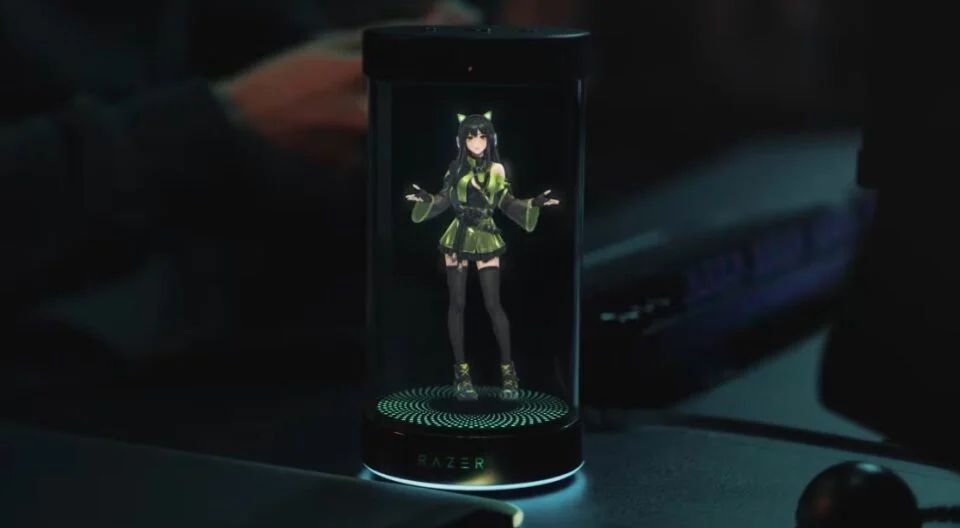
In a splendidly combative interview with Razer’s billionaire CEO Min-Liang Tan, The Verge‘s Nilay Patel took him to task over the peripheral company’s approach to AI, not least including the Grok-powered waifu-AI-in-a-jar stunt it pulled at this year’s CES. The hour-long interview gets more and more uncomfortable as it becomes clear Tan has no answers for any of the crucial questions Patel is putting to him. And just wait until he’s asked what games he’s played recently.
The interview, which took place live on stage at 2026’s CES, has such a peculiar tone. The Verge‘s Nilay Patel makes pretty obviously cynical remarks about Razer’s approach in terms of the attention-seeking silliness it pretends to be developing, and Min-Liang Tan replies as if the questions are entirely sincere. Of the Ava AI tube, “Did you say to your team, ‘I want a holographic anime waifu on my desk’? You say the metric is ‘what we want.’ Who was like, ‘I want this’?” asks Patel. Tan then launches into a deeply sincere response about how the holo-lady was there to represent technology Razer can create for game companies, meeting an imagined desire for “a holographic representation of some of your latest characters,” and that the product demonstrates “we’re now able to get personality there and have conversational AI coming through,” and further that it isn’t just “great software” but now features “great intelligence.”
As impossible as it is to think of a single use-case for a game character appearing in a physical tube and being able to spurt Grok responses back at people, Tan enthuses, “It’s that premise of being able to chat, as opposed to clicking a button or typing on something, and having a little thing over there.” It’s “a little bit of sci-fi, us growing up always wanting something cool like that, and so we said, ‘Hey, it’s a great concept,’ and I think the community loves it.”
Ava, which has a website that’s taking $20 preorder deposits and states that the product “is expected to be available in the second half of 2026,” is certainly not going to be released then, if at all, as becomes awkwardly obvious as the interview continues. When pressed on the reality of Ava actually being developed as a consumer product, rather than something “hack[ed] together” for CES, Tan starts to prevaricate. “We plan to put it out, but we do want to get as much feedback, to hear what the concerns are, right? Are there things we can do better? What’s cool? What are the characters that we would like to get on?” Which are all really strange questions to be asking of a product that’s supposedly going on sale later this year. Not least one that’s planning to run on Grok, Elon Musk’s wildly unstable and poorly managed AI.
“Can you care about trust and safety, and also partner with Grok?” asked Patel, with the interview taking place as the stories of Grok’s gleeful creation of revenge porn and CSAM were breaking. Tan does not answer the question at all, but rather speaks of Grok’s “really great conversational AI model.” When Patel puts to him the other obvious issues of a Grok-powered conversational device, Tan gives some of the most astonishingly dreadful responses, such as declaring, “Well, the doors have been open since Tamagotchi,” and “we’ve interacted with NPCs.” Patel desperately persists, laboring over the point that intentions are meaningless when we all know what gen-AI is already doing, but Tan refuses to engage, instead just repeating the usual lines about “software guardrails” and how the tech is [deep sigh] “evolving.”
 © Razer
Patel continues heroically on. When asking Tan about glowy-keyboard company Razer’s intentions to invest $600 million into “AI” alongside employing 150 AI engineers, the host points out “that gamers hate it. The gamers, I think, are in open revolt against AI coming into their games, into their platforms.” This obviously hits rather close to home for the Razer CEO, who arrived at CES under the banner of “AI is the future of gaming.”
Tan attempts to draw a line between the “AI slop” that most game players are currently revolting against, and the nebulous “AI tools” that will help developers with QA and cause them to “develop better games.” He talks of a “QA companion” that Razer is developing to “work with the human QA tester” by, um, filling in forms. Genuinely, that’s the example.
But as much as Patel pushes, Tan never provides an actual example of a compelling use case. Instead it’s all about how “helpful” it will be, how it’ll “work with” current products, but never with a single concrete example of what he’s actually talking about. But it is, of course, “revolutionary.” Thank goodness for Patel, who jumps in at this point to demand that Tan explain what exactly is “revolutionary” about putting a camera with “AI” in it in some headphones in Razer’s Motoko. The answer: “Well, I would say, first off, we are really looking at being able to have an unobtrusive universal form factor to enable AI smarts.” Ho boy. It’s ChatGPT talking at you in your ears. And, more specifically, an imaginary future version of ChatGPT that can interpret live camera footage and ambient audio and provide related answers based on these feeds.
And for all of Tan’s protestations that Razer isn’t interested in “slop,” he then goes on to deliver that hoary old line, “We’ll see new forms of artists, artists of whom may not necessarily have been so adept in terms of using a paint brush or using Photoshop, now being able to kind of wordsmith and craft great pieces of art with prompts throughout.” So yeah, just plagiarized slop then.
And just in case it couldn’t get any worse, Patel finishes up by asking Tan—who repeatedly declared his love for gaming throughout—what games he’s playing right now. “Oh, it depends.” Nope. On a second try he says, “Civilization and stuff like that…I do play some MMOs of sorts, shooters, and I still play a lot of the battle royale genre.” Patel points out those are genres and desperately presses for the name of a game. “Oh, well, I play random stuff.” Fucking hell.