
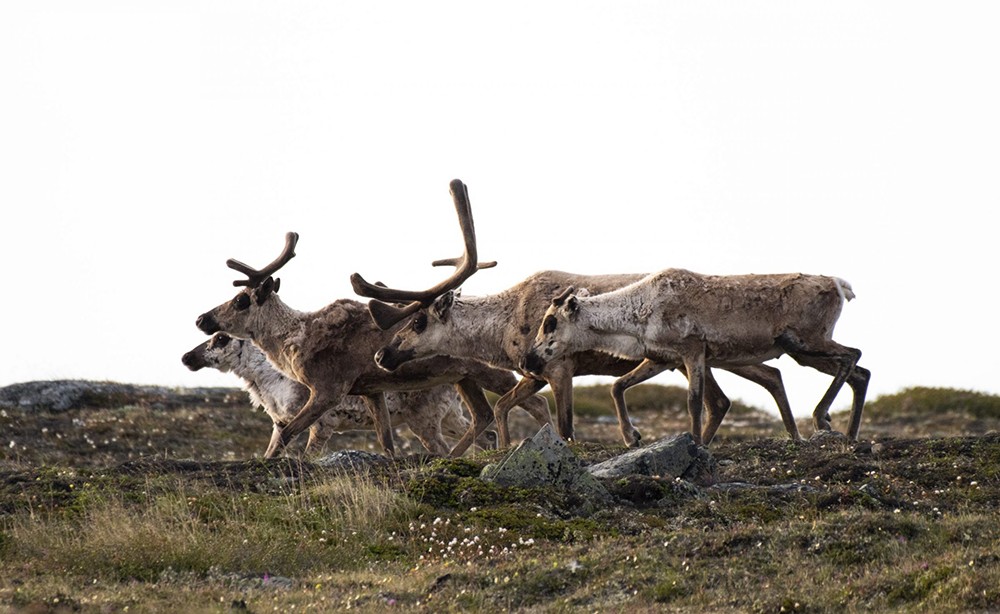
Scientists studying Baffin Island’s caribou herds say there has been a ten-fold recovery of the population in the past decade.
“The numbers we are seeing are incredibly good news right across the board,” said Mitch Campbell, regional wildlife biologist for the Kivalliq region at Nunavut’s Environment Department, in an interview.
The population has grown to more than 48,000, the Aerial Abundance Estimates and Trends of the Barren-Ground Caribou of Baffin Island Nunavut – March 2024 and 2025 said.
The 2014 aerial abundance study determined the population had collapsed to 4,600 animals from a previous 1980s estimate of 150,000.
Government of Nunavut researchers broke their recent survey into two phases: March-April 2024 and March-April 2025.
In 2024, they surveyed south Baffin Island using two Twin Otter planes and a helicopter. Some caribou were tagged with tracking devices so researchers could locate herds and ensure they weren’t counting the same herds twice.
The process was repeated in 2025 for central and northern Baffin Island.

Before the recent study, researchers believed the population had been recovering. But the growth rate indicated in the study exceeded expectations, Campbell said.
Researchers estimate the population grew by between 15 per cent and 36 per cent every year from 2014 to 2025.
Prince Charles Island, an uninhabited island in the Foxe Basin, was the only place where the population declined. The number of caribou there shrank to 1,063 in 2025 from 1,603 in 2014.
Campbell said he isn’t concerned by that because small island herds are subject to frequent boom and bust cycles, so the island’s caribou population is expected to recover relatively quickly.
Overall, he said he believes the caribou population growth on Baffin Island hasn’t peaked, but he could not say what the upper limit could be.
The previous estimate of more than 150,000 in the 1980s was based on sparse data, he said, and scientists could not be certain the population was ever that size. Nunavummiut shouldn’t see that number as a target.

The new numbers are good news for the people of Baffin Island who depend on the caribou herds for hunting.
Since the 2014 survey, Nunavummiut on Baffin Island have faced restrictions on caribou harvests. Hunting caribou was banned outright until 2015 when the moratorium was replaced with a limited harvest that continues to this day.
The Nunavut Wildlife Management Board “came up with a solution, and the people stood behind the solution and the herd recovered,” Campbell said.
With the study completed and the caribou population rebounding, there will be new discussions around hunting and conservation. Campbell said the Government of Nunavut will hold consultations with hamlets, hunters, and other stakeholders.
Consultations are set to begin in February, he said. Campbell couldn’t say whether harvesting restrictions might be relaxed, but that possibility would be a part of the conversation.

“I have a huge faith in the communities to continue providing excellent advice with their expertise on the land and with wildlife,” he said.
While the exact circumstances of the caribou population’s collapse before 2014 are not known, it’s suspected they go through cycles due to natural factors like food abundance and less due to animal predation or hunting.
“We’ve got the science end of it. [Now] we need Inuit knowledge to come into this equation,” Campell said. “We need to speak with the communities and caribou experts in the communities.”