
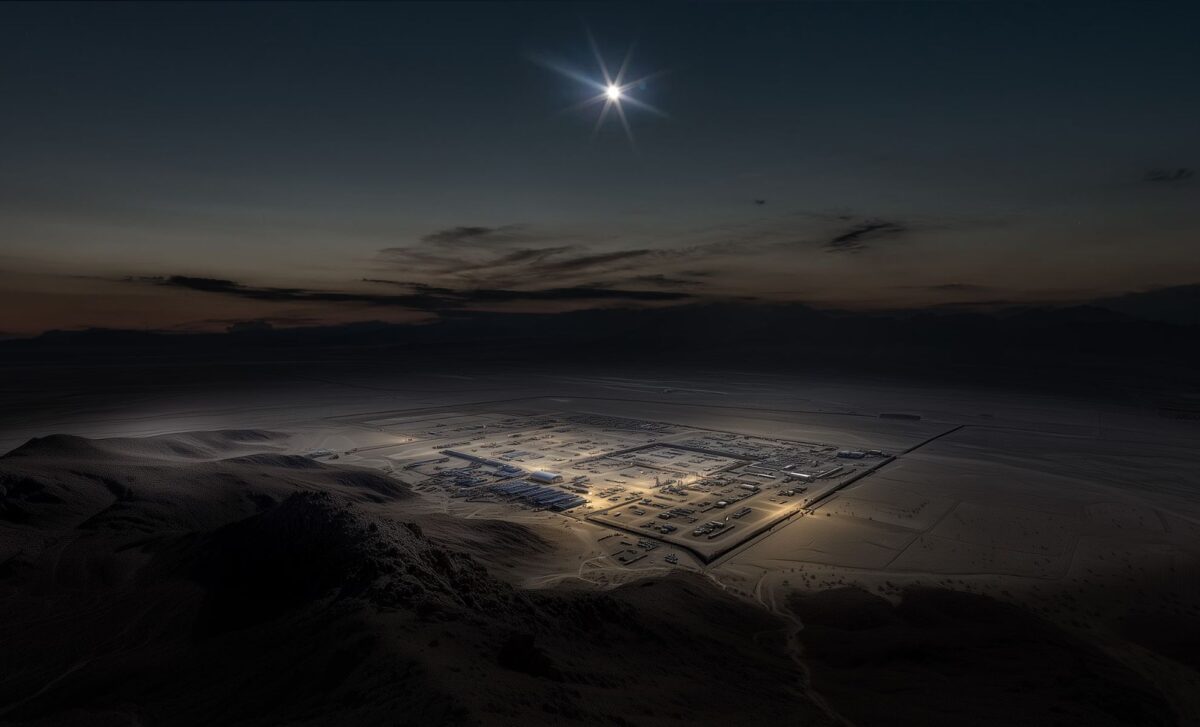
A California startup wants to use giant orbiting mirrors to reflect sunlight onto Earth after dark. The first test satellite is set for launch in April 2026, but the idea has already sparked backlash from astronomers, environmentalists, and sleep researchers.
The company behind the project, Reflect Orbital, envisions a future where darkness is no longer a limitation. By placing thousands of 55-meter-wide mirrors in low Earth orbit, the startup aims to direct sunlight onto solar power sites and other critical areas during nighttime hours. These satellites would follow a sun-synchronous orbit, hugging the line between night and day, to capture and redirect sunlight even when the surface below has gone dark.
The Unintended Glow Of Space Mirrors
Reflect Orbital’s mirrors are designed to act like massive reflectors, sending diffused beams of light back to Earth. Because the Sun occupies a significant portion of the sky, the redirected sunlight naturally spreads over a wide area, reducing the beam’s intensity and making it difficult to tightly control.
“Reflect Orbital is pioneering a new category in-space infrastructure,” stated Josh Wolfe, Managing Partner at Lux Capital. “We believe their on-demand illumination technology has the potential to reshape how we solve problems on Earth–from critical operations to energy resilience.”
According to Communications Daily, the first test satellite, called Earendil-1, has already been filed for approval with the Federal Communications Commission, with a launch window in early April 2026. And as Earth.com explains, light can travel up to 96 kilometers beyond the target zone due to atmospheric scattering caused by air particles and aerosols.
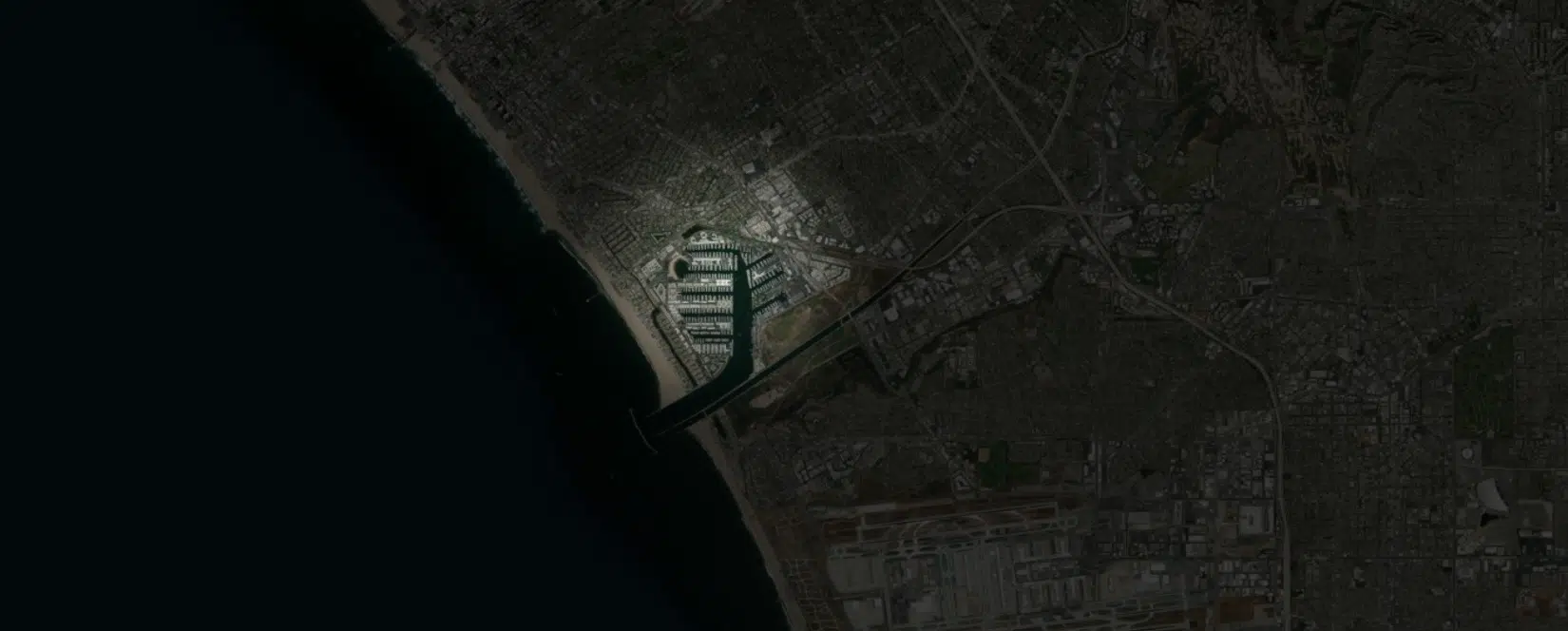 Simulated satellite view of space mirror light illuminating California’s coast at night. Credit: Reflect Orbital
The Night Sky May Never Be The Same
The astronomical community has reacted strongly to the sky mirror concept, citing the increasing difficulty of conducting uncontaminated observations. According to NASA researcher Dr. Alejandro S. Borlaff, whose work was published in Nature, light from reflective satellites can streak across telescope images, obscuring faint celestial bodies and interfering with time-sensitive data collection.
Even with software that removes satellite trails from images, the process often results in lost data in affected areas. Dr. Borlaff’s findings show that one-third of Hubble Space Telescope images are already impacted by satellite contamination. With the number of satellites expected to explode in the coming years, concerns about sky brightness and image quality are becoming urgent.
Some experts have estimated that the direct beam from one of these mirrors could appear up to four times brighter than a full moon. In nighttime conditions, such brightness could overwhelm sensitive instruments and make it impossible to detect dim asteroids, galaxies, or transient cosmic events.
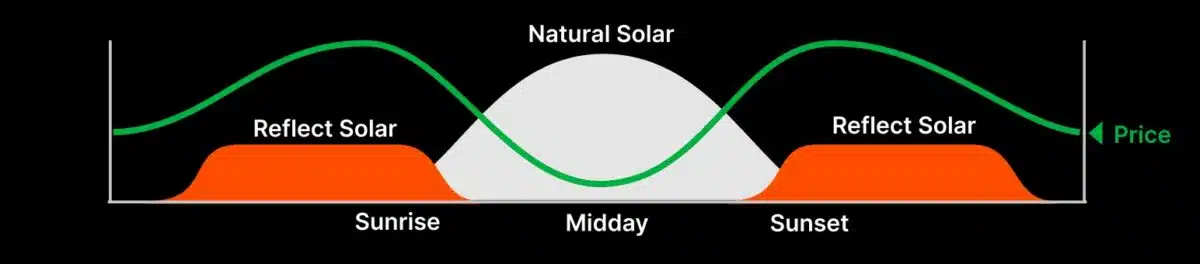 Space mirrors boost solar output at sunrise and sunset. Credit: Reflect Orbital
What Happens To Wildlife When We Light Up The Night?
Many animals, like birds and insects, rely on natural darkness to feed, rest, or migrate. Earth.com explains that sudden or repeated artificial light can confuse these rhythms and cause stress. Humans are affected too, bright light at night can mess with sleep, lower melatonin, and harm mental health, especially when it comes from the sky and can’t be avoided.
There’s also the question of fairness. People living under the mirrors wouldn’t get a say, even though the light affects them. The same source noteed that private companies could control when and where the light appears, but the impact would cross borders. With no global rules in place, this could quickly become a bigger problem.