
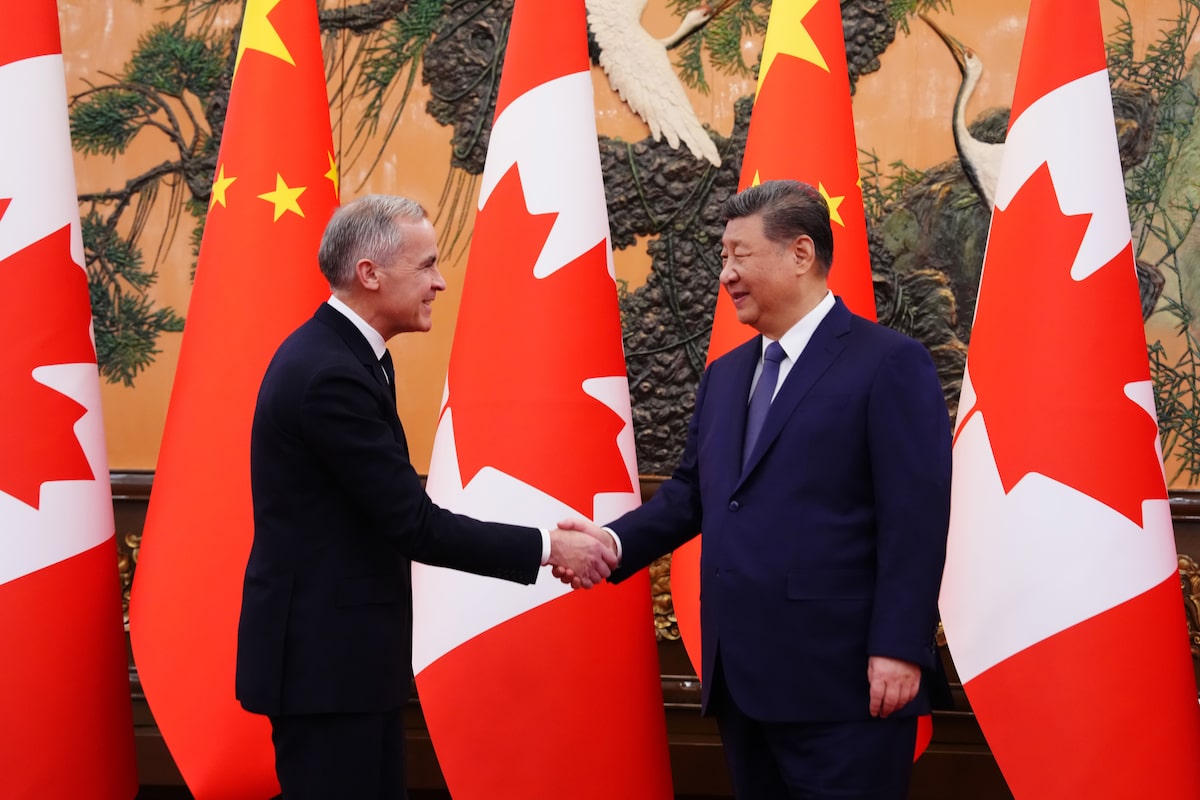
Prime Minister Mark Carney meets with Chinese President Xi Jinping at the Great Hall of the People in Beijing, on Friday.Sean Kilpatrick/The Canadian Press
Prime Minister Mark Carney reached what he called a “landmark” trade deal with Chinese President Xi Jinping in Beijing on Friday, ending a four-day visit aimed at mending strained relations between Canada and China.
The new “strategic partnership” will slash tariffs on Chinese electric vehicles and certain agricultural and food products – including Canadian canola, lobsters and crab. It also brings about a truce in a painful trade war between Ottawa and Beijing as the Prime Minister seeks bigger overseas export markets and new foreign investment to offset the economic damage caused by U.S. President Donald Trump’s protectionist tariffs.
Here’s a breakdown on the details of the agreement, which tariffs remain between the two countries and how key players are reacting to the news.
What are the details of the trade deal between Canada and China?
Ottawa has agreed to allow 49,000 Chinese-made EVs into the Canadian market, lowering the tariff rate to 6.1 per cent – a reduction from the 100-per-cent tariff imposed on all Chinese EVs in tandem with the United States in 2024. Mr. Carney later told reporters he expects the EV amount will rise about 6 per cent annually – reaching 70,000 vehicles in half a decade – and that part of the quota will be reserved for cars with an import price of $35,000 or less.
In return, China will cut tariffs on canola seed to approximately 15 per cent from current combined tariff levels of 84 per cent starting March 1.
According to Mr. Carney, China has also committed to removing tariffs on Canadian canola meal, lobsters, crabs and peas by March 1 “until at least the end of this year.” It is unclear whether this tariff relief would be extended beyond 2026.
China was Canada’s largest customer for canola seed, with a market valued at $4-billion in 2024. Without Chinese buyers, total exports of canola since Aug. 1 fell by more than two million tonnes compared with the same period a year earlier.
What else is expected from the ‘strategic partnership?’
According to statements from the two countries, Canada and China have agreed to work together in a wide range of areas, such as EVs, energy and agriculture.
The Canadian government has set a goal of increasing exports to China by 50 per cent by 2030, a news release from the Prime Minister’s Office stated. The PMO also said Mr. Carney and Mr. Xi spoke about boosting two-way investment in clean energy and technology, agri-food and wood products.
In addition, the Prime Minister said Mr. Xi has committed to removing visa requirements for Canadians travelling to China.
The two nations will restart the Canada-China Joint Committee on Culture and Canada will look to attract more Chinese tourism to the country, particularly around this year’s FIFA World Cup.
Which tariffs remain between Canada and China?Open this photo in gallery:
Canola crops at a farm in Saskatoon, in July, 2025.Ed White/Reuters
While Canada and China have agreed to ease some tariffs, some significant ones still remain.
In March, 2025, China slapped 100-per-cent tariffs on canola oil, meal and peas, as well as 25-per-cent tariffs on pork and seafood products. There was no mention of canola oil or pork in the recent trade deal, so Chinese tariffs on both remain in place.
Canada, on the other hand, still maintains 25-per-cent tariffs on certain Chinese steel and aluminum products, a measure that was introduced in 2024.
How long have tensions been strained between the two countries?Open this photo in gallery:
Prime Minister Mark Carney walks at Ritan Park in Beijing, on Friday.Carlos Osorio/Reuters
Mr. Carney’s official visit to China is the first by a Canadian Prime Minister since 2017, and marked a turning point in the relationship between the two countries.
Diplomatic relations deteriorated in 2018 when Beijing detained two Canadian citizens – Michael Kovrig and Michael Spavor – for more than 1,000 days after Ottawa arrested Chinese tech executive Meng Wanzhou on an extradition request from the U.S. The two Michaels, as they became known, returned to Canada on Sept. 24, 2021, after the legal issues surrounding Ms. Meng were resolved.
However, Guy Saint-Jacques, a former Canadian ambassador to China and a 40-year veteran of this country’s diplomatic corps, told The Globe and Mail’s Steven Chase that the erosion of the relationship started in 2017, when then-prime minister Justin Trudeau tried but failed to launch negotiations with Beijing on a free trade agreement.
Since then, there have been reports around foreign interference that resulted in a months-long federal public inquiry in 2025 that concluded that China is “the most active perpetrator of foreign interference targeting Canada’s democratic institutions.”
A trade war between Canada and China was specifically ignited when Ottawa placed its 100-per-cent tariff on Chinese EVs in tandem with the U.S. in 2024 under the Biden administration. The rationale was that China was subsidizing and overproducing EVs, swamping global markets and undermining other countries’ ability to compete. Beijing later responded with retaliatory levies on Canadian seafood and agricultural products.
What could the Canada-China trade deal mean for Trump, USMCA negotiations and U.S. relations?Open this photo in gallery:
U.S. President Donald Trump delivers remarks on tariffs in the Rose Garden at the White House on April 2, 2025.Carlos Barria/Reuters
President Trump said Friday it’s a “good thing” that Mr. Carney has signed a trade deal with China: “That’s what he should be doing. It’s a good thing for him to sign a trade deal. If you can get a deal with China, you should do that,” Mr. Trump told reporters at the White House.
Meanwhile, U.S. Trade Representative Jamieson Greer said Ottawa’s decision to allow Chinese EVs in at a low tariff rate is “problematic.” He said that Canada may come to regret the decision, signalling that it could spell trouble for domestic auto workers.
“There’s a reason why we don’t sell a lot of Chinese cars in the United States. It’s because we have tariffs to protect American auto workers and Americans from those vehicles,” he told CNBC Friday morning.
Canada’s deal with China marks a major break from the U.S. as Ottawa confronts the effects of massive U.S. tariffs that are rattling Canadian industries. The U.S. imposed 35-per-cent tariffs on Canada, but those only apply to goods traded outside the United States-Mexico-Canada Agreement (USMCA). Mr. Trump also implemented separate sector-specific tariffs on industries such as steel, aluminum, copper, lumber and cabinets.
Mr. Carney’s bigger ambition with this trade deal is not only boosting exports to China but attracting new capital to Canada and diversifying its trade. The Carney government set a 10-year goal last October for Canada to double non-U.S. trade, which would generate $300-billion more in annual exports.
The Prime Minister made several references during his visit to the shift in global trading rules. “The world has changed much since that last visit. I believe the progress that we have made in the partnership sets us up well for the new world order,” Mr. Carney said Thursday during meetings with Premier Li Qiang.
He is aiming, however, to open the door to more trade and investment without jeopardizing an expected renegotiation of parts of the USMCA this year.
What’s the reaction from Canadian politicians so far?
Saskatchewan Premier Scott Moe, who joined Mr. Carney on the trip and has been advocating for a break on canola tariffs, praised the deal in a statement as “very good news for Canada and Saskatchewan.”
Manitoba Premier Wab Kinew also said the tariff relief was welcome. And the Atlantic provinces such as Nova Scotia, New Brunswick and Newfoundland say the deal sends positive signals to the seafood industry.
Ontario Premier Doug Ford criticized the EV tariff cut Friday, warning this could hurt Canada’s auto sector, which is largely concentrated in his province. Mr. Ford said the move will “tick off” the Americans, and he believes Canadians wouldn’t be allowed across the U.S. border in a Chinese-made vehicle, which he likened to a “spy car.”
“Make no mistake: China now has a foothold in the Canadian market and will use it to their full advantage at the expense of Canadian workers.”
Conservative Leader Pierre Poilievre, who has previously described Chinese EVs as “roving surveillance systems” that should not be allowed on Canadian streets, issued a statement criticizing the deal.
“Prime Minister Carney must explain how he has gone from saying China was Canada’s ‘biggest security threat’ before the election to announcing a ‘strategic partnership’ with Beijing after the election,” he said.
What’s the reaction from the Canadian industry?Open this photo in gallery:
Boats loaded with traps head from the harbour in West Dover, N.S., in November, 2020, as the lobster fishing season on Nova Scotia’s South Shore opens.Andrew Vaughan/The Canadian Press
Key players in Nova Scotia’s seafood industry applaud the deal, saying the “painful” 25-per-cent tariff China currently has in place has raised the cost of crab and lobster and led to a decline in overall Canadian sales.
Agricultural industry figures also said it was a consequential first step. Although producers want to see a return to tariff-free exports across the board, they said that in the interim a deal will at least get trade flowing again.
Meanwhile, Unifor president Lana Payne echoed Mr. Ford’s concerns, saying the deal with China poses extreme risk to Canadian auto jobs and the future of the auto sector.
“Canada is at the lowest point in how we protect and secure the auto industry that we have right now,” she said in an interview. “We just increased the number of imports from a part of the world that has suspect labour conditions, with very, very low wages, that then will create a kind of problem here.”
With reports from Steven Chase, Laura Stone and The Canadian Press