
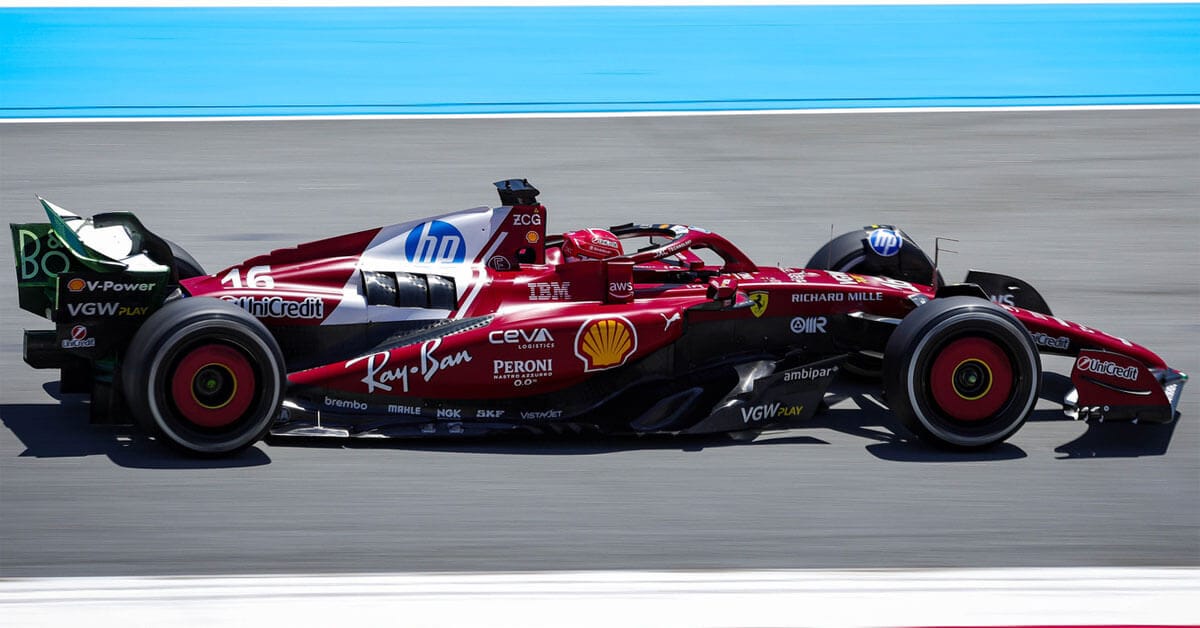
The Ferrari SF-26 reportedly has two completely different versions for the 2026 F1 season, as some rumors suggest that Maranello’s engineers are confused and exploring a dual approach to satisfy both drivers. This “urban legend” has spread unchecked, but what is actually happening as the team approaches the Barcelona test next week?
Ferrari: perceived worries for the 2026 F1 season
Even before the official 2026 tests, speculation has circulated about a potentially challenging start for the Scuderia. According to some rumors filling pages and social media in recent days, Ferrari is allegedly behind in the car’s development. However, it should be noted that in preparation for the regulation changes, Maranello shifted its focus to the 2026 project well in advance, recognizing the absence of immediate performance targets.
Uncertainty remains high, though. And this is true for all teams, since nobody yet knows where they will stand relative to their rivals. The changes are so extensive that they affect almost every component of the cars. While some aerodynamic concepts from the previous regulations will be reused, most aspects will differ significantly.
We’re talking about the power unit, chassis, fluid management, mechanics, fuel, and tires. In short, a transformation strongly promoted by the FIA that amplifies doubts to the maximum. But, as mentioned, this applies to everyone. Some believe Ferrari’s engineers have struggled to develop a competitive design and that the silence from the top management confirms it. But is that really the case?
F1 2026: Ferrari’s silence misinterpreted as chaos
Team principal Frederic Vasseur has largely stayed out of the public eye. He has repeatedly emphasized caution, downplaying the significance of the first Barcelona test next week, which will take place behind closed doors. During this on-track session, Ferrari’s primary goal will be to evaluate the performance of the SF-26’s power unit, a focus shared by all teams.
Talk of two versions of the car exists for one clear reason: to accommodate the preferences of both drivers, who theoretically have opposite perspectives. Some claim this has created chaos at Maranello, but this is entirely unfounded. Within a completely new regulatory framework, it’s natural to have questions about design choices.
These concerns do not apply to the entire car, but rather to individual components such as the front wing or bargeboard area, for example. The same applies to the Italian power unit, often criticized and accused of various problems that are not supported by the team’s operations. Speculation is high, but the eagerness to discredit Ferrari before any track action is unnecessary.
 Ferrari SF-26: the story behind the “two cars” rumor
In reality, Ferrari is cautiously optimistic and satisfied with the work done relative to the original plans. Again, it should be stressed that, like all teams, Maranello has no precise idea where the SF-26’s competitiveness will place them in the initial 2026 F1 standings. Patience and careful judgment are required.
The narrative about two different projects—implying the team didn’t know which direction to take and built two separate cars—is misleading and not credible. It stems from Ferrari’s exploratory approach over the past months. This method, of course, has been employed by every team to ensure nothing is left untested.
The desire to push development to the limit is being confused with team confusion. This misconception is entirely false but convenient for rumor-mongers in recent days. That said, this does not imply that Ferrari will be among the top cars competing for victories. No. However, portraying a crisis scenario and exaggerating it is as imaginative as it is unrealistic.
Jan 20, 2026Elena Rossi
Let other Scuderia Fans know about us


