

Listen to this article
Estimated 3 minutes
The audio version of this article is generated by AI-based technology. Mispronunciations can occur. We are working with our partners to continually review and improve the results.
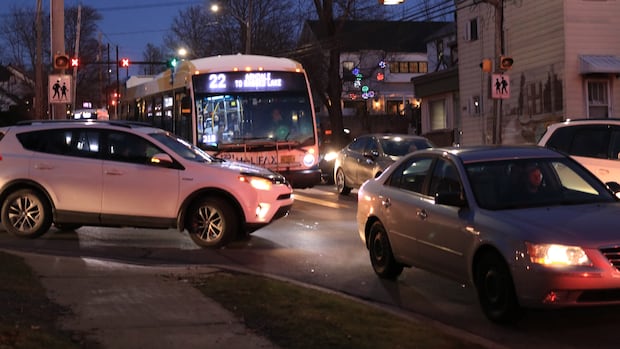
New data appears to confirm a widespread perception among Halifax drivers: traffic congestion is not improving and remains among the worst in Canada.
The annual traffic index from geolocation company TomTom released Wednesday suggests that in 2025, Halifax’s city centre ranked third worst in the country for congestion — trailing only Vancouver and Toronto — for the second year in a row.
“It’s not surprising,” Ahsan Habib, transportation professor with Dalhousie University, said Tuesday.
TomTom calculates congestion to represent the increase in travel time due to traffic, compared to free-flow conditions when one can smoothly drive through a route.
The latest data measured congestion levels in Halifax around 45 per cent last year, resulting in a loss of 111 hours for drivers in rush-hour traffic. Congestion was also at 45 per cent in 2024.
 Ahsan Habib is a transportation professor with Dalhousie University in Halifax. (Haley Ryan/CBC)
Habib said the data validates the predictions from the Dalhousie Transportation Collaboratory (DalTRAC) he directs, which show traffic volumes increasing over the coming years due to population growth and people returning to work in person.
The city’s population has grown by more than 60,000 people since 2021 to reach about 503,000 in 2024. But there are still only a few access points to the urban core such as the two harbour bridges and the Windsor Street exchange.
Given Halifax’s geography, Habib said the only way to improve congestion is a major shift to transit. A 2022-23 Dalhousie study showed about 77 per cent of Halifax residents depended on their car for trips, with only about six per cent choosing transit.
Although Habib said he does not believe Halifax has hit a traffic crisis yet, “I would say we are heading towards that.”
“We are talking about transit for [the] last 10 to 15 years, but we haven’t seen substantial system change,” he said.
Halifax and the province are working on short- and long-term solutions laid out in the Link Nova Scotia plan, including a long-discussed rapid bus system.
Habib said he would like to see Halifax start a pilot project by next year with one rapid bus route. Even without dedicated bus lanes for the entire route, Habib said it would be a good start and would show where improvements are needed.
Deputy Mayor Patty Cuttell said she hears regularly from both drivers and transit users frustrated about delayed buses stuck in traffic, and said Halifax needed rapid buses “yesterday.”
Although Cuttell said transit remains a priority for the municipality and work is underway to create bus lanes and plan routes, provincial and federal funded is needed to make it a reality.
“We’ve approved a lot of development along transit corridors based on the concept of having bus rapid transit. So, you know, now it’s time that we really start making that investment,” Cuttell said.
The TomTom index shows Halifax ranks 147th in the world for congestion, behind cities such as Berlin, Tokyo, Stockholm and Dubai. The index ranked 501 cities.
MORE TOP STORIES