
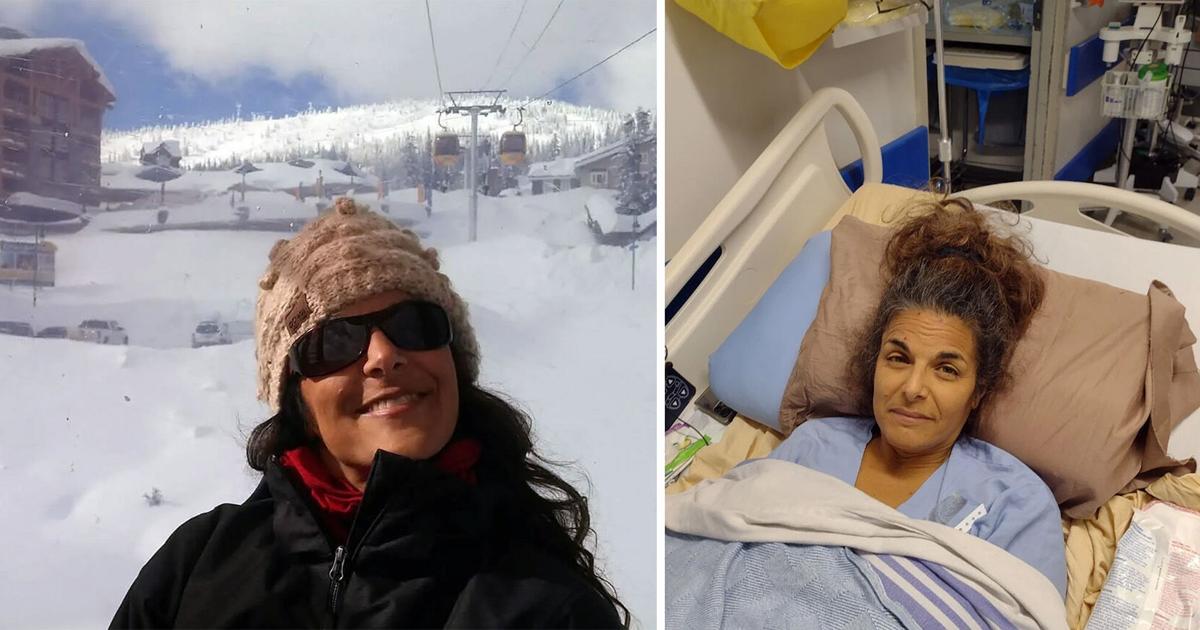
Lori Roter is a former West Islander who grew up in Montreal and now lives in Victoria, British Columbia. She suffers from Primary Sclerosing Cholangitis (PSC), a rare liver disease that causes scarring and narrowing of your bile ducts. Her parents, brother and other family members still live in Montreal.
Roter’s goal is to raise awareness for the live liver donation program, with the hope that her story will reach people who might step forward to become a donor for her. The program is her only hope for survival, as there is no treatment or cure. People with this disease often fail to reach the top of the transplant list due to evaluation criteria that she says needs to change.
With the live liver donor program, Roter says “people with her disease face long waits for transplants due to scoring system limitations.” A live liver donation involves removing about two-thirds of the donor’s liver, with the transplanted liver regenerating over four to eight weeks. An RH factor doesn’t matter, but an ‘A’ or ‘O’ blood type is what is key. In BC the doner age ranges from 19-55, elsewhere in Canada, it’s 19-60, with only three places in Canada that perform this donation process: BC, Edmonton and Toronto.
Roter has lived in BC since 1991 and was diagnosed with PSC in 2017. She says her symptoms escalated rapidly last year, leading to an emergency Endoscopic Retrograde Cholangiopancreatography (ERCP) procedure that revealed extensive bile duct problems. Her doctor informed her that if the treatment didn’t work, she would need to be prepared for a liver transplant.
Roter explored the live liver donor programs, including the donation process, eligibility requirements, and coordination between hospitals in British Columbia and Quebec. “There has to be some matching in terms of blood type and health of an individual. They go in — it sounds very scary, and it is — about two-thirds of somebody’s liver gets removed, and mine gets removed. But the miraculous part, just like amphibians, it grows back, it regenerates.”
The surgery carries risks, however there is so much testing that is done in advance. Rigourous testing ensures only healthy candidates proceed, and donors typically recover quickly, though they experience fatigue during regeneration.
“Probably two out of the three people who step forward to donate get rejected, either because — like my brother — the configuration of the liver or because of the person’s state, health state of their liver and or their kidneys, as they go through the operation,” says Roter. “But I do know a number of people who have donated and they are perfectly fine. Often with a lot of organ donations, for ‘live ones’ it’s usually a family member or close friend, but there’s an age limit for this on who can donate.”
A potential donor for Roter doesn’t have to live in BC. “If somebody wants to donate to me, [and] there are plenty of other people in need of a liver, so that’s always an option as well, so it can be done anonymously or it can be directed.”
Roter explains medical professionals are very precise when choosing a donor, making sure they weren’t coerced, that they really want to do this, and ask some general questions. If they make it through that stage, the potential donor undergoes various tests. “At any time somebody can bail out,” says Roter. “I do appreciate that because it is a big deal. Finally, they would schedule a date for the surgeons for both participants.”
As someone from Quebec, you would need to coordinate with the Vancouver General Hospital, Lori mentioning: “that the person would have to work with the Vancouver coordinator nurse, and then that person would work with the primary care physician to make sure that someone has ongoing care.”
For anybody who may be interested, Roter says contacting the nurse coordinator in BC for information would be the way to go. To find out more, there is a link to Roter’s liver search page and contact information:
Learn more: Lori Roter’s search for a live liver donor
Facebook: www.facebook.com/profile.php?id=61581451659490
To contact Lori directly, message her via Facebook Messenger or email at lorisliverdonorsearch@gmail.com
For information and support related to PSC, visit the patient-led charity PSC Partners Seeking a Cure Canada at https://pscpartners.ca/ n