
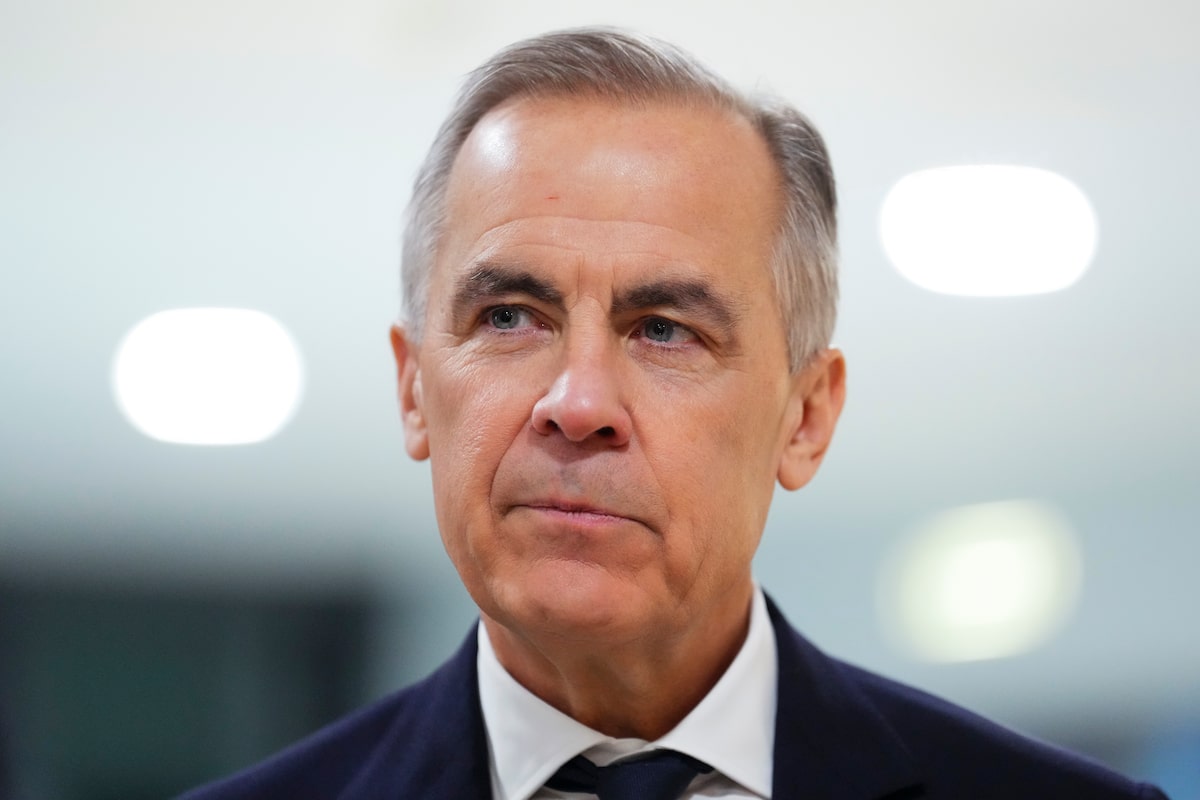
In a speech on Tuesday, Prime Minister Mark Carney told the World Economic Forum in Davos, Switzerland, “The old order is not coming back.”Sean Kilpatrick/The Canadian Press
Mark Carney is heading home from a global gathering of political and business elites in Switzerland on Wednesday without meeting Donald Trump after delivering a major speech that blamed the U.S. President, without naming him, for rupturing the rules-based international order.
His office, speaking at 5:30 a.m. ET, said that at that time, there were no plans for Mr. Carney to speak to Mr. Trump on Wednesday.
The Prime Minister is scheduled to depart Zurich for Ottawa at about 10:30 a.m. ET on Wednesday, a short time after the U.S. President at the World Economic Forum in Davos is due to deliver his own address to the gathering. Mr. Trump’s flight to Switzerland was delayed by an electrical issue but he was still on track to speak.
Trump says ‘you’ll find out’ when asked about his ambition to annex Greenland
Mr. Carney is getting ready for a cabinet retreat in Quebec City rather than remaining at the World Economic Forum in the wake of his much-celebrated Tuesday speech, which called for middle powers to stop pretending the rules-based international order is still functioning, and instead build coalitions to survive in a new era where great powers prey on smaller countries to take what they want.
Prime Minister Mark Carney gave a speech at the World Economic Forum that blamed U.S. President Donald Trump, without naming him, for what Carney described as a rupture in global relations.
Mr. Carney urged countries to start publicly condemning economic coercion, even when practised by an ally, in another clear reference to the United States.
“The old order is not coming back,” he said.
The Prime Minister’s speech on Tuesday, for which he received a standing ovation, came days after an extraordinary threat by Mr. Trump to impose tariffs on European allies and Britain until Washington is allowed to acquire Greenland for strategic purposes.
International Trade Minister Maninder Sidhu, talking to reporters, defended the Canadian delegation’s decision to head home without any plans to meet Mr. Trump.
“Parliament’s resuming on Monday. We have our cabinet retreat, and there’s things that we’ve got to take care of for Canadians,” Mr. Sidhu said. “I think what we wanted to do here in Davos, we accomplished that.”
Opinion: Carney calls for resistance in a world of ravenous powers
Mr. Carney met with Apple CEO Tim Cook, executives from India’s Tata Sons, drug company Roche Holding’s vice-chairman André Hoffmann, Norway’s Equinor energy company, and Swedish banker and industrialist Marcus Wallenberg, among others.
The Prime Minister is a veteran of the World Economic Forum. His office said he has attended about 30 times.
Asked why Mr. Carney would not remain in Davos to have a chat with Mr. Trump, where more than 75 per cent of Canadian exports traditionally flow, Mr. Sidhu said the focus right now is trade diversification to a multitude of markets. Ottawa and Washington are preparing for a review of the United States Mexico Canada Agreement that is expected to lead to U.S. demands for renegotiation of some chapters. Numerous hefty tariffs are still hurting industries from steel to autos.
After resetting damaged relations with China last week, Mr. Carney is soon headed to India to repair ties that ruptured in 2023 after former prime minister Justin Trudeau accused New Delhi of being behind the slaying of a Canadian Sikh activist, Hardeep Singh Nijjar.
Mr. Sidhu said negotiations for a trade deal with India will launch in February. “India’s year-over-year growth is about 7 per cent, so they need food; they need energy. We have that,” he said.
“When you talk about the Americans, they’ll always remain important to Canada. Our geography is not going to change,” he said. “But you look at who else we want to deal with: China is our second-largest trading partner. India is going to be the third-largest economy,” Mr. Sidhu said. “We’re looking across the world for areas of opportunity.”
After the Nijjar murder, Canada-India relations were further fractured in October, 2024, when the RCMP announced they had clear evidence that Indian government agents had been linked to homicides, extortions and other violent criminal activities in Canada. Ottawa followed up by expelling India’s high commissioner and five other diplomats.
Canadian authorities continue to investigate alleged transnational repression targeting Sikh activists domestically, with four Indian nationals now facing charges in the Nijjar case.
Asked why Canada is warming up to India despite the alleged wrongdoings, Mr. Sidhu repeated Mr. Carney’s recent rationale. “The Prime Minister has been clear: We want to see the world as it is, not as we wish it to be,” he said. “At the end of the day, we need to find opportunities for Canadians.”
Several European countries have sent troops to Greenland in recent days, saying they are there for Arctic security training, but U.S. President Donald Trump downplayed that development. ‘They sent a few people and they say they sent them not for me, but for me to guard against Russia,’ he told reporters.
The Associated Press