
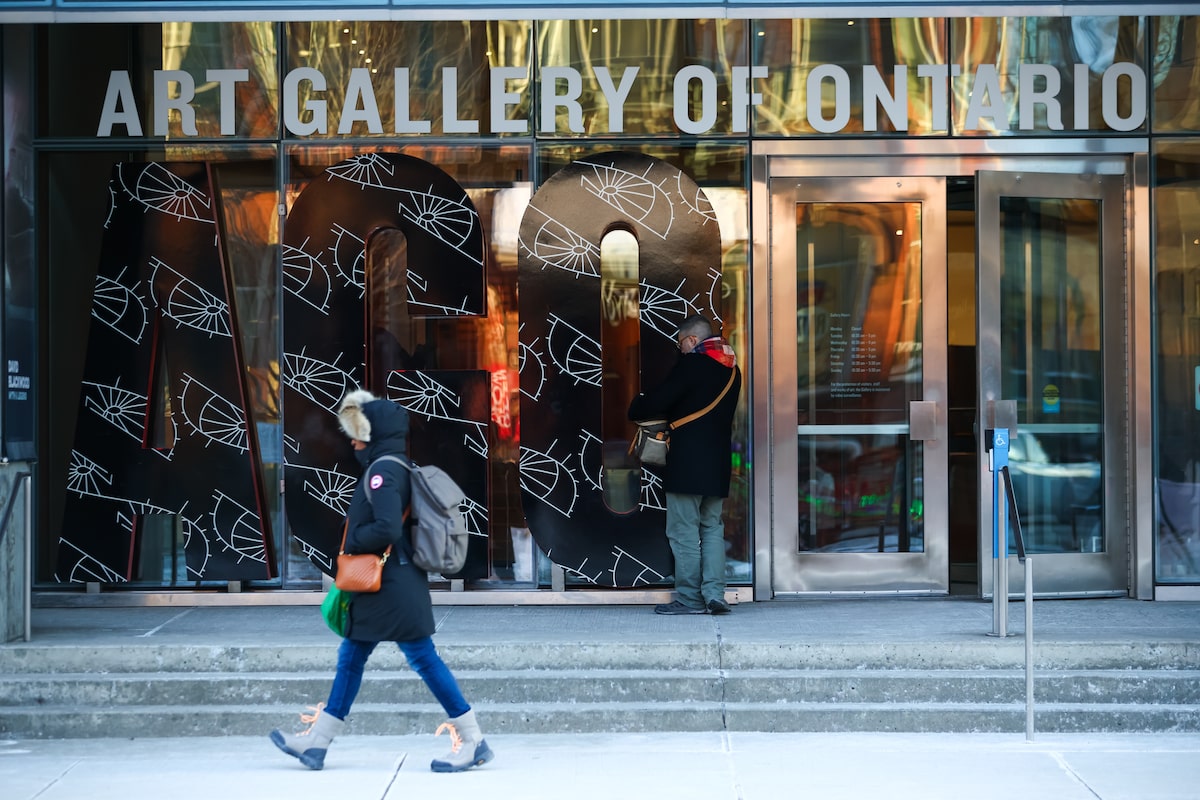
The exterior of the Art Gallery of Ontario, in Toronto, on Tuesday.Cole Burston/The Globe and Mail
The Art Gallery of Ontario is reckoning with the resignations of a senior curator and two volunteer members of a collections committee after the group narrowly voted to not acquire a work by Nan Goldin over accusations that the Jewish-American photographer’s views are antisemitic.
Ms. Goldin, a celebrated photographer and a long-time activist, used a late 2024 speech at Berlin’s Neue Nationalgalerie to share her “moral outrage at the genocide in Gaza and Lebanon.” She levelled criticism at Israel for the tens of thousands of deaths reported since it launched its war on Hamas in 2023, after the group’s Oct. 7 attacks that left 1,200 dead in Israel and 251 others taken as hostages.
Months after her remarks, the Toronto gallery set out to jointly purchase the American artist’s video work Stendhal Syndrome with the Vancouver Art Gallery and Minneapolis’s Walker Art Center.
But the AGO stepped back from the joint acquisition in the middle of last year, after its modern and contemporary curatorial working committee voted 11-9 against it, according to a source. Some committee members alleged the artist’s remarks were “offensive” and “antisemitic,” according to an internal memo from AGO director and chief executive Stephan Jost that was obtained by The Globe and Mail.
The committee members who voted to acquire Ms. Goldin’s work felt that the remarks were not antisemitic, with some adding that “refusing the work because of the artist’s views was censorship,” according to the memo.
The AGO’s modern and contemporary curator, John Zeppetelli, who had advocated for the acquisition, eventually resigned from that full-time position in connection with the incident, two people with direct knowledge of the situation said.
2024: Art Gallery of Ontario’s associate curator of Indigenous art, Taqralik Partridge, departs
Two members of the modern and contemporary collections committee subsequently resigned their volunteer roles as well, according to the sources. Their decisions were also directly tied to the debate over and decision not to acquire Stendhal Syndrome, one source added. The Globe is not identifying the sources because they were not authorized to publicly discuss the situation.
The decision happened even as the AGO, one of North America’s biggest arts institutions, already houses three of Ms. Goldin’s works. The gallery is publicly funded, receiving $26-million from governments in its last fiscal year, primarily from Ontario.
Mr. Zeppetelli is still working with the AGO for the next few months in a reduced capacity as a guest curator, co-organizing an exhibition of work from the Italian artist Diego Marcon that is scheduled to open in June. He did not respond to repeated requests for comment.
In his memo, Mr. Jost outlined a governance review that followed the vote. The review recommended a “reset” on the committee’s acquisition discussions, and “clarification” of its members’ responsibilities.
In an e-mailed statement, the AGO acknowledged both the discord over Ms. Goldin’s work and the governance review. “Personal political views were brought into the conversation. This is not intended to be part of the process,” spokesperson Laura Quinn said.
“Our reset is to ensure that conversations remain focused on an artwork’s alignment to the AGO’s acquisition criteria, are healthy and productive, and welcome multiple perspectives.”
Stendhal Syndrome does not touch upon the politics of Ms. Goldin’s speech in Berlin, but rather juxtaposes her photos of classical, Renaissance and baroque artworks with portraits of her loved ones. The title references the intense psychosomatic response some people feel when viewing a striking piece of art. Neither Ms. Goldin nor Gagosian, the major global gallery that represents her, responded to requests for comment.
Mr. Zeppetelli joined the AGO as its curator of modern and contemporary art in September, 2024, after leading the Musée d’art contemporain de Montréal. He pitched acquiring Ms. Goldin’s work to the modern and contemporary collections committee within months of joining.
When the committee of about 20 people – largely from around Toronto and connected to the art world – convened for a May, 2025, meeting to discuss acquisitions, Ms. Goldin’s was one of five works from the 20th and 21st centuries under consideration. Though the committee had limited funding and could not acquire all five, discussion of Stendhal Syndrome led to the debate about Ms. Goldin’s politics.
While members of the committee largely agreed that Stendhal Syndrome had artistic merit, they voted against acquiring it, and instead recommended a different work for acquisition.
Several members of the committee then pressed Mr. Jost to acquire the work through a separate tranche of funding, according to a source. But the request went unheeded. The Vancouver Art Gallery and Walker Art Center went on to acquire Stendhal Syndrome without the AGO’s participation; it has been on display in Vancouver since November.
Zainub Verjee, the executive director of Galeries Ontario / Ontario Galleries, an advocacy group serving public art galleries, declined to comment on the AGO situation specifically – but said collections aren’t meant to be “a comfort zone.”
Instead, she said, collections should be “a record of what a society dared to look at.” She added: “If the institution can only acquire art that flatters its consensus, it isn’t collecting, it’s curating obedience.”
Dr. Verjee further warned that “if artists perceive that acquisitions are influenced by political litmus tests or opaque committee dynamics, it can have a chilling effect on trust and willingness to engage with the institution.”
Stephen Borys, who launched the arts-consulting firm Civic Muse after running the Winnipeg Art Gallery and its Inuit art centre Qaumajuq for nearly two decades, said: “There is always a danger when an acquisition is made that would appear to be based on an artist’s political perspective or comments.”
This, he said, could lead to tumult for the curator and the artist, “but also for artistic expression, the institution’s credibility and public trust.” He also only spoke in general terms, and not about the AGO’s Stendhal Syndrome vote. Developing strong governance policies, he added, is necessary for encouraging robust debate among collections committee members without overstepping bounds. (The AGO reviewed and revised its governance policies after the incident.)
The AGO has had numerous curatorial departures in recent years.
The Anishinaabe curator Wanda Nanibush, appointed as Indigenous curator in 2016, was widely credited with boosting the museum’s efforts toward reconciliation. She left in 2023, when The Globe and Mail reported she had caused friction with her outspoken support of Palestinians, whose experience she had for years linked to that of Indigenous peoples living in Canada.
Her exit was followed months later by the departure of Taqralik Partridge, an Inuk poet, performer and editor who was serving as associate curator of Indigenous art.
Xiaoyu Weng, Mr. Zeppetelli’s predecessor as the AGO’s curator of modern and contemporary art, was hired in 2021 but spent only about two years with the gallery – a brief term for such a high-profile position.