
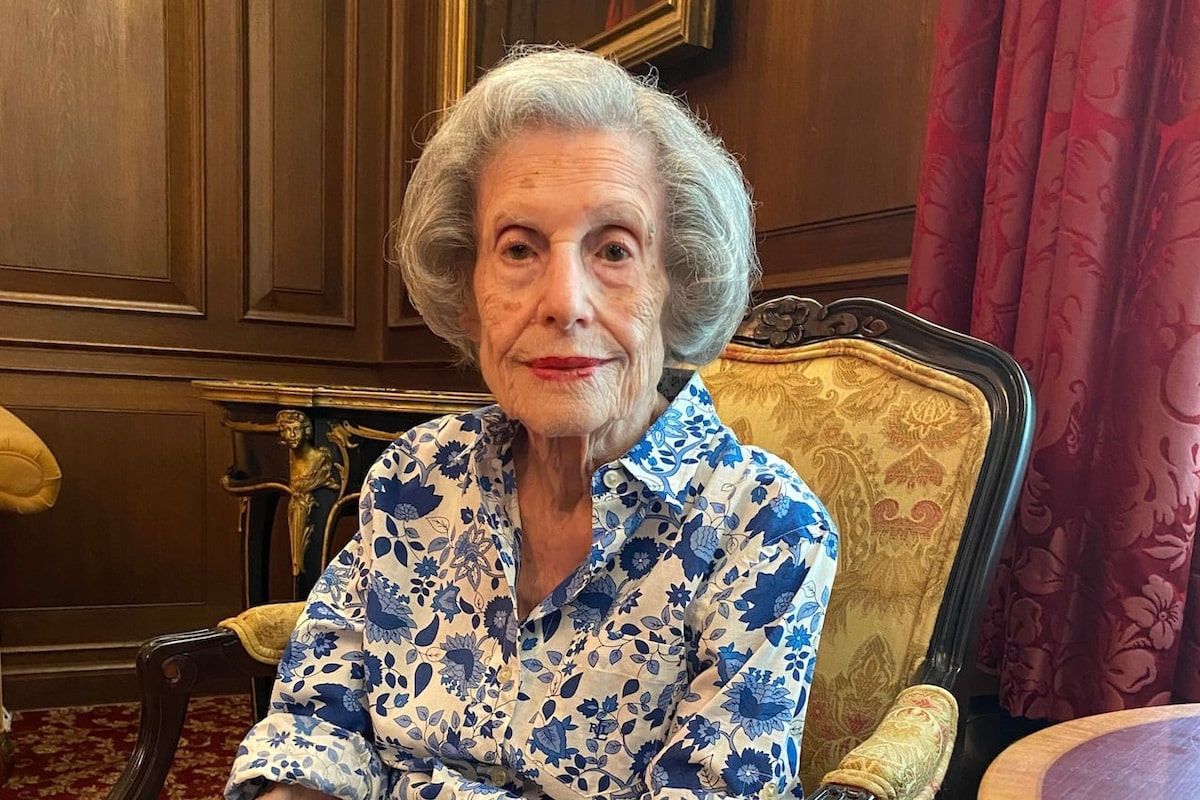
Former Second World War codebreaker Sylvia Gellman in 2022. During the war, she and her colleagues — many of whom were women — worked in Ottawa to assist a top secret mission: cracking codes and ciphers used in secret and diplomatic communications.Joe Tunney/CBC
Susie Gellman, 101 years old, was the centre of attention on Aug. 6, 2022 as she stood next to a plaque unveiled at Laurier House, near downtown Ottawa.
Ms. Gellman was, at the time, likely the only surviving member of a top-secret Canadian organization during the Second World War. She was definitely the only former member able to attend the historic commemoration ceremony.
The tiny woman (4 foot 8, or 142 centimetres) held the hand of her friend’s daughter for support but otherwise used no cane or walker.
The plaque unveiled that day honoured the vital code-breaking work done by the 80 people in what was called the Examination Unit (or XU) from 1941 until the federal government shut it down at war’s end in 1945.
The ceremony that day in 2022 finally ended the oath that Ms. Gellman had taken not to speak of the unit for as long as she lived.
Mariposa Folk Festival co-founder Ruth Jones-McVeigh gave an enduring gift to Canadian music
Ms. Gellman died in Ottawa on Dec. 22 at the age of 104, shortly after suffering a stroke.
She was born Sylvia Irene Abelson on May 8, 1921, in Ottawa, the eldest of five children and the only daughter of Jess and Mollie Abelson.
Her father worked in insurance and was a superb athlete, playing a position called “flying wing” from 1910 until 1914 for the Ottawa Rough Riders, a professional football team. He also played basketball, tennis and curled and was the first to be inducted into the Ottawa Jewish Sports Hall of Fame in 1986.
Her mother was a homemaker, devoted parent and grandmother. For every grandchild’s birthday each year, she would make their favourite dessert.
Sylvia, who went by the nickname Susie, attended Lisgar Collegiate Institute then business school.
She had four brothers: Lawrence (nicknamed “Duke”), Stanley, Alan and Bobby. Duke, whose nickname was a punny reference to the family’s home on Marlborough Avenue in Ottawa, joined the Royal Canadian Air Force in 1940 and went overseas in 1942 as a navigator with its 418 City of Edmonton Squadron.
The Abelson family in a photo circa 1940. Susie is front row, second from left. Brother ‘Duke’ is in the second row at the far left.Ottawa Jewish Archives
He died the following year at the age of 21 when his de Havilland Mosquito nightfighter-intruder crashed during a training mission.
Duke’s death was devastating. The family often said that when he died, they lost their mother as well. Mollie Abelson never fully recovered from the death of her eldest son.
The other brothers went on to have successful careers in medicine, law and business.
In 1943, still mourning Duke, Susie joined the Examination Unit as a typist. She was 22.
Former Vancouver Writers Fest head Hal Wake was ‘a crucial figure in Canadian books’
The Unit had a deliberately dull-sounding name to discourage interest in its top-secret operation. Canada launched the XU in 1941 to decipher diplomatic and military messages. It regularly shared information with Britain’s Government Code and Cypher School at Bletchley Park, with the Canadian spymaster William Stephenson (the famous “Intrepid” who headed British Security Co-ordination in New York) and with U.S. intelligence.
To keep it low-profile, the XU was housed with the federal scientific agency, the National Research Council. Staff with the XU were given scientific-sounding job titles, such as “laboratory assistant” with a promotion to “senior laboratory assistant.”
As the XU expanded, it outgrew its offices at the NRC. More space was found in an Ottawa mansion built in 1902-03 by lumber baron John Edwards. Oddly enough, the top-secret operation just happened to be next door to Laurier House, the home of prime minister Sir Wilfrid Laurier, and later, prime minister William Lyon Mackenzie King (1923 to 1950).
Ms. Abelson worked for the XU’s Japanese Diplomatic Section. The code breakers in that section had great success in cracking Tokyo’s coded messages to its diplomatic missions, which included vital information on the location of Japanese convoys.
She would type up the decoded messages then seal them in an envelope using wax. She would then hand the envelope to the same courier who cycled there twice a day to pick up these envelopes, to and from the Department of External Affairs (now called Global Affairs Canada).
Other sections at the XU focused on coded messages from the Vichy French and Japanese military.
Women made up 40 per cent of the XU’s work force, although it is not clear how many were code breakers.
Examination Unit office staff in June, 1945, with Sylvia Abelson kneeling at front right.Hayne Family Collection
Staff at the XU managed to have fun despite (or because of) the pressure of their wartime work. A few times a year, they would head back to the mansion in the evening, move the furniture then hold a square dance. Ms. Abelson made friends at the Unit that lasted for much of the rest of her life.
She told CBC News in a 2022 interview that she kept her work secret from outsiders during the war and for decades after.
“You were so aware of it being a secret mission. And you didn’t tell anybody. And I followed that very closely. I didn’t even tell my family.”
Her family finally found out about Aunt Susie’s “important work” during the war a few years before the 2022 plaque ceremony. One of her nephews, McMaster University professor Dr. Donald Abelson, says the family was not shocked by the news, given that their aunt was fairly quiet and, at times, secretive.
“But she was also incredibly loyal to her family and her country,” he said. “She would have had no difficulty keeping her work a secret for as long as that was required.”
After the war, with the XU disbanded, the mansion was sold, then subdivided and renamed the Embassy Row apartments. It was torn down in 1967 and replaced by an apartment building.
Meanwhile, Ms. Abelson found her bashert (Yiddish for a person’s soulmate) when she met Lawrence Gellman at a resort in Lake George, N.Y.
The couple married in 1957 and settled in New York. Their daughter, Barbara, was born a few years later.
Family and friends said the couple were a perfect match. Larry was the extrovert while Susie was the introvert.
In 1970, the family of three moved to Ottawa so Ms. Gellman could help care for her aging parents. She also worked for the National Gallery of Canada at its former home on Elgin Street.
Mr. Gellman died suddenly in 1987, shortly before his planned retirement. Family and friends say he remained Susie’s one true love.
Hall of Famer Bob Pulford won four Stanley Cups with the Maple Leafs
Typical of her generation, Ms. Gellman never let tragedy or adversity slow her down.
She loved to walk and kept at it well into her later years. She was known in her neighbourhood as “The Walker” and would regularly be seen racking up mile after mile on her jaunts.
In 2022, at the age of 101, Ms. Gellman broke her hip, an injury that can lead to fatal complications in elderly patients. But Ms. Gellman simply waited for the hip to heal then resumed walking.
The work Ms. Gellman and her colleagues at the top-secret Examination Unit became known to a wider public in part because of Diana Pepall, an Ottawa researcher who started writing about it in 2014.
Ms. Pepall became interested when a friend asked her to help track down former members of the Women’s Royal Canadian Naval Service so Bletchley Park could send them a badge to thank them for their wartime work. These women monitored radio and written traffic at listening posts across Canada for intelligence.
Ms. Pepall said her attention turned to the house on Laurier Avenue after “dribs and drabs” of information on the XU began to circulate through books and documentaries.
However, the federal government never acknowledged the code-breaking operation until recently.
Ms. Pepall wrote about the XU for community newspapers, alumni magazines and a popular pamphlet for the Historical Society of Ottawa. She also gave talks on the XU that grew in popularity each time she spoke.
“I thought everyone [with the XU] was dead by this point,” she said. “But during a talk I gave at the Jewish Community Centre in Ottawa in 2016, Susie approached me after and said she had worked there.
“I was dumbfounded.”
Ms. Pepall said it was unfair – but very Canadian – that while Britain’s Bletchley Park was rightly celebrated in books, movies and television, most Canadians had never heard of the Examination Unit, even though its work was also important in helping to end the war.
In 2020, Ms. Pepall applied to the Historic Sites and Monuments Board of Canada to request that a plaque be installed to at last acknowledge the work of the XU and honour the members of the unit for their code-breaking achievements.
The following year, the Examination Unit was designated a national historic event. Parks Canada declared it the first such unit in Canada and the only civilian cryptographic bureau that was active during the Second World War.
Then in 2022, the plaque that Ms. Pepall requested was unveiled in the ceremony at Laurier House. Ms. Gellman was front and centre, her war work finally known to all.
She leaves her daughter, Barbara Gellman; brothers Alan and Robert Abelson; as well as several nieces and nephews.
Rabbi Dara Lithwick, officiating at the graveside funeral last month, summed up Ms. Gellman’s 104 years: “While she experienced much loss in life, and ups and downs, in all, she lived a good, healthy life.”
You can find more obituaries from The Globe and Mail here.
To submit a memory about someone we have recently profiled on the Obituaries page, e-mail us at obit@globeandmail.com.